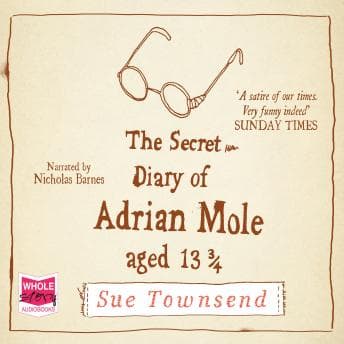

Look, I need to talk about Adrian Mole's obsession with his pimples, because this kid counts them with the devotion I reserve for tracking how many goldfish crackers are left in the pantry. He literally catalogs every spot on his face like it's a war journal. And honestly? I felt seen. Not the pimple part - the part where you're convinced your problems are the biggest problems anyone has ever had, ever, while the actual world is falling apart around you.
I listened to this during Sophie's nap times over three days - which tells you two things: she actually napped (miracle), and at 5 hours 15 minutes, this is the perfect length for a week of stolen listening moments. I could've finished faster but I kept pausing to laugh, which is not something I say lightly because laughing during nap time is DANGEROUS.
A Thirteen-Year-Old Boy Just Dragged My Entire Parenting Style
Sue Townsend wrote Adrian Mole in the early '80s and the scary thing is how little has changed about being thirteen. Adrian thinks he's an intellectual. He writes terrible poetry and submits it to the BBC. He worries about nuclear war and his mother's affair with the neighbor Mr. Lucas in the same diary entry with roughly equal emotional weight. His parents are splitting up, the dog keeps eating things it shouldn't, and Adrian is out here forming a relationship with an elderly neighbor named Bert Baxter who is magnificently disgusting and lonely.
What got me - really got me - is the way Townsend uses the diary format to show you what Adrian CAN'T see. His parents' marriage is crumbling and he's writing about Pandora's hair. His dad loses his job and Adrian's worried about being in the Good Samaritans group at school. It's funny because it's so painfully, specifically thirteen. You're laughing AT him while also remembering being exactly this self-absorbed. I definitely never wrote melodramatic poetry about a boy named Kevin in seventh grade. Definitely not. (I absolutely did.)
The diary format means there's no real plot arc, and I get why some people find that frustrating. It IS directionless. It's a year in the life of a kid whose biggest dramatic moments are joining a library and discovering his mom left. But that's... kind of the point? Life at thirteen doesn't have a narrative arc. It has Tuesday.
Nicholas Barnes Knows Exactly How Seriously to Take This Kid
Nicholas Barnes does something really smart with the narration - he plays Adrian completely straight. No winking at the audience, no nudging you to laugh. Adrian is deadly serious about everything, and Barnes matches that energy perfectly. When Adrian describes himself as a misunderstood intellectual while simultaneously failing to understand basic social cues, Barnes delivers it with such earnest conviction that the comedy lands harder.
His voice for Adrian hits this perfect register of querulous, slightly pompous teenaged boy who thinks using big words makes him deep. It's not a showy performance at all - he's basically stepping aside and letting Townsend's writing do the heavy lifting, which is exactly right.
I will say the hospital section drags. Adrian's in the hospital for a bit and the entries get repetitive, and I zoned out during a school pickup line. Had to rewind about ten minutes. But it's a brief dip in an otherwise snappy listen. Survived 47 pauses and still made sense - the diary format actually helps here because each entry is self-contained enough that you can pick it up anywhere without thinking "wait, who was talking?"
The '80s England of It All
There's a very specific flavor to this book that I wasn't expecting to enjoy so much. Adrian lives in a world of Thatcher references, school dinners, and the Royal Wedding. He sends letters to the BBC and actually gets responses. He joins the Labour Party. At thirteen. The cultural specificity makes it funnier, not less accessible - you don't need to know British politics to understand a kid who joins a political party to seem impressive to a girl.
And Pandora. Oh, Pandora. Adrian's crush on Pandora is written with such excruciating accuracy that I physically cringed in my car in the garage. The way he describes her like she's a figure from literature while she's probably just a normal girl in his class - it's perfect and awful and I loved every second of it.
Car Time Verdict: Your Next Nap Time Listen
This isn't going to change your life. The ending is abrupt - it just kind of... stops, which makes sense for a diary but might leave you wanting more. Not groundbreaking, but sometimes you don't need groundbreaking. Sometimes you need a short, funny book that makes you snort-laugh alone in your minivan and remember that adolescence was terrible for everyone. Though if you want adolescence from the other end of the emotional spectrum - raw and gutting instead of funny - Yellow Birds wrecked me in the best possible way during a particularly quiet school pickup week.
Perfect for multitasking moms who want something light that doesn't require remembering 47 character names. Skip it if you need a strong plot or a satisfying wrap-up. But if you want to spend five hours feeling superior to a thirteen-year-old boy's life choices while also uncomfortably relating to them? Car time approved.
I finished this during nap time. High praise.