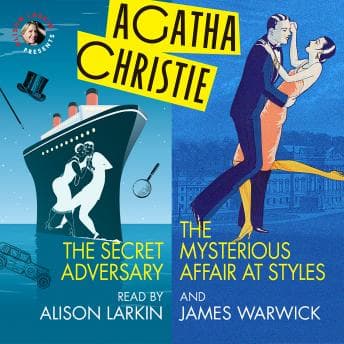

I was making pancit at 6 AM - post-shift cooking therapy, the kind where you're too wired to sleep but too tired to think - and Alison Larkin was doing this absolutely fizzy rendition of Tuppence that made me laugh out loud into the rice noodles. Carlos wandered in, half asleep, and asked who I was talking to. Nobody, babe. Just a woman from 1919 who's broke and willing to do anything for money. He gave me the look. You know the look.
So here's the thing about this double-bill: you're getting two very different books, two very different narrators, and two very different experiences. And honestly? That split is both the strength and the weird wobble of this audiobook.
Tuppence Would've Made a Great ER Nurse
Alison Larkin handles The Secret Adversary, and she is an absolute delight. Her Tommy and Tuppence voices have this breezy, post-WWI energy that makes you feel like you're eavesdropping on two broke twenty-somethings scheming at a tea shop. Her comedic timing is sharp - there's a specific way she delivers Tuppence's more outrageous declarations that had me grinning through three consecutive red lights on my drive home one morning. (Don't tell Carlos about the red lights.) The accents feel authentic without being cartoonish, and she gives each character enough distinction that you're never lost even when Christie is throwing new names at you every other chapter. Publishers Weekly called her reading "champagne bubbly" and honestly? Yeah. That's the word. Bubbly. It's light, it's fun, it's the kind of mystery that doesn't try to traumatize you.
Compared to the darker, more procedural mysteries I usually gravitate toward - the Tana Frenches, the Alex Michaelides types - The Secret Adversary is practically a romp. Though I'll say that even lighter mysteries can have real teeth when the plotting is sharp - Dead Men's Money pulled that off, though it's a different flavor of breezy. Tommy and Tuppence are charming in that very specific early-twentieth-century way where everyone's impoverished but still witty about it. Larkin gets that tone exactly right.
Poirot Deserves Better Than That Court Scene
James Warwick narrating The Mysterious Affair at Styles is... more complicated. His Poirot characterization is genuinely good - AudioFile Magazine called it spot-on and I agree. He nails the fussy precision, the ego, the particular way Poirot talks around what he knows while Hastings bumbles along behind him. And his Hastings is warm and a little clueless in exactly the right way. Warwick actually played Tommy in the old Partners in Crime TV series, so the man knows his Christie.
But. And this is a real but.
Some of his secondary character accents are... choices. There are moments where a voice will pull you right out of the scene because it doesn't quite land. The court scene near the end - which should be this tense, satisfying moment where everything clicks together - feels flat and unconvincing in his delivery. I've sat through real courtroom testimony for assault cases at work (yes, nurses do that), and even real court proceedings have more dramatic tension than what Warwick gives us here. It's not terrible. But in a story where the final reveal IS the payoff, you need that scene to hit.
I've seen some listeners say they couldn't finish Warwick's half at all. I think that's harsh. His strengths with the main characters are real. But I understand the frustration - when you're juggling fifty characters and some of them sound like they wandered in from a different audiobook, it gets distracting.
The Bonus Interview Nobody Asked For (But I Actually Liked)
There's an interview with both narrators tacked on at the end, which - look, I almost skipped it. I was pulling into my driveway and wanted to get inside before the kids woke up. But I sat in the car for an extra few minutes and listened, and it actually gave me a new appreciation for their approach. Hearing them talk about their choices made the Warwick accent issue feel less like carelessness and more like a deliberate risk that didn't always pay off. I can respect the swing even when I don't love where it lands.
Who Gets This Prescription
If you're a Christie completist, this is a no-brainer - her first two novels in one package, solid narration on the Larkin side, decent-with-caveats on the Warwick side. If you've never read Christie and want to start? Honestly, start with Larkin's half. The Secret Adversary is lighter, more accessible, and her performance carries it beautifully. The Mysterious Affair at Styles is the more famous book - it's POIROT, come on - but the narration inconsistencies might frustrate you if you're particular about voices.
Perfect for that post-shift decompression. The Secret Adversary especially is the audio equivalent of chamomile tea after a twelve-hour shift - light enough that your fried brain can follow it, engaging enough that you're not zoning out.
Not recommended if you need your narrator to be flawless across every character. Warwick's highs are high but his lows will make you yell at your dashboard. And not in the fun way.
Night Shift Rx: Take With Morning Coffee
Sixteen hours is a solid commitment - basically two full shifts - but the two-book structure means you can take a natural break between them. Larkin's half is the better listen. Warwick's half has Poirot. Life is about trade-offs. My mom would love this, actually. She devoured every Christie novel in Tagalog translations back in Manila. She still thinks I should've been a doctor, but she'd appreciate that I know when a court scene doesn't work.