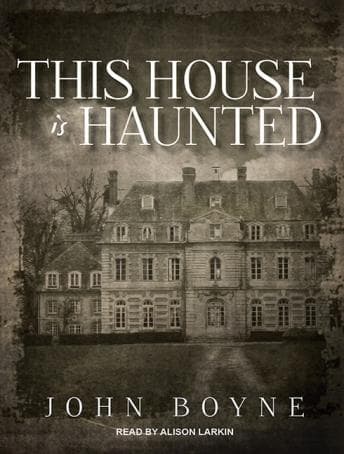

Shirley Jackson walked so John Boyne could run. And honestly? He runs pretty well in her footsteps.
I've been waiting for a good Victorian ghost story to sink my teeth into, and This House Is Haunted landed in my queue at exactly the right moment. It's November, the Oregon rain hasn't stopped in three days, and my library branch has that particular damp-paper smell that makes everything feel slightly haunted anyway. Perfect conditions.
The Slow Dread That Actually Works
Look, I need to be upfront about something: this isn't going to make you jump. If you're coming in expecting the audio equivalent of a haunted house attraction with things leaping out at you, recalibrate now. Boyne is playing a different game here—he's after that creeping unease that settles into your bones. The kind where you realize you've been holding your breath and you're not sure when you started.
Eliza Caine arrives at Gaudlin Hall to be a governess. No adults are there to greet her. Just two children who seem to know more than they're saying. And from that first night, something in the house notices her.
The Dickensian prose is deliberate, and I mean that as a compliment. Boyne isn't just imitating the style for aesthetic points—he understands that Victorian ghost stories worked because of their pacing. The formality creates distance, and that distance makes the intrusions of the supernatural feel genuinely violating. The Drawing of the Three uses a similar technique—formal distance that makes the horror land harder when it arrives. When something wrong happens in this world, you feel the wrongness.
That said, there's filler. Passages where the description doesn't advance anything, where we're circling the same atmospheric ground we've already covered. I found myself zoning out during a few stretches, and I don't think that's entirely on me. The book could've been tighter by maybe an hour without losing anything essential.
Why Alison Larkin Saves This
Here's the thing about audiobook horror: the narrator has to commit. Half-measures kill dread faster than anything. Larkin commits.
Her voice has this warmth that makes Eliza immediately sympathetic, but she's also got the range to shift into something unsettling when the text demands it. The children—Isabella and Eustace—each get distinct voices that walk the line between innocent and knowing in exactly the right way. (Creepy kids are hard to pull off in audio. Really hard. She nails it.)
Some listeners have called her performance "childish" at points, and I can see where that's coming from. Eliza is young and somewhat naive, and Larkin leans into that. Personally, I think it works—it makes the moments where Eliza has to be brave feel earned. But if you prefer your gothic heroines more sardonic from the start, it might grate.
The Dickensian tone could've been a disaster in the wrong hands. Larkin treats it like what it is: a performance piece. She's not just reading, she's inhabiting a specific register. There's a theatricality to it that reminded me of the best classic radio dramas. My podcast listeners are going to love this recommendation.
The Haunting Itself
I listened to the last two hours in the dark. Mistake? Maybe. Worth it? Absolutely.
The ghost at Gaudlin Hall isn't subtle, but she's not over-explained either. Boyne gives you just enough to understand what you're dealing with, then trusts you to fill in the shadows yourself. The violence when it comes is sharp and quick—this isn't torture porn, it's punctuation. The horror is in the anticipation, in Eliza's growing understanding that she's trapped in a house with something that wants her dead and two children who desperately need her to survive anyway.
The mystery unravels at a good pace. I figured out pieces before Eliza did, but not everything, and the final revelations hit with the weight they needed to. It's a proper ghost story—there's a wrong that needs righting, a history that refuses to stay buried, and the question of whether understanding the haunting is enough to survive it.
Shirley (my cat, not Jackson) was unimpressed by my occasional startled noises. But she's a cat. Her standards are impossible.
Who Should Listen (And Who Should Skip)
If you love the classics—The Turn of the Screw, The Woman in Black, anything by M.R. James—this is your book. It's an homage that understands what it's paying tribute to. The atmospheric slow-burn is the point, not a flaw.
If you scare easily, honestly, you'll probably be fine. This is more unsettling than terrifying. But if you're chasing that classic gothic dread, the kind that makes you check the corners of rooms even though you know nothing's there? You need this.
Skip it if you want modern horror pacing. Skip it if Victorian prose makes you impatient. Skip it if you need your ghosts to have complex mythologies and rule systems. This isn't that kind of story.
Finally, horror that respects the genre. Nine hours well spent.