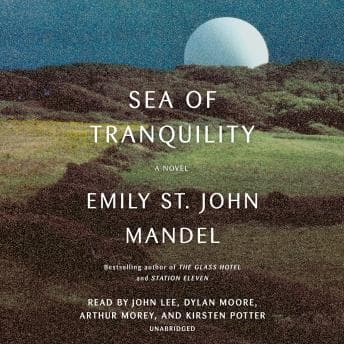

Everyone told me Emily St. John Mandel writes "literary fiction with speculative elements" and I should expect something quiet and contemplative. They weren't wrong, exactly. But nobody prepared me for how this book would mess with my sense of time while I was supposed to be debugging a procedural generation algorithm at 2 AM.
Look, I came to Mandel late. Never read Station Eleven. (I know, I know.) Picked this up because the premise sounded like someone took Doctor Who, stripped out the camp, and replaced it with existential dread about pandemics and the nature of reality. As a guy who spends way too much time thinking about simulation theory between D&D sessions, I was in.
World-Building Without the Appendices
Here's what caught me off guard—this isn't Sanderson-level world-building where you get detailed magic systems and appendices. Mandel does something more subtle. She drops you into 1912 Vancouver Island, then a moon colony five hundred years later, then the "Night City" (which, yes, made me think of Cyberpunk 2077 every single time). And somehow it all feels cohesive without her ever stopping to explain the rules.
The time travel mechanics? Deliberately vague. The moon colonies? Sketched in broad strokes—white stone, spired towers, artificial beauty. Normally this would drive me nuts. I'm the guy who needs to know how the magic system works. But Mandel isn't interested in the how. She's interested in the what-does-it-mean-to-exist-across-time question, and honestly? It works. The ambiguity becomes the point.
Gaspery-Jacques Roberts—the detective investigating temporal anomalies—is basically what you'd get if you made a time cop who's kind of bad at his job but deeply human about it. He's no Kelsier or Kaladin. He's just a guy trying to do the right thing while the universe keeps throwing impossible choices at him.
Four Narrators, Zero Chaos
I was skeptical about the multi-narrator setup. Four people voicing different timelines? Recipe for whiplash. But John Lee, Dylan Moore, Arthur Morey, and Kirsten Potter pull off something I didn't expect—they make the time shifts feel intentional rather than jarring.
Arthur Morey's sections have this haunting quality that ties the whole thing together. There's a deadpan delivery that somehow enhances the weirdness of what's happening. And Kirsten Potter absolutely nails Olive Llewellyn's book tour sections—there's this exhausted-author energy that felt painfully real. (Not that I'd know anything about being exhausted by deadlines. Dr. Patel, if you're reading this, my thesis is going great.)
The pacing is deliberate. Some might say slow. The first hour especially takes its time establishing Edwin St. Andrew in 1912, and if you're expecting action, you'll be waiting. But once the violin-in-the-forest motif starts recurring across centuries? The payoff is worth the setup.
When the Timelines Click
There's a moment—and I won't spoil it—where you realize how all these seemingly disconnected timelines connect. It's not a twist exactly. More like watching a puzzle complete itself. I was on a late-night coding session, supposedly working, and I just stopped. Sat there. Let it hit me.
Mandel writes about pandemics in a way that feels uncomfortably relevant without being preachy. Golden Girl hit me with that same emotional weight—grief and isolation rendered without melodrama. Olive's trapped on Earth during a plague while her family is on the moon. The isolation, the guilt, the impossible distance—it's all there. And yeah, listening to pandemic fiction in 2024 hits different than it would have in 2019.
The book asks big questions about whether we're living in a simulation, whether time is linear, whether our choices matter across centuries. But it never gets preachy about it. These ideas just... emerge. Like Mandel trusts you to think about them without being told what to think.
Roll for Initiative (Or Don't)
If you need hard sci-fi with explained mechanics, this isn't it. If you want action-heavy space opera, look elsewhere. This is for people who want to feel something while thinking about something. It's literary fiction wearing a time-travel costume, and it knows it.
At under six hours, it's a quick listen. Perfect for a road trip or a weekend of avoiding responsibilities. (Not that I'm advocating for thesis avoidance. That would be irresponsible.) My D&D group would have mixed feelings—our barbarian player would zone out, but our wizard who's always asking about timeline paradoxes would love it. That's probably the best way I can describe who this is for.
The production is clean, the narration is genuinely excellent, and the story sticks with you longer than you'd expect from something this short. I finished it three days ago and I'm still thinking about that violin echoing through an airship terminal while forest trees rise around it.
Now if you'll excuse me, I have a thesis to not write.