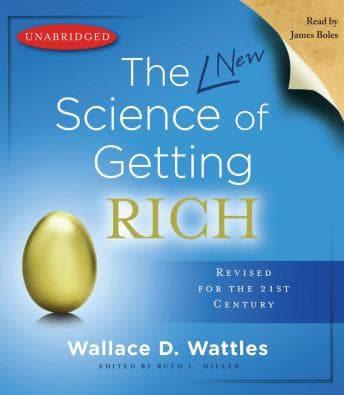

Wallace D. Wattles wrote this in 1910, and honestly? It reads like a psychology experiment I'd design if I had zero ethical oversight and unlimited funding.
I was chopping onions for a chana masala at 9 PM on a Tuesday - one of those nights where you're too wired to sleep but too tired to do real work - and I figured, fine, let me finally listen to this thing. Two and a half hours. That's shorter than most Bollywood movies. How bad could it be?
The Mind as a Money Machine (According to 1910)
Here's what's fascinating about The Science of Getting Rich: Wattles isn't writing self-help the way we understand it now. He's writing what he genuinely believes is a physics textbook. He treats wealth acquisition the way you'd treat a chemistry formula - do X, add Y, wealth precipitates out of the solution. There's a "Certain Way" to think, and if you think in this Certain Way (yes, he capitalizes it like that), the universe will rearrange itself to make you rich.
The research actually shows that Wattles was pulling from New Thought philosophy, which was huge in late 19th-century America - this idea that consciousness shapes material reality. And I found myself asking: why does this particular framework keep resurrecting itself? Rhonda Byrne built The Secret on this book. The Law of Attraction industry is worth billions. Wattles died in 1911 with very little money to his name, which is - and I say this with genuine academic interest - a fascinating case study in cognitive dissonance.
Psychologically, what Wattles gets right is the power of focused intention and gratitude. There's actual research on visualization and goal-setting that supports pieces of what he's saying. What he gets wrong is... the causal mechanism. Thinking about wealth doesn't bend reality. But thinking about wealth can change your behavior patterns, your risk tolerance, your attention to opportunity. He stumbled onto something real and then explained it with metaphysics instead of neuroscience. Which, fair enough. It was 1910. Neuroscience wasn't really an option. The gap between "this feels true" and "this is mechanistically accurate" is exactly what Motivation Myth tears apart so satisfyingly — same territory, but with actual evidence behind the claims.
James Boles and the Audiobook as Time Capsule
So here's the thing about the narration: I don't have a ton of specifics on James Boles's performance, and I want to be honest about that rather than make things up. What I can tell you is that at 2 hours and 30 minutes, this is a short listen - barely a commitment. The book is structured as a series of short chapters, almost like sermons, and the single-narrator format works for material this didactic. You're essentially listening to one man's philosophy delivered in declarative statements. There's no story here, no characters, no dramatic arc. It's instruction.
And that creates a specific listening challenge: repetition. Wattles makes his point in chapter 2 and then makes it again in chapters 3 through 17. The "Certain Way" is mentioned so many times it starts to lose meaning - which, ironically, is the opposite of what a mantra is supposed to do. At 1.25x speed, the whole thing flies by, and I'd actually recommend that. You'll absorb the core ideas without the repetition drilling a hole in your patience.
Why Your Brain Wants to Believe This
What makes this book endure isn't the quality of the argument. It's the emotional architecture. Wattles does something clever - maybe intentionally, maybe not. He tells you that poverty is not your fault, that the system isn't rigged against you, that there's enough wealth for everyone, and that you deserve prosperity. That's not economics. That's therapy. That's someone telling you that your situation is temporary and controllable.
The protagonist here - because Wattles is absolutely the protagonist of his own text - exhibits classic grandiosity mixed with genuine compassion. He wants everyone to be rich. He's not gatekeeping. He believes abundance is infinite. My therapist would have thoughts about a man who died poor after writing a book called The Science of Getting Rich, but there's something almost heartbreaking about the sincerity.
As a psychology text? It's a historical artifact showing how humans construct meaning around money and agency. As actual financial advice? Please don't. Talk to a financial planner.
Who This Is For (and Who Should Run)
If you're interested in the intellectual history behind modern manifestation culture - where The Secret came from, why vision boards exist, why your Instagram feed is full of abundance mindset coaches - this is genuinely useful primary source material. It's also mercifully short.
If you're looking for practical wealth-building strategies, this isn't it. If you're in a tough financial spot and someone recommended this as a solution, I'm going to be direct: this book will make you feel better temporarily and solve nothing structurally. Read it for cultural literacy, not as a financial plan.
The Case File, Closed
I finished the chana masala before I finished the audiobook. The chana masala was more useful for my immediate well-being, but Wattles gave me something to think about on my morning jog the next day - namely, why do we keep repackaging the same ideas about mind-over-matter wealth every twenty years? The answer, I think, is that wanting to believe we control our fate is the most human impulse there is. Wattles didn't discover a science. He discovered a need.