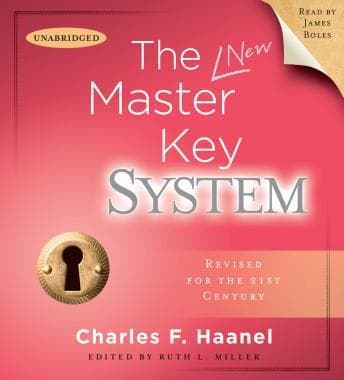

Everyone talks about The Master Key System like it's this secret text that Silicon Valley billionaires passed around before they made their first million. The legend goes that Bill Gates read it at Harvard. That it was banned. That it contains the formula. So naturally, when I queued this up while making dal makhani at 9 PM on a Tuesday — the kind of elaborate cooking project I undertake when I'm procrastinating on a literature review — I expected either profound revelation or total nonsense.
What I got was somewhere in between, and the audiobook format did it no favors.
Haanel as Accidental Psychologist (Sort Of)
Here's what's genuinely interesting about this book if you approach it the way I do, which is as a case study in early 20th-century thinking about the mind. Haanel published this in 1912 as a correspondence course — twenty-four lessons, one per week. And some of what he's describing? It's a rough, pre-scientific sketch of concepts we now recognize in cognitive behavioral therapy and visualization research. The idea that habitual thought patterns shape perception and behavior? The research actually shows he wasn't entirely wrong about that. Where he loses me — and where my training in actual empirical psychology starts twitching — is the leap from "your thoughts influence your habits" to "your thoughts literally attract material wealth through universal vibration." That's... not how any of this works.
But I found myself asking: why does this book still have such a hold on people over a century later? And I think the answer is that Haanel understood something psychologically real about the human need for agency. The twenty-four-week structure, with exercises at the end of each section, gives you the feeling of doing something. Of having control. In a world that felt chaotic in 1912 and feels chaotic now, that's not nothing. It's just not what he claims it is.
Ruth L. Miller's updated sections for twenty-first-century readers add some context, but honestly they feel grafted on — like someone explaining a Model T by comparing it to a Tesla. The original text has its own weird charm. The additions just made me aware I was listening to an edited product.
James Boles and the Problem of Reading vs. Performing
Okay, the narration. This is where the audiobook experience really struggles. James Boles has a distinctive voice — I'll give him that. It's not unpleasant, and over seven hours, "not unpleasant" matters more than you'd think. But the delivery is flat. Casual in a way that doesn't match the material's tone. Haanel wrote with this grandiose, almost sermonic intensity — the man genuinely believed he was handing you the keys to the universe — and Boles reads it like he's going through a corporate training manual before lunch.
Compare this to, say, how a narrator like Simon Vance would handle dense, philosophical nonfiction — there's a way to give this kind of material weight and rhythm without going full dramatic reading. Boles just... doesn't find that register. He sounds hurried in places, like he's trying to get through the session rather than letting the ideas land. For a book that literally tells you to spend a week on each chapter, absorbing it slowly, the narration's pace undercuts the whole philosophy.
And then there's the recording quality. It's noticeable. Not catastrophically bad, but there's a thinness to the audio that made me reach for my volume controls more than once. When I'm stirring a pot and my hands are covered in turmeric, that's genuinely annoying.
Who Gets Something Out of This (And Who Should Run)
If you're interested in the history of self-help and New Thought philosophy — where the Law of Attraction came from before The Secret turned it into a Oprah-endorsed phenomenon — this is a worthwhile primary source. It's the origin text, and hearing it rather than reading it does give you a sense of how it might have felt as those original correspondence lessons arrived weekly in someone's mailbox.
But if you're looking for actionable psychology? Read actual psychology. If you want a great audiobook experience? This production doesn't deliver it. The combination of flat narration, mediocre audio quality, and content that requires slow, contemplative engagement makes this a strange fit for the audio format in the first place.
My therapist would have thoughts about the entire Law of Attraction framework, actually. The idea that you attract what you think about — that failure is essentially a failure of mental discipline — is psychologically dangerous for anyone dealing with depression, trauma, or systemic barriers. Haanel doesn't account for any of that, because in 1912, nobody did. But we're not in 1912 anymore.
The Case File Gets a Footnote, Not a Star
I'm glad I listened to it. As someone who studies how narratives shape identity, The Master Key System is a fascinating artifact — it's the story millions of people have told themselves about how the mind works, and that story itself has power even when its claims don't hold up. But this particular audiobook version? The narration and production drag down an already challenging listen. Read the text if you're curious. Save your credit for something that earns its seven hours. Matthew McConaughey's Greenlights is exactly that kind of credit-worthy listen — a memoir that actually rewards the audio format because the narrator and the material are inseparable in a way Haanel and Boles never manage to be.