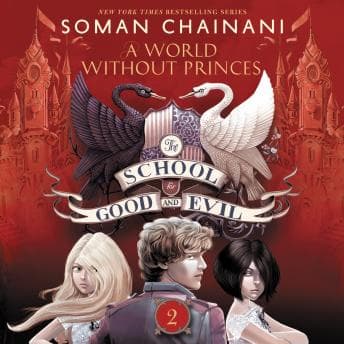

"With her glass slippers and devotion to good deeds, Sophie knows she'll earn top marks at the School for Good."
That's the setup. And if you've spent any time in business - or life - you already know the punchline: Sophie ends up in the School for Evil. Agatha, the girl who looks like she belongs in a villain's origin story, lands in the School for Good. The whole book is basically a 13-hour case study in why your assumptions about people are wrong.
Let me back up. Jenny picked this one. Our niece is ten, obsessed with the Netflix movie, and Jenny decided I needed to "understand what she's into" before Christmas. So there I was, Saturday morning, reorganizing my home office bookshelves (yes, I organize by ROI potential, no I will not apologize), listening to a middle-grade fairy tale at 1.5x speed. I started at 2.0x but - and I genuinely cannot believe I'm saying this - I slowed down. For a kids' book.
The Sorting Algorithm That Actually Works
Here's what Chainani does that most business books fail at: he sets up a binary framework (Good vs. Evil, pretty vs. ugly, princess vs. witch) and then systematically demolishes it. Sophie's obsession with being Good is really just narcissism in glass slippers. Agatha's "ugliness" is actually just... being a normal person who doesn't perform for approval. I've seen this dynamic in every startup I've ever consulted for. The founder who's convinced they're the visionary? Usually the problem. The quiet operator everyone ignores? Usually the one keeping the lights on.
The School for Good teaches Princess Etiquette and Animal Communication. The School for Evil teaches Uglification and Henchmen Training. And the moment Sophie starts excelling at villainy - not because she's evil but because her desperate need to be special makes her ruthless - that's when the book stops being cute and starts being uncomfortably smart. This is what my parents did instinctively, by the way. They never cared about looking successful. They just worked. Sophie would've lasted about forty minutes at their dry cleaning shop.
Polly Lee Is the Reason You Listen Instead of Read
Bottom line: Polly Lee is doing something special here. She's got this fairy tale cadence - almost like a bedtime story voice - but she shifts it depending on who's speaking. Sophie gets this breathy, self-important lilt. Agatha is drier, more grounded. The male characters don't sound like a woman doing a bad impression of men, which is honestly the bar most single-narrator audiobooks trip over. She clears it easily.
There's a moment where Agatha starts to realize she might actually belong in the School for Good - not because she's pretty or polished but because she genuinely cares about people - and Lee's delivery slows down just enough to let it land. No dramatic pause. No vocal gymnastics. Just a slight shift in warmth. That's craft. Some listeners say she's their favorite narrator across all audiobooks, and I get it. She sets the tone so precisely that when the story gets dark (wolves, witches, magical battles that don't pull punches for the age group), you feel the shift in your chest.
At nearly 14 hours, this is a commitment. But Lee earns the runtime in a way most narrators don't. I've sat through 8-hour business books that felt longer than this.
What My Parents' Dry Cleaning Shop Taught Me About Good and Evil
Look, I'm a 40-year-old former McKinsey consultant reviewing a children's fantasy novel. I'm aware of how this looks. But Chainani is doing something genuinely interesting with the good/evil binary that most "leadership" books try to do and fail. The idea that goodness isn't about appearance or performance but about actual choices made when nobody's watching? I've seen this fail at three different companies where the CEO had a "values wall" in the lobby and a toxic culture behind closed doors. Sophie IS that CEO.
The friendship between Sophie and Agatha is the engine of the whole thing, and it's more honest about how complicated female friendship is than most adult fiction I've encountered. (Jenny would say I'm being harsh about adult fiction. Jenny is right. But also, I'm right.)
Is it perfect? No. There's padding in the middle - some school scenes that feel like worldbuilding for worldbuilding's sake, and a few side characters who exist mostly to fill seats. Brisingr has the same issue—rich world, occasionally too much of it—but both books earn the investment. Skip to chapter 5 if the setup feels slow. Thank me later. But the core story earns its runtime, and the ending sets up the sequel without feeling like a cliffhanger hostage situation.
The Consulting Fee
If you have kids between 8 and 14, this is a road trip essential. If you're an adult who secretly (or not so secretly) loves fairy tale deconstructions, Polly Lee's narration makes this worth the credit over reading it yourself. If you watched the Netflix movie and thought "that was fine," the audiobook is better. Same goes for Torment—the narration elevates material that could feel flat on the page. Significantly.
The key takeaway is worth the listen: goodness isn't a costume you put on. It's what you do when the fairy tale stops going your way. My niece is getting the whole series for Christmas. I might finish it before she does.