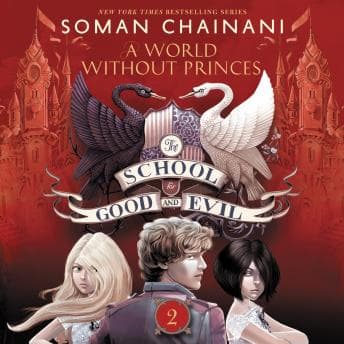

"Boys are the enemy now."
That line hit around hour two, and I actually snorted loud enough that the guy next to me on the 6:47 AM Caltrain gave me a look. Fair. But honestly? Chainani's gender war premise in this second School for Good and Evil book is basically a satirical debugging of fairy tale logic—what happens when you remove the prince variable from the happily-ever-after equation?
Bottom Line: Worth your commute. This is a fairy tale deconstruction wrapped in middle-grade packaging, and Polly Lee's narration elevates it from good to genuinely impressive.
When Your Happy Ending Has a Bug
So Sophie and Agatha got their Ever After at the end of book one. Cool. Except—and this is where Chainani's plotting gets clever—the fairy tale system doesn't know what to do with two girls who chose each other over the prince. The schools literally reorganize themselves. Witches and princesses now share dorms at the School for Girls, united against boys. Tedros and the other princes are camping in Evil's old towers like some kind of aggrieved fantasy frat.
It's absurd. It's also... kind of a sharp commentary on how binary systems break when you introduce edge cases? (Yes, I'm applying distributed systems thinking to a children's book. This is what happens when you're on-call for three weeks straight.)
Polly Lee Does the Heavy Lifting
Here's the thing about this audiobook: Polly Lee has this fairytale rhythm to her delivery that makes 13 hours feel like significantly less. Her Sophie voice drips with exactly the right amount of self-absorbed drama—there's this breathy, slightly theatrical quality that captures Sophie's constant need to be the protagonist of every scene. Meanwhile, her Agatha is grounded, almost reluctant, with this dry edge that sells the "I didn't ask for any of this" energy.
The boys' voices are where it gets interesting. Tedros sounds appropriately princely but with this wounded undertone that develops as the war escalates. She's not just doing "different voices"—she's doing consistent character work across 13 hours. That's harder than it sounds. (Trust me, I've listened to enough audiobooks where the narrator forgets what accent they gave a character by hour six.)
Where the Code Gets Messy
Look, I'm going to be honest—this is a middle-grade book, and sometimes it reads like one. The love triangle mechanics can feel a bit... repetitive? Sophie's "am I good or evil" oscillation happens maybe four times too many. And there are moments where the pacing drags, particularly in the middle third when everyone's just... angry at each other without much plot movement.
But here's my counterargument: the thematic ambition is genuinely impressive for the target audience. That same kind of unexpected depth showed up in Gambler: Secrets from a Life at Risk, where what looked like surface-level memoir turned into something much more layered. Chainani's asking real questions about identity, friendship versus romance, and whether the stories we're told about ourselves become self-fulfilling prophecies. The moment where Agatha finally understands her place in the world—it's not a twist, exactly, but it's earned.
Who Should Queue This Up (And Who Should Skip)
This is an active-listening audiobook. There's enough plot complexity and character switching that you can't zone out for twenty minutes and pick it back up. I finished it across about four commutes, and I appreciated having the mental engagement during those early morning zombie hours.
Skip if: You need something to fall asleep to—too much happens, and Lee's narration has enough energy that it'll keep you awake. Also skip if you haven't read book one; this assumes you know the world and characters.
Perfect for: Train rides, gym sessions, anyone with kids in the 10-14 range looking for a family listen. The themes are sophisticated enough to not bore adults, but the content stays appropriate. Kevin and I don't have kids, but I could see this being a road trip staple for families.
Final Commit
Should you spend a credit on this? If you liked book one, yes. If you're an adult without kids looking for fantasy, this probably isn't your primary use case, but it's a surprisingly smart listen if you're in the mood for something lighter.
Polly Lee's narration is the killer feature here. The fairytale cadence, the character voices, the way Lee handles the tonal shifts between comedy and genuine emotional beats—it's the kind of performance that reminds you why audiobooks exist as their own art form.
Finished in 4 commutes. Already queuing up book three.