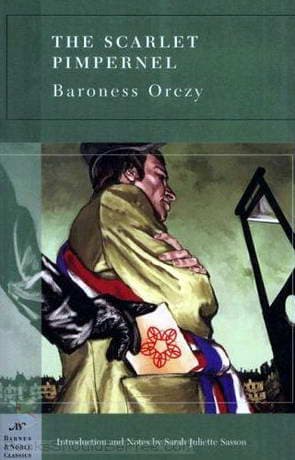

Everyone assumes an English teacher with a literature podcast has already read The Scarlet Pimpernel. I had not. Twenty years of teaching Fitzgerald and Morrison somehow left no room for Baroness Orczy. I fixed that last Saturday walking the lakefront with Denise, who kept asking why I was smiling at my phone like an idiot. The answer: Percy Blakeney, the most elaborately constructed fool in all of Victorian adventure fiction, was sleeping on a ballroom couch while a French spy frantically searched the room for him. I actually stopped walking.
This is why we still read the classics. Or listen to them, which is the same thing now and I've made my peace with that.
The Disguise Is the Point — and Orczy Knows It
Here's what I wasn't expecting: this is a novel about performance. Percy Blakeney plays a vapid English aristocrat so convincingly that his own wife despises him - and Orczy makes you feel the specific ache of that. Marguerite is brilliant, politically savvy, and completely fooled. The dramatic irony isn't cheap suspense. It's Orczy asking you to sit with the cost of a double life, the loneliness of a secret heroism that can't be shared with the person you love most.
Let's talk about what the author is really saying: identity is a performance, and sometimes the performance swallows the man. That's not an adventure story premise. That's closer to what James was doing in the same decade. My students would hate this. I love it.
The French Revolution backdrop isn't decoration either. Orczy was a Hungarian aristocrat who fled with her family as a child - she understood what it felt like when the political ground shifts under your feet. The guillotine in this novel has weight. The aristocrats being smuggled out of Paris are specific, frightened people, not props for Percy's cleverness.
The Narrator Lottery (And Why It Matters Here)
I have to be honest with you about something: this audiobook exists in multiple versions with wildly different narrators, and the version you land on will substantially change your experience. The prose deserves to be savored, and not every narrator here gets that.
Julian Rhind-Tutt apparently understood the assignment - reviewers describe him sounding like he's having as much fun as the Pimpernel himself, which is exactly right for material this theatrical. The prose has a breathless, conspiratorial energy that needs a narrator who leans in.
Hugh Laurie's version won an AudioFile Earphones Award, which I respect, but the description I keep encountering - "sounds like a little boy performing with a puppet theater" - is specific enough to give me pause. For a book this dependent on aristocratic register and tonal control, a narration that reads as childlike could undercut everything Orczy is building. Laurie is obviously talented. Whether that particular instinct serves this particular text is a genuine question.
Michael Page gets praised for emotional delivery, which tracks - the Marguerite sections need that. Karen Savage apparently handles the material with real skill.
The honest advice: check which narrator you're getting before you buy. This isn't a case where it doesn't matter.
Who This Is Actually For
If you loved Dumas - the plotting, the disguises, the men who are smarter than they appear - this is its spiritual successor and Orczy is doing something Dumas rarely bothered with: she's writing a woman who is the intellectual equal of the hero, and making the reader feel her exclusion from his secret as a genuine tragedy. That tension between a brilliant woman and the secrets kept from her is something I kept thinking about in Divergent too — Tris is also navigating a world where the people closest to her are performing versions of themselves she can't fully access.
If you want pure action with no emotional complication, you might find the Marguerite sections slow. They're not. But I understand the impatience.
At 8 hours and 24 minutes, this is a weekend commitment, not a week-long project. Lakefront walk pace. Faculty meeting pace, if Principal Martinez isn't reading this.
The Grade I'd Actually Give
The book itself: four and a half stars, no hesitation. Orczy invented the masked avenger archetype and she did it with more psychological sophistication than most of her imitators ever managed. The narrator situation pulls the audiobook rating down to a solid four - not because any individual narrator is bad, but because the lottery element is real and the wrong version genuinely matters for this material.
Find the Rhind-Tutt version if you can. Listen at 1.0x. The pause before Percy reveals himself is punctuation.