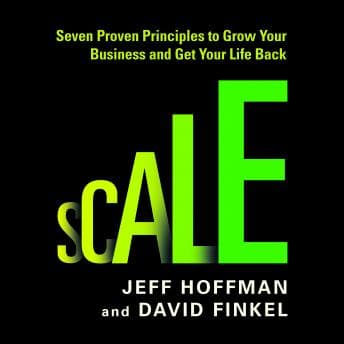

This is what my parents did instinctively. Now it has a TED talk.
I'm serious. My folks ran that dry cleaning shop in Koreatown for decades, and somewhere around year fifteen, my dad figured out he needed to stop being the only one who could fix the pressing machine. He trained three people. Took vacations. Lived longer, probably. Finkel and Hoffman have basically reverse-engineered that survival instinct into a seven-principle framework, and honestly? It works.
The 45 Minutes That Actually Matter
Bottom line: The core insight is worth your time. The execution is... padded. The central thesis - that scaling isn't about working harder but about systematically removing yourself as a bottleneck - lands hard if you've ever been trapped in a business you technically own but that actually owns you. Essentialism: The Disciplined Pursuit of Less makes a similar argument about ruthlessly cutting what doesn't matter—same instinct, different application. The "Time Value Matrix" concept alone (categorizing tasks by what only you can do versus what anyone could do) is the kind of obvious-in-hindsight thinking that can genuinely restructure how you operate.
But here's the thing. They take about 90 minutes to deliver what could be a killer keynote. The remaining five and a half hours? Case studies that blur together. Repetition dressed as reinforcement. I found myself nodding along during a 6 AM gym session, then realizing I'd heard the same point three different ways in the last twenty minutes.
Finkel Narrating His Own Work
David Finkel reads his own material, which cuts both ways. On the plus side, he clearly understands the emphasis - when he's explaining why most business owners confuse activity with progress, you can hear the frustration of someone who's watched clients make this mistake for years. His delivery is clean, professional, no weird mouth sounds or pronunciation stumbles.
The downside? He sounds like he's presenting at a conference. Not bad, just... corporate. There's a motivational speaker energy that works for some people and makes others (okay, me) instinctively reach for the speed controls. At 1.75x, he sounds like a normal person having a conversation. At 1.0x, he sounds like he's waiting for applause.
Who Should Listen (And Who Should Skip)
If you're a first-time business owner who's never thought systematically about delegation, this is genuinely useful. The frameworks are actionable. The checklists are practical. Finkel and Hoffman aren't selling you on some abstract vision of "passive income" (a phrase that makes me physically cringe) - they're giving you specific questions to ask about every role in your organization.
If you've read Gerber's E-Myth, Wickman's Traction, or spent any time in the EOS ecosystem, you're going to find maybe 30% new material here. The rest is familiar territory with different vocabulary. Not worthless - sometimes hearing the same principle from a different angle helps it stick - but not exactly revelatory either. Skip this one and revisit your existing systems instead.
I've seen the "owner as bottleneck" problem kill three companies I consulted for. One founder literally couldn't take a two-week vacation because he was the only one who knew the vendor relationships. Another had built a $4M revenue business that collapsed when she got sick for a month. This book addresses that specific failure mode better than most.
The Credibility Question
Jeff Hoffman's background (Goldman Sachs alum, Priceline.com founding team, multiple exits) gives the advice weight. These aren't academics theorizing about entrepreneurship - they've actually scaled and sold businesses. When they talk about the emotional difficulty of letting go of control, it reads as authentic rather than performative.
That said, the book leans heavily on their Maui Mastermind consulting work, which occasionally feels like a seven-hour advertisement for their coaching program. Not egregiously so, but you'll notice it.
The Park Efficiency Rating
Skip to chapter 3 for the Time Value Matrix. That's the meat. Chapters 1-2 are throat-clearing about why scaling matters (you already know, that's why you're listening). The later chapters on team building and systems are solid but not essential if you're already running a functioning organization.
My 2.0x speed made this a reasonable 3.5-hour listen during a week of early morning workouts. At normal speed, I'd have abandoned it by hour four. The ideas deserve better packaging.
Jenny would say I'm being harsh. Jenny is right. But she also doesn't have to sit through another business book that could've been a memo. This one's better than most - it's just not as good as it could be.