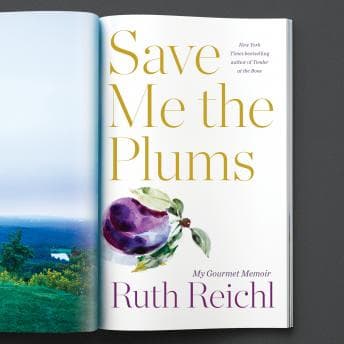

What happens when you hand a Berkeley hippie the keys to Condé Nast's oldest food magazine and tell her to make it matter?
I was up late last Sunday—Jenny was already asleep, and I was sitting at the kitchen table doing what I always do when I can't shut my brain off: listening to something on my headphones and picking at leftover banchan my mom dropped off earlier. And something about Ruth Reichl's voice narrating her own story while I ate my mom's kimchi at midnight felt... right. Like the book found its correct context.
A Management Case Study Disguised as a Food Memoir
Bottom line: This is one of the best books about organizational leadership I've listened to in the last two years, and it's shelved under "food writing." That's not an accident—it's what makes it work.
Reichl walks into Gourmet as someone who explicitly does not want to be a manager. She's a writer. She's a critic. She's the person who has opinions about plums, not P&L statements. And yet she proceeds to do what I've watched maybe five CEOs out of a hundred actually pull off: she transforms the culture of an institution without destroying what made it an institution in the first place.
The behind-the-scenes stories of Gourmet's staff and internal culture are gold. Not corporate-retreat-case-study gold—real, messy, human gold. She's navigating egos, legacy employees who've been there since the Carter administration, art directors with vision, and the impossible tension between editorial integrity and Condé Nast's spending habits. I've consulted for startups trying to pivot their culture with a fraction of this complexity. Most of them failed. Reichl somehow didn't, and she's honest about the luck involved.
This is what my parents did instinctively. Now it has a TED talk. My dad ran a dry cleaning business where he was the owner, the presser, the customer service rep, and the HR department. Reichl's version involves David Chang and Eric Ripert instead of starch and plastic wrap, but the core challenge is identical: How do you lead people when you never set out to be a leader?
The 9/11 Chapter Hit Different
I need to flag this because it caught me off guard. There's a chapter dealing with September 11th and how Gourmet—a food magazine—responded to that moment. I wasn't ready for it. Reichl doesn't overplay it, doesn't make it about herself. She talks about what food means when everything else falls apart, and it lands with a weight that most business memoirs couldn't achieve if they tried for eight hundred pages.
At 2.0x speed, I actually slowed down for this section. That almost never happens.
Ruth Reading Ruth
Here's the thing about author-narrated memoirs: they're usually either fantastic or painful. No middle ground. Reichl is fantastic. Her voice has this warmth that doesn't feel performed—she sounds like she's telling you this story over dinner, not recording in a booth. When she talks about the writers she worked with, including David Foster Wallace, you can hear genuine affection. When she talks about the corporate machinery grinding against her editorial instincts, there's this quiet steel underneath.
No full cast, no sound effects, no production gimmicks. Just her voice for nearly eight hours. And it's enough. Finally, a business book—fine, a memoir—that respects your time. At 7 hours 56 minutes, it's tight. She doesn't pad. Every chapter earns its place.
Who Gets the ROI Here
If you're in any kind of leadership role—startup founder, middle manager, reluctant team lead—listen to this. Reichl articulates the loneliness of being in charge better than most leadership books I've plowed through at McKinsey. If you love food culture, the farm-to-table movement's origin story, or the golden age of print media before the internet torched it all, this is your book.
If you're looking for a step-by-step management framework with bullet points and action items, skip it. This isn't that. This is a woman figuring it out in real time, making mistakes, getting lucky, and somehow building something that mattered—right up until the day Condé Nast pulled the plug on Gourmet entirely.
That ending, by the way. She knows from page one that this story ends with the magazine dying. And she tells it anyway, with more grace than bitterness. That's harder than it sounds. I found that same quality—a narrator who already knows the outcome and chooses honesty over mythology—in Twilight of the Idols, though the register there is considerably less warm.
The Consulting Engagement Is Over
Jenny would say I'm being harsh when I call most business memoirs glorified LinkedIn posts. Jenny is right. But this one earned its shelf space. Reichl's not selling a methodology. She's not building a personal brand. She's just telling you what happened when a food writer tried to run a magazine and accidentally became a leader. The key takeaway is worth the listen. And for once, so are the other seven hours.









![Steve Jobs [unabridged audiobook] audiobook cover](/_next/image?url=https%3A%2F%2Fcovers.audiobooks.com%2Fimages%2Fcovers%2Ffull%2F9788499923406.jpg&w=1920&q=75)