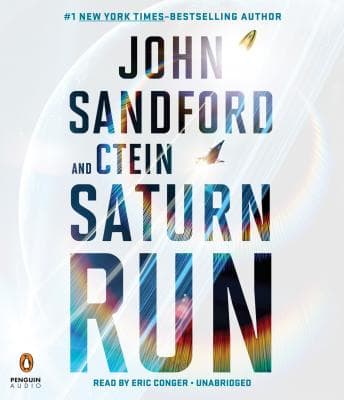

So everyone kept telling me Saturn Run was "The Martian but for Saturn" and I went in expecting Andy Weir-style problem solving with a wink. What I actually got was something weirder and more interesting — a near-future space race thriller that reads like John Sandford wrote a Tom Clancy techno-thriller but set it in 2066 and actually cared about the physics. I was not prepared for how much I'd enjoy this while procrastinating on my thesis at 2 AM, half-buried in a pile of ungraded assignments I'm supposed to be helping my advisor with.
Let me set the scene: something decelerates near Saturn. Space objects don't decelerate. That single premise — that one beautiful hook — carries you through sixteen and a half hours of political maneuvering, engineering problem-solving, and a US-versus-China space race that feels disturbingly plausible for something written in 2015.
The World-Building Is the Point (And I'm Not Mad About It)
Sandford and Ctein went hard on the technical details here. We're talking orbital mechanics, ship design constraints, propulsion systems that actually track with real physics extrapolated fifty years out. The magic system is — okay, there's no magic system, but the engineering system is chef's kiss. The way they work through how you'd actually convert a space station into an interplanetary vessel, the logistics of feeding a crew, the heat dissipation problems — this is Sanderson-level world-building except the world is our solar system and the rules are thermodynamics.
If you don't like info-dumps, this isn't for you (but you're wrong). Seriously though, the book does meander. There are stretches where Sandford and Ctein are clearly geeking out about spacecraft design and the plot takes a backseat. I was into it because my brain is basically wired for "tell me more about how the fictional spaceship works," but I can see how someone wanting pure thriller pacing would get antsy around the middle third. The story digresses — sometimes into character backstories that don't fully pay off, sometimes into technical asides that feel more like the authors couldn't bear to cut their research.
But when the tension ramps up? When the Chinese ship and the American ship are both bearing down on Saturn and the political chess gets nasty? That's where Sandford's thriller instincts kick in and the book sings.
Eric Conger Doing Heavy Lifting Across Two Spacecraft
Here's where I was genuinely surprised. I'd heard Conger was good but hadn't spent much time with his work before this. He's juggling a massive cast split between an American crew and a Chinese crew — men, women, politicians, engineers, military types — and he keeps them distinct enough that you're never lost. His pacing shifts noticeably between the political backroom scenes (slower, measured, almost conspiratorial) and the action sequences (clipped, urgent). It's not Steven Pacey — Steven Pacey walked so other narrators could run — but Conger is doing smart, professional work here. On the subject of narrators doing quietly excellent work with ensemble casts, I keep thinking about how the audiobook of Girl, Woman, Other handles twelve completely distinct voices — a different challenge entirely, but the same core skill of keeping you anchored in a crowded room.
One thing that bugged me slightly: there's a flatness to some of the quieter character moments. The protagonist, Sandy, is this rich-kid-turned-engineer with a complicated past, and in the text you can feel Sandford trying to give him emotional depth, but Conger doesn't always sell the vulnerability. He's great at competence and tension, less great at the softer beats. It's a minor thing, but it kept me from fully connecting with Sandy as a person rather than a plot device.
The Chinese characters are handled respectfully — no cartoonish accents, which I appreciate — though I'll admit I sometimes lost track of who was who on that side of the story.
Who's Rolling a Nat 20 With This One
If you're the kind of person who pauses a movie to say "actually, that's not how orbital insertion works" — this is your book. My D&D group would love this, especially our forever-DM who's been running a Spelljammer campaign and won't shut up about realistic space travel. Hard sci-fi fans, Clancy readers who want something set in space, anyone who loved The Martian's "science the crap out of this" energy but wants it on a geopolitical scale.
If you need fast pacing throughout or deep character work, you might bounce off it. The progression is satisfying but it takes its time getting there, and some characters exist more as archetypes than people.
I listened to this across three late-night coding sessions while my thesis document sat open and untouched in another tab. (Dr. Patel, if you're reading this, I was absolutely working on my procedural generation framework. The audiobook was just... ambient.) Yes, it's 16 hours. Yes, it's worth it. Not every minute, but enough of them that I'd do it again.
Save Your Credit, Grab Some Snacks, and Strap In
Saturn Run is a big, ambitious, nerdy space thriller that's more interested in getting the science right than in giving you non-stop action — and I respect the hell out of that. Conger's narration is solid if not spectacular, the plot delivers when it counts, and the final act payoff with the alien technology is satisfyingly weird without being hand-wavy. It's not perfect. It sags in the middle, some characters are thin, and it occasionally reads like a very entertaining textbook. But I'd rather have a book that's too smart than one that's too dumb, and Saturn Run is absolutely too smart in the best way.