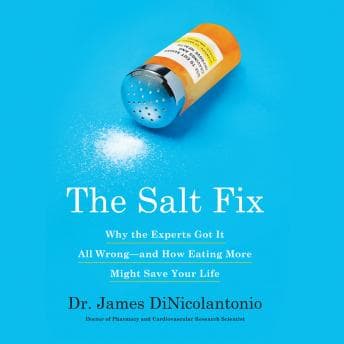

"We've been told to fear salt for decades, but what if the research was wrong from the start?"
I paused my morning jog through Cambridge when DiNicolantonio dropped that line early in the audiobook. Just stood there on the sidewalk like a weirdo, processing. Because here's the thing - as someone who spends her life analyzing why people believe what they believe, watching a cardiovascular research scientist systematically dismantle a decades-old nutritional orthodoxy is... well, it's a case study in how groupthink infiltrates even evidence-based fields.
And honestly? My therapist would have thoughts about how personally attacked I felt realizing I've been guilt-salting my aloo gobi for years.
The Psychology of Nutritional Fear
What makes this book compelling isn't just the contrarian thesis - it's watching DiNicolantonio trace the genealogy of an idea. How did "salt is bad" become gospel? The original studies linking sodium to hypertension were methodologically shaky at best. And once the medical establishment committed to a position, confirmation bias did the rest.
This is a fascinating case study in institutional psychology. Scientists are human. They have careers to protect, reputations to maintain, and a very human tendency to interpret new data through the lens of existing beliefs. Mastery explores this same tension between institutional thinking and individual insight, though from a different angle. DiNicolantonio doesn't just present alternative evidence - he explains why the field got stuck. That's the part that hooked me.
The book covers the biological mechanisms too - how low sodium can trigger insulin resistance, increase fat absorption, even raise blood pressure in some populations (yes, the opposite of what we've been told). It's dense material, but he breaks it down into digestible chunks. Not dumbed down, just... accessible. The kind of science communication that respects your intelligence while acknowledging you probably don't have a pharmacy doctorate.
Qarie Marshall Gets Out of the Way
I couldn't find much about Qarie Marshall online, but based on this performance? He understands something crucial about narrating science books: the goal is clarity, not drama. His pacing is steady without being soporific. He handles the technical terminology - and there's plenty of it - without stumbling or over-emphasizing.
The delivery is professional in the best sense. No weird affectations, no narrator ego getting between you and the content. When you're listening to someone explain the renin-angiotensin-aldosterone system (yes, that's a real thing, I looked it up), you want a guide who sounds confident and calm. Marshall delivers that.
One listener mentioned they had no leg cramps on their ride after applying the book's advice - and specifically praised the narrator. Weirdly endearing. The bar for success here is "I absorbed enough information to change my behavior AND my muscles feel better." That's the dream for health audiobooks.
Where the Argument Gets Complicated
I do have some reservations. Not about Marshall's performance - that's solid throughout. But about the book's rhetorical strategy.
DiNicolantonio is clearly a credentialed expert. Two hundred publications, testimony before the Canadian Senate, the whole deal. But sometimes the book reads like it's swinging the pendulum too far in the opposite direction. "Salt is bad" becomes "salt is basically a superfood." He exhibits classic reformer psychology - the zeal of someone who's discovered what they believe is a suppressed truth.
Is he right? Probably more right than the conventional wisdom, based on the evidence he presents. But I found myself asking: why does this need to be framed as "eat MORE salt" rather than "stop worrying so much about salt"? The answer, I suspect, is that nuance doesn't sell books. (Don't tell my students I said that.)
The practical applications are genuinely useful, though. The sections on athletic performance and hydration were eye-opening. And the sugar-salt connection - how reducing salt can actually increase sugar cravings - is the kind of insight that makes you rethink your entire approach to eating.
Who This Is For (And Who Should Skip)
Best for: health nerds, skeptics of conventional nutritional wisdom, anyone who's ever felt vaguely guilty about salting their food. Commuters will get through this in about a week of driving. Works well at 1.25x speed - the pacing is deliberate enough that you can accelerate without losing comprehension.
Maybe skip if: you want narrative storytelling, or if scientific argumentation makes your eyes glaze over. This is a research-based argument, not a memoir.
Pass the Salt Shaker
I'm not qualified to evaluate the medical claims - that's between you and your doctor. But as a study in how scientific consensus forms, how experts can be wrong, and how one researcher builds a case against institutional orthodoxy? This is genuinely interesting stuff. DiNicolantonio understands human nature - specifically, how humans in institutions stop questioning their assumptions.
Now if you'll excuse me, I need to go salt my dinner without guilt for the first time in years.