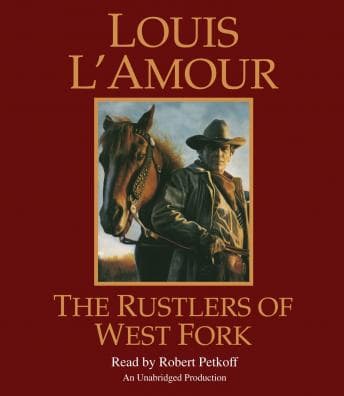

So I'm sitting in my apartment at 1 AM, supposedly debugging a procedural terrain generation algorithm for my thesis, and instead I'm listening to Hopalong Cassidy ride through Apache country because apparently my priorities are exactly where they've always been. Look - I didn't plan on picking up a Louis L'Amour western. My queue is stacked with Cosmere re-listens and a LitRPG series I've been eyeing for months. But sometimes you need a palate cleanser, something lean and mean that doesn't require you to cross-reference a wiki to remember which magic system you're tracking. Rustlers of West Fork delivered exactly that.
Hopalong Cassidy Is Basically a Lawful Good Gunslinger and I'm Here For It
Here's the thing about L'Amour's version of Hopalong Cassidy - this isn't the goofy TV cowboy your grandpa watched. This Cassidy is sharp, pragmatic, and genuinely dangerous. The setup is classic: deliver bank notes to an old friend, arrive to find said friend held hostage by outlaws, proceed to methodically wreck everyone's day. It's a D&D one-shot, basically. Your buddy shows up at the table with a Ranger who has max Perception and a quick draw, and the DM throws waves of bandits at him for seven hours.
And honestly? The progression is satisfying. L'Amour doesn't waste time with existential cowboy angst. Cassidy assesses the situation at the Circle J ranch, realizes Dick Jordan and his daughter Pam are trapped by Avery Sparr's gang, and starts making moves. The escape through Apache territory is where the book really finds its stride - there's genuine tension in the pursuit sequences because L'Amour understood landscape the way Sanderson understands magic systems. Every canyon, every ridge, every water source matters tactically. You feel the terrain pressing in on the characters.
Is the plot predictable? Sure. Cassidy's going to win. You know it, I know it, the outlaws should know it. But L'Amour makes the how interesting enough that the foregone conclusion doesn't bother you. Sparr and Soper make decent enough villains - Sparr's the muscle with ambition, Soper's the scheming type who thinks he's smarter than everyone. Classic duo. My D&D group would love dropping these two into a campaign as mid-tier antagonists. I got a similar kick out of the antagonist dynamics in Gray Ghost - different setting, same satisfying sense that the villains actually have a plan before the hero dismantles it.
Robert Petkoff's Volume Knob Goes to 11 (Whether You Want It To or Not)
Petkoff is a legitimately talented narrator. The guy has Audie Awards for a reason, and his dramatic instincts are solid when they're calibrated right. His voice for Cassidy carries the right amount of weathered confidence, and he handles the action sequences with real energy.
But - and this is a real but - he overplays his hand. There are moments in quieter scenes, dialogue exchanges where characters are just talking over campfire or sizing each other up, where Petkoff punches the delivery like someone's about to draw. It's like watching a DM who voices EVERY line at maximum intensity. Sometimes a sentence is just a sentence, man. You don't need to hit "Jordan looked at the horizon" like it's a dramatic reveal.
It's not a dealbreaker. Once I adjusted my expectations around hour two, I started filtering it out. But if you're sensitive to narrators who treat every paragraph like it's the climax, be warned. Steven Pacey walked so other narrators could run, and Petkoff is running a bit too fast in the wrong moments here.
Seven Hours of Clean, Efficient Frontier Fiction
At 7 hours and 49 minutes, this is a tight listen. No bloat, no meandering subplots about a side character's backstory that goes nowhere. L'Amour was writing these books like he was billing by the word and wanted to keep costs down. Every chapter moves the plot forward. For someone who regularly commits to 40+ hour fantasy epics (yes, it's 40 hours, yes, it's worth it - different book, same principle), this felt like a sprint.
The violence is present but not gratuitous. Gunfights are described with mechanical precision - L'Amour clearly knew his firearms and his geography. If you don't like info-dumps about trail conditions and weapon mechanics, this isn't for you. (But you're wrong.) The landscape descriptions of the American West function almost like world-building in a fantasy novel, establishing rules and constraints that drive the plot.
Who Rides and Who Walks
If you're a fantasy listener like me looking for a change of pace, this is a surprisingly good crossover pick. Cassidy's tactical mind scratches the same itch as a competent protagonist in progression fantasy. If you're already a L'Amour fan, you know what you're getting and you'll enjoy it. If you need complex character development or moral ambiguity - this ain't that. Cassidy's the good guy. The bad guys are bad. The West is wild. Simple as.
I read this instead of writing my thesis, and while I can't say it advanced my procedural generation research, it did remind me that sometimes the simplest story structures work because they work. Now if you'll excuse me, I have a chapter to not write and a Stormlight re-listen calling my name.