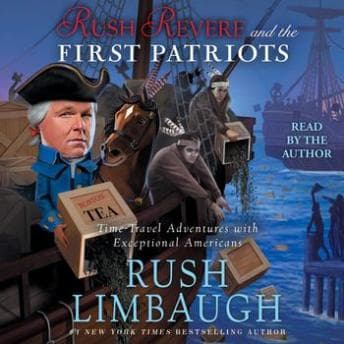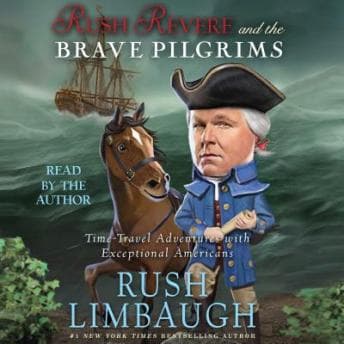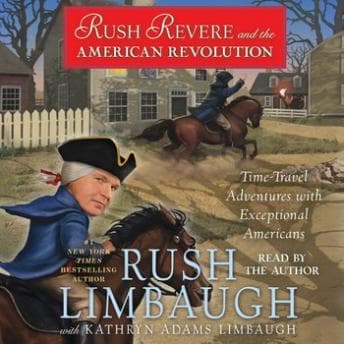

Look, I need to get something off my chest: a talking time-traveling horse named Liberty who makes smoothie jokes should not work as a vehicle for teaching kids about the American Revolution. It shouldn't. It's the kind of premise that sounds like someone pitched it at 2 AM after too much caffeine and a Wikipedia binge. And yet here I am, a grown man who plays D&D and argues about Sanderson's magic systems, genuinely charmed by a kids' audiobook about a substitute teacher and his sarcastic equine companion galloping through 1775.
I listened to this while debugging a procedural terrain generator that kept spawning mountains inside lakes. (Dr. Patel, if you're reading this — I was working. Sort of.) At five hours and thirty-nine minutes, it's basically a long afternoon, and honestly? It was a better use of my time than fixing those mountains.
A Talking Horse, Paul Revere, and a Pepper Spray Incident
So the setup: Rush Revere is a history teacher with a time-traveling horse named Liberty who can open portals to the past. They take a crew of modern kids — Cam, Tommy, Freedom — back to the key moments of the American Revolution. Paul Revere's midnight ride. The battles of Lexington, Concord, Bunker Hill. The signing of the Declaration of Independence. There's even a scene where they have to prevent a British spy from capturing Paul Revere, which involves — and I'm not making this up — pepper spray as a distraction against British soldiers. My D&D group would love this. That's basically a creative use of a cantrip. The same kind of gleeful historical chaos runs through Artemis Fowl 2: The Arctic Incident, where kid protagonists also stumble through high-stakes situations with a confidence that probably shouldn't work but absolutely does.
The emotional throughline is Cam, whose dad is deployed in Afghanistan. He's angry about it. He doesn't understand why his father has to be away. And as they meet figures like Dr. Joseph Warren and George Washington — people who sacrificed everything for something bigger than themselves — Cam starts to reframe his own dad's service. It's not subtle. It's not trying to be. But for the target audience? It lands. There's a directness to it that I actually respect.
Liberty the horse is the comic relief, constantly cracking jokes and requesting spinach-oats-alfalfa smoothies while the kids want strawberry. He's basically the bard of this party — high charisma, questionable decision-making, always hungry.
Rush Behind the Mic
Here's the thing about Rush Limbaugh narrating his own book: the man was a radio broadcaster for decades. He knew how to hold an audience's attention with just his voice. There's a natural confidence to the delivery, a warmth that comes through especially in the scenes with the kids. His southern drawl gives everything a folksy, storytelling-around-a-campfire quality that fits the "enthusiastic history teacher" character surprisingly well.
That said — this is not Steven Pacey. (Steven Pacey walked so other narrators could run, and I will say that until I die.) Limbaugh doesn't do wildly distinct character voices. You're not going to hear a dramatically different George Washington versus Paul Revere. It's more like one guy telling you a really animated story, which is... exactly what it is. For a kids' audiobook, that's fine. For an adult expecting a full performance? Temper those expectations.
The production is clean but straightforward — no sound effects, no musical score, no full cast. Just Limbaugh and the story. Given that this won a Children's Choice award and hit #1 on the NYT bestseller list, clearly the simplicity works for the audience it's aimed at.
The D&D Dungeon Master Energy Is Real
What I didn't expect was how much this reminded me of being twelve years old in the back of the Wilkinson County Public Library, listening to my DM describe a world we'd never been to with enough enthusiasm that we could see it. Limbaugh has that same energy — this unironic excitement about history that's almost infectious. He genuinely thinks the American Revolution is the coolest thing that ever happened, and he wants kids to think so too.
Is the history simplified? Absolutely. This is a broad strokes picture designed to make kids excited enough to learn more. The two lanterns in the Old North Church, the midnight ride, Bunker Hill — they're presented as set pieces in an adventure story rather than a textbook. And honestly? That's how I got into history in the first place. Through stories. Through someone making it feel like it mattered.
If you don't like info-dumps, this isn't for you (but you're wrong). Kidding — sort of. There are definitely moments where the educational mission takes over and you get a mini-lecture dressed up in dialogue. But it's a kids' book. That's the deal.
Who's Rolling Initiative on This One
This is for families with kids roughly 8-12 who want history to feel like an adventure instead of homework. It's great for road trips — short enough to finish in one long drive, engaging enough to keep backseat attention. If you're an adult without kids looking for your next epic fantasy listen, this ain't it. But if you're a parent, an uncle, a cool older cousin, or honestly just someone who wants a light palate cleanser between 40-hour Stormlight Archive re-listens? There are worse ways to spend an afternoon.
Roll for History Check
I read this instead of writing my thesis. (Listened. Whatever.) It's earnest, it's goofy, it's patriotic in a way that's more campfire than campaign rally. The talking horse grew on me. The pepper spray scene made me laugh out loud in my apartment full of board games and regret. And Cam's arc about understanding sacrifice — simple as it is — stuck with me longer than I expected. Not everything needs to be a Sanderson-level magic system to be worth your time. Sometimes a talking horse and some history is enough.