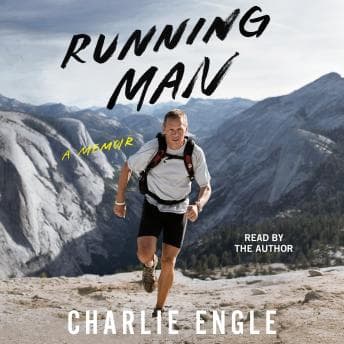

Look, I need to start with a complaint. Charlie Engle describes running through the Sahara Desert - 4,500 miles of it - and at one point talks about the blisters, the hallucinations, the sand in places sand should never be, and my first thought was: "Sir, I have worked a triple shift on a holiday weekend in the ER. I understand suffering." My second thought was: "Okay, no. No, I don't. You win."
I picked this one up on a whim because my library app recommended it and I had a stretch of night shifts coming up. Figured a running memoir would be light, motivational, maybe a little rah-rah. I was wrong. This book hit me somewhere I wasn't expecting.
The Part Where He Almost Dies (Multiple Times)
Charlie Engle narrates his own story, and thank God for that, because nobody else could sell the crack cocaine binge that ends in actual gunfire the way he does. His voice gets tight when he talks about the six-day bender that finally broke him. There's no dramatic music, no production tricks - just a man sitting with his own worst memories and telling you about them like he's across a kitchen table at 2 AM. As someone who's actually worked a code on patients who came in after binges like the one he describes, hearing the other side - the inside of that spiral - hit different.
He doesn't sanitize it. The addiction sections are raw in a way that made me uncomfortable, and I mean that as a compliment. Roald Dahl's Boy has that same quality - where someone just sits down and tells you the hard thing plainly, without dressing it up for your comfort. I've held the hands of people in withdrawal. I've watched families fall apart in waiting rooms. Engle puts you inside the head of the person everyone else is trying to save, and he doesn't ask for sympathy. He just tells you what happened. That honesty is rare.
But here's what surprised me: the book isn't really about addiction. Or running. It's about what happens when your brain needs to be consumed by something - anything - and you have to choose whether that something destroys you or saves you. The ultramarathons aren't just exercise. They're replacement obsession. He basically says as much, and I respect that he doesn't pretend running cured him in some clean, linear way.
4,500 Miles of Sand and the Federal Prison Nobody Saw Coming
The Sahara crossing is genuinely wild. Engle describes the team dynamics, the moments when his body just... stops cooperating, the hallucinations from sleep deprivation. I was listening to this in my kitchen at 7 AM making pancakes for my kids after a shift, and I had to stop flipping because he's describing running through a sandstorm in Niger and I'm standing there with a spatula thinking, "What am I even doing with my life?"
But the section that really got me was the federal prison stint. He gets convicted of mortgage fraud - and from his telling, it's a case that never should have been brought. An IRS agent literally saw the Running the Sahara documentary and decided to investigate him because he couldn't figure out how a runner afforded his house. Whether you believe his version entirely or not, the sixteen months in Beckley, West Virginia, are devastating. And what does he do? He runs. In circles. On a tiny prison track. And his fellow inmates start joining him.
Carlos asked why I was crying in the car. I blamed allergies. But it was the prison running. Something about men running in circles in a place designed to make them feel small - that broke me.
The Voice Behind the Miles
The medical details are accurate. Finally. When Engle talks about what ultramarathons do to your body - the kidney stress, the electrolyte disasters, the foot trauma - he gets it right. I've treated runners who've come into the ER after pushing too far, and his descriptions match what I've seen on the other side of the gurney. No Hollywood dramatics, just the reality of what happens when you run 135 miles through Death Valley.
As a narrator, Engle is not a polished voice actor. His pacing can be uneven - some sections about race logistics drag a bit, and there are stretches in the middle where he's listing races and the chronology gets fuzzy. But his voice cracks when it should crack. He laughs at himself at the right moments. There's a section where he's talking about his kids and you can hear the weight of regret and love tangled together. A professional narrator would've smoothed that out. I'm glad nobody did.
At 10 and a half hours, it's a solid commitment. I'd say 1.25x speed works fine for the race detail sections, but slow it back down for the addiction and prison chapters. They deserve your full attention.
Who Needs This Book (and Who Doesn't)
If you're a runner, obviously. But honestly? This is for anyone who's watched someone struggle with addiction and wanted to understand the inside of it. It's for people who know that recovery isn't a straight line. It's for night shift workers who understand that sometimes you just keep moving because stopping means thinking.
If you want a polished, perfectly structured memoir with clean narrative arcs - this isn't it. It's messy in places. The pacing wobbles. But life wobbles. And this book is honest about that.
My mom would love this (she still thinks I should've been a doctor). She'd also tell Charlie Engle to eat more rice.
Night Shift Prescription
Perfect for that post-shift decompression. This one earned its place in my rotation, and I don't say that about many memoirs. It's imperfect, it's human, and it made me feel something real at 7 AM over pancake batter. Night shift approved.