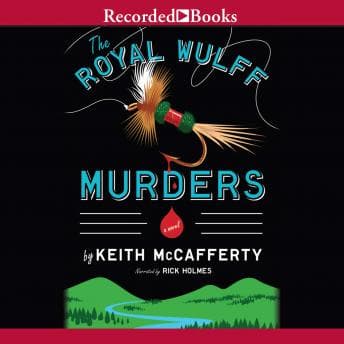

What happens when a magazine editor who actually knows how to tie a Royal Wulff decides to write a murder mystery? You'd expect the fishing details to be impeccable and the crime plotting to be, well, a first draft. And that's almost what you get here — except McCafferty is smarter than that assumption gives him credit for.
I was chopping onions for a chana masala at 9 PM on a Tuesday when Sean Stranahan's dead body discovery floated into my kitchen through my earbuds. There's something about the methodical rhythm of cooking alone that pairs surprisingly well with a slow-unfolding mystery set in Montana. The cadence of this book doesn't rush you. It lets you simmer.
A Fly Fisher's Crime Scene (And Why That Actually Works)
The protagonist exhibits classic displaced-identity patterns — Sean Stranahan is an ex-PI who's reinvented himself as a reclusive artist in Montana, which is the kind of biography that practically screams "I'm running from something." McCafferty understands this. He doesn't over-explain Stranahan's motivations; instead, he lets the guy's behavior speak. Stranahan keeps getting pulled back into investigative work not because of some noble impulse but because his brain is wired for pattern recognition and he can't turn it off. As a psychology researcher, I found myself asking: why does Stranahan really stay in Montana? The fishing is the excuse. The isolation is the point.
What makes this character compelling is the pairing with Sheriff Martha Ettinger, who is refreshingly competent without being written as a "tough woman in a man's world" cliché. She's just... good at her job and slightly annoyed that a civilian keeps being useful. Their dynamic is professional friction with an undercurrent of mutual respect, not forced romantic tension. Psychologically, this tracks. Two people who are both slightly too good at reading others would circle each other exactly like this.
The fly-fishing world as a backdrop for murder is genuinely interesting. McCafferty's Field & Stream credentials show — the details about the industry, the culture, the economics of guided fishing in Montana all feel lived-in rather than researched. When the murder ties back to fly fishing as big business, the stakes feel real because McCafferty has already made you understand that this isn't just a hobby. It's an ecosystem of money, territory, and ego. The Royal Wulff fly itself becomes almost a character — a specific, identifiable detail that anchors the whole mystery in something tangible.
Rick Holmes Made Me Forget I Was Listening to One Person
Okay, so here's the thing about narration that "becomes invisible" — that's the highest compliment you can give an audiobook narrator, and Rick Holmes earns it. His character voices aren't showy. He doesn't do theatrical accents or vocal gymnastics. Instead, he finds the register for each character — Martha's clipped authority versus Stranahan's more measured, observational tone — and just... stays there. Consistently. For ten and a half hours.
The near-drowning scene with Stranahan is where Holmes really demonstrates his range. There's a physicality to his reading in that sequence — the pacing tightens, the breaths shorten — and you feel the threat without any sound effects or production tricks. Just a guy reading words in a way that makes your pulse pick up while you're stirring cumin into a pot. That's craft.
I will say this: the 10-hour-28-minute runtime felt appropriate for the pacing, but there are stretches in the middle where the investigation meanders through Montana scenery and fishing culture that could test your patience if you're expecting thriller-speed plotting. This is a mystery that moves like a river — sometimes fast through the narrows, sometimes wide and lazy through a valley. If you need constant adrenaline, this isn't your book. If you like the detective work of watching a case build piece by piece, it rewards your patience.
Who Gets to Pull This Fly From the Water
This is a fascinating case study in niche-expertise fiction. If you love Tony Hillerman's Navajo mysteries or Craig Johnson's Longmire series — books where the setting isn't just backdrop but practically a suspect — you'll feel at home here. Echo Burning scratches a related itch if you need your rural American setting to carry more threat — Lee Child plants Reacher in Texas heat the same way McCafferty plants Stranahan in Montana cold, where the landscape itself is doing psychological work on the characters. Readers who want their mysteries soaked in a specific subculture's details will eat this up.
Skip it if: you need your mysteries urban, fast, and body-count heavy. This is rural, deliberate, and character-driven. One body. Lots of thinking about why.
Psychologically, this doesn't track as a perfect mystery — some of the secondary character motivations feel underdeveloped, and there's a reveal near the end that relies on information the reader couldn't have reasonably pieced together, which is a pet peeve. But McCafferty's understanding of human nature — specifically, how people construct new identities when they're trying to escape old ones — is strong enough to carry the book past its structural wobbles.
My Diagnosis: A Solid Debut With Good Instincts
McCafferty writes like someone who's spent decades observing people in the wild — literally — and has finally decided to put those observations into fiction. The research actually shows that writers with deep domain expertise produce more authentic settings but sometimes struggle with plot mechanics, and that pattern holds here. The world is rich. The characters are psychologically coherent. The mystery itself is good, not great. But I'll be back for the next Stranahan novel, because McCafferty's character instincts are worth following downstream.