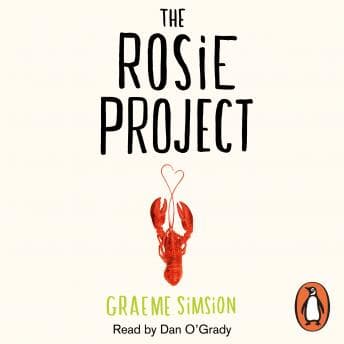

Everyone kept telling me The Rosie Project was "like The Curious Incident of the Dog in the Night-Time but romantic" and honestly, I went in a little skeptical. Comparisons like that are usually marketing shorthand for "protagonist thinks differently, hijinks ensue." And look - that's not entirely wrong here. But what Graeme Simsion actually pulls off is something sneakier and more interesting than I expected, and Dan O'Grady's narration is a big part of why it works.
I started this one during a Saturday morning walk along the lakefront with Denise. She had her own podcast going, I had my earbuds in, and within twenty minutes I was laughing hard enough that she pulled one of her earbuds out to ask what was wrong with me. Nothing was wrong. Everything was extremely right.
A Geneticist Walks Into His Own Blind Spot
Don Tillman is a genetics professor who has designed a multi-page questionnaire to find a wife. He's screening for punctuality, dietary compatibility, fitness habits - the works. He's systematic, brilliant, and completely incapable of recognizing that his system is the problem. The book is told entirely from Don's first-person perspective, and this is where Simsion does something clever: Don narrates his own emotional evolution without understanding it's happening. He'll describe a physiological response to Rosie - elevated heart rate, difficulty concentrating - and clinically attribute it to some external variable. Never love. The reader figures it out chapters before Don does.
This reminds me of what Hemingway said about the iceberg theory - what's left unsaid carries the weight. Except here, Don isn't being stoic. He's being precise. He genuinely doesn't have the emotional vocabulary yet. And watching him slowly, painfully acquire it? That's the real story. The Wife Project questionnaire, the Father Project to find Rosie's biological dad - those are just the scaffolding.
O'Grady Gets the Assignment (And Then Some)
Here's where I walked in expecting competent narration and got something better. Dan O'Grady reads Don with this Australian deadpan that's absolutely essential to the comedy. Don's voice is measured, almost clinical - he's the kind of guy who would describe a cocktail party disaster with the same tone he'd use for a lab report. O'Grady nails that flat delivery so precisely that when Don does stumble emotionally - when there's a crack in the composure, a hesitation where certainty used to be - you feel it like a gut punch.
And then there's Rosie. O'Grady shifts into something looser, more playful, with this irreverent edge that immediately signals: this woman is going to wreck every spreadsheet Don has ever made. The contrast between the two voices isn't just characterization - it's the whole thesis of the book made audible. Order meets chaos. The narrator understands that pause is punctuation, and O'Grady deploys silence in Don's moments of confusion the way a comedian holds for a beat before the punchline.
The technical genetic explanations - and there are a few, because Don is Don - stay accessible. O'Grady reads them with enough enthusiasm that you can hear Don's genuine passion for his field, which matters. Don isn't a punchline. He's a person who experiences the world differently, and the narration never condescends to him. That's a tightrope, and O'Grady walks it.
Where the Formula Shows Its Seams
Look, I teach fiction. I know structure. And The Rosie Project is, structurally, a romantic comedy. You know where it's going from page - sorry, minute - one. Rosie is wrong for the questionnaire but right for Don. Don will have to abandon the system to get the girl. There will be a crisis in the third act where it looks like everything falls apart.
All of that happens. Exactly as you'd predict.
But here's the thing - and I've been thinking about this since I finished it last night while grading a stack of sophomore essays on Lord of the Flies (the irony of reading about human connection while marking papers about civilization's collapse is not lost on me) - predictability isn't always a flaw. Sometimes the pleasure is in the execution. My students would roll their eyes at a Pride and Prejudice comparison, but the DNA is there: brilliant person with a blind spot, slowly dismantled by someone who refuses to play by their rules.
My students would hate this. I love it.
What keeps it from a perfect score is that Rosie herself stays a bit more sketch than portrait. We get her energy, her warmth, her backstory with the father search - but Don's interior life is so richly drawn that Rosie sometimes feels like a catalyst rather than a co-lead. At seven and a half hours, there was room to give her more.
Who This Is For (And Who Should Keep Walking)
If you loved A Man Called Ove, this is its spiritual successor - same principle of a rigid, rule-bound man softened by human connection, different execution. I didn't find that same warmth in Titanic Secret, which I reviewed a while back and which takes a much colder, more procedural approach to its characters - worth knowing before you queue it up. If you want dark, complex literary fiction, this isn't your stop. This is warm. Genuinely, unapologetically warm. It earns its emotional beats through specificity - Don's Standardized Meal System, his inability to read social cues at a faculty dinner, the way he schedules every minute of his day until Rosie blows the schedule apart.
The prose deserves to be savored. Listen at 1.0x. O'Grady's timing depends on it.
Worth Pausing the Faculty Meeting For
Seven hours and thirty-one minutes. I finished it in three days. Started on the lakefront, continued through a Sunday of errands, wrapped it up at my desk at 11 PM with red pen in one hand and absolutely zero attention left for Ralph and Piggy. This book made me laugh, made me genuinely moved in its final act, and reminded me why romantic comedies - when they're built on real character work instead of contrivance - still matter. Don Tillman is going on my shelf of fictional people I'd actually want to have dinner with. He'd hate the dinner, of course. But he'd show up. On time. With a spreadsheet.