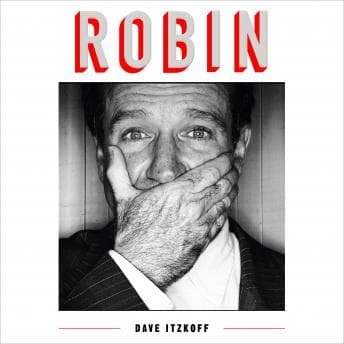

My wife Jenny cried at the end of Titanic. I did not. I have a reputation to maintain.
I cried on a Tuesday afternoon, sitting in my car in a parking garage after a client meeting, because Fred Berman read me the last chapters of Robin Williams' life and I apparently have no defenses left.
Let's start there.
The Book That Earned Its 16 Hours
I almost didn't listen to this one. Sixteen hours is a significant commitment. That's roughly eight business books at my standard pace, or four if I'm being disciplined about it. And celebrity biographies have a failure mode I've seen too many times: hagiography dressed up as journalism, where everyone's a genius and the tragedy arrives in chapter fifteen like a scheduled meeting nobody wanted.
Itzkoff doesn't do that. He's a New York Times culture reporter, and it shows - not in a dry, academic way, but in the sense that he actually did the work. Over a hundred interviews. Archival research. And crucially, he doesn't protect Robin Williams from the story. The addiction cycles aren't a sidebar. The self-doubt isn't a footnote. Marcus Aurelius does something similar in Meditations - the private record of a man performing strength publicly while cataloguing his own doubts in the margins, and it hits differently when you realize he never intended anyone to read it. The Lewy body dementia diagnosis at the end - the condition his family and team didn't fully understand while he was deteriorating - that's handled with the kind of specificity that makes you realize you never actually knew what happened.
I grew up watching Good Morning, Vietnam on a VHS tape my parents kept next to the register at the dry cleaners. Robin Williams was furniture in my childhood. I thought I knew the broad strokes. I did not know the broad strokes. The gap between his public persona - that relentless, generous, machine-gun comedian - and the private man who was terrified the ideas would stop coming is not a small gap. It's a canyon.
This is what my parents did instinctively - perform energy they didn't always have, because the alternative was showing weakness to customers. Now it has a TED talk and a 400-page biography.
The Narrator Problem (That Isn't Quite a Problem)
Okay. Fred Berman. This is where I have to be honest about the split.
Half the reviews I saw before listening said he was extraordinary - that he somehow became Robin Williams during the reading, that the rat-a-tat rhythm of Williams' speech patterns came through in a way that felt almost haunted. The other half said to avoid the audiobook entirely because his attempts at Robin's voices and accents were distracting, even ruining.
Both camps are right. That's the uncomfortable answer.
When Berman is narrating Itzkoff's prose - the reporting, the context, the analysis - he's very good. Emotionally present, well-paced, knows when to let a sentence breathe. But when he shifts into attempting Williams' actual comedy bits or mimicking his characters, there's an uncanny valley effect that I couldn't fully shake. It's not that he's bad at it. It's that nobody can do Robin Williams except Robin Williams, and trying surfaces that absence rather than filling it.
Here's my actual take: the attempts at the voices made the book sadder, not worse. Every time Berman reached for that energy and couldn't quite land it, I felt the loss more acutely. Whether that's a feature or a bug depends entirely on what you're looking for.
The author Dave Itzkoff reads the prologue and epilogue himself. Do not skip these. The epilogue in particular - Itzkoff's own voice, clearly not a professional narrator, slightly unpolished - hit harder than anything Berman delivered. Something about hearing the journalist who spent years on this project speak directly to you at the end.
The ROI Calculation on 16 Hours
I've unfinished 70% of my Audible library. I finished this one.
That's the real metric. Not the star rating, not the narrator debate - the fact that I kept coming back to it, including that parking garage Tuesday where I sat for an extra twenty minutes because I wasn't ready to stop.
The book earns its length. It doesn't pad. The early chapters on Williams' childhood and Juilliard years build context that pays off later. The Mork & Mindy section is genuinely fascinating from a business angle - watching a performer navigate sudden fame with no infrastructure around him, making decisions that would haunt his financial situation for years. The addiction chapters are uncomfortable in the way true things are uncomfortable.
Skip to chapter 5 if you want. But you'll miss the foundation.
The key takeaway is worth the listen. The other 10 hours? Also worth the listen, which I did not expect to say about a celebrity biography.
If you knew Robin Williams only as the guy from Mrs. Doubtfire or the Genie, this book will complicate that in ways that are worth being complicated. If you grew up with him as furniture in your house the way I did - the VHS tapes, the HBO specials, the Sunday afternoon movies - bring a parking garage and some privacy for the last two chapters.
Jenny would say I'm being too measured. Jenny is right. Just listen to it.







![Steve Jobs [unabridged audiobook] audiobook cover](/_next/image?url=https%3A%2F%2Fcovers.audiobooks.com%2Fimages%2Fcovers%2Ffull%2F9788499923406.jpg&w=1920&q=75)