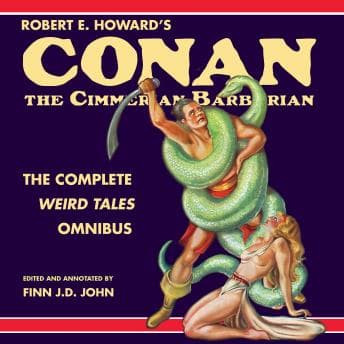

"Know, O prince, that between the years when the oceans drank Atlantis and the gleaming cities..."
That opening incantation from "The Phoenix on the Sword" hit me around hour three, and I physically sat up straighter in my desk chair. I was supposed to be debugging a procedural dungeon generator for my thesis. Instead I was 35 hours deep into the literary equivalent of a barbarian kicking down every door in said dungeon.
Let me be honest about something: I came to Conan backwards. Like a lot of people my age, I knew Conan from D&D — the Barbarian class, the rage mechanic, the "hit things until they stop moving" philosophy. I'd read maybe two or three of the original Howard stories in a dog-eared paperback I found at a used bookstore in Macon. But I'd never sat down and consumed the whole body of work in order. This audiobook forced me to, and it changed how I think about the entire sword and sorcery genre.
The Guy Who Built the Dungeon Before There Was a Dungeon
Here's what hit me hardest: Robert E. Howard wasn't riffing on a genre. He was inventing it. Every trope you think of when someone says "sword and sorcery" — the wandering warrior, the corrupt sorcerer-kings, the ancient civilizations crumbling under their own decadence — Howard wrote that first. Reading Conan stories in 2024 feels like listening to early Black Sabbath. You think "oh, this sounds derivative" and then your brain catches up and goes "wait, no, everything else is derivative of THIS."
The collection is organized chronologically by publication in Weird Tales, which is the right call. You get to watch Howard sharpen his craft in real time. The early Solomon Kane and Kull of Atlantis stories included as context? Smart move. You can literally hear Howard working out his ideas about civilization versus barbarism before he crystallizes them into Conan. Kull is the rough draft. Conan is the final build. I kept thinking about how rare it is to watch a creator's mythology crystallize in real time like this — 1986 - Book 3: At the End of Time gave me a similar feeling of watching a fictional universe reach its final, inevitable shape.
And the biographical interludes between stories — Finn J.D. John contextualizing Howard's life, his relationship with Weird Tales editor Farnsworth Wright, the financial pressures of writing pulp in Depression-era Texas — that's the kind of supplementary material that turns a story collection into a course. My D&D group would love this just for the world-building archaeology alone.
Finn J.D. John: Scholar First, Narrator Second (And That's Mostly Fine)
Here's where it gets complicated. Finn J.D. John clearly knows this material cold. His analytical commentary between stories is genuinely insightful — he's not just reading liner notes, he's making arguments about Howard's creative evolution. That scholarly energy carries into his narration too. He reads Howard's prose with a respect for the rhythm that suggests he's spent real time with these sentences.
But — and this is a real but — his character work has limits. His Conan is solid. His various sorcerers and kings land well enough. His women? Look, I'll just say it: when Bêlit or Yasmela speaks, the illusion cracks. It's not catastrophic, but in a 35-hour listen, you notice. Steven Pacey walked so other narrators could run, and John is still finding his stride on that front. It doesn't ruin the experience, but if you're someone who needs pristine character differentiation across every voice, calibrate your expectations.
For a solo narrator handling this much material — we're talking 35 hours — John's stamina is impressive. His energy doesn't flag in hour 28 the way some narrators' does. That counts for a lot in a collection this size.
The Elephant in the Hyborian Age
I need to talk about the racism and misogyny because pretending they're not there would be dishonest. Howard was writing pulp fiction in 1930s Texas, and it shows. Some of the racial descriptions made me wince hard. The women exist almost exclusively as prizes to be rescued or temptresses to be resisted. Bêlit in "Queen of the Black Coast" gets the closest thing to agency and even that's... complicated.
This doesn't mean you can't engage with the work. It means you engage with it eyes open. The biographical context John provides actually helps here — understanding Howard's isolation, his influences, his era doesn't excuse anything, but it gives you a framework.
Who's Rolling Initiative on This One
If you're a fantasy reader who's never gone back to the source material, this is worth the commitment. Yes, it's 35 hours. Yes, it's worth it. The contextual framing elevates it above a straight story collection into something closer to a literary history of sword and sorcery's birth. If you play D&D or Pathfinder and have never read Howard, you owe it to your character sheets.
Skip this if: you need a tight magic system (Howard's sorcery is vibes-based, not Sanderson-level), you can't stomach period-accurate bigotry even with context, or you specifically need top-tier vocal performance for female characters.
But if you want to understand why a Cimmerian barbarian has been stomping through pop culture for ninety years? Sit down. This is the primary source.
I Read This Instead of Writing My Thesis (Again)
Dr. Patel, if you're reading this, the procedural generation chapter is coming. But I will say: listening to Howard invent an entire fictional world from scratch while writing at pulp speed gave me more insight into procedural world-building than three academic papers did. That's my story and I'm sticking with it.