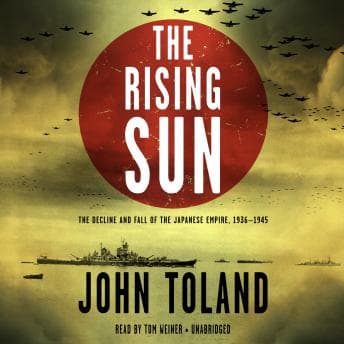
How often do Americans actually sit down and try to understand what the war looked like from the other side of the rifle? I don't mean the sanitized textbook version. I mean the real, ugly, contradictory human mess of it - the junior officers who knew the war was lost but kept fighting, the diplomats who tried to prevent it, the civilians who got ground up in the machinery of imperial ambition.
I spent the better part of two weeks with this one. Forty-one hours. That's not a book, that's a deployment. And I treated it like one - dedicated listening sessions at my desk after hours, some long stretches during a drive to a client site in San Antonio, and a few late nights in the study with Ranger snoring at my feet and a bourbon I barely touched because I was too locked in.
The Enemy Gets a Voice
Let me cut to the chase: Toland did something genuinely remarkable here, and he did it in 1970 when most Americans still had living memory of Pearl Harbor and Bataan. He interviewed hundreds of Japanese participants - military officers, diplomats, civilians, nurses - and built a narrative that treats the Japanese not as cartoon villains but as human beings making decisions within a system that was simultaneously brilliant and catastrophically flawed. The political maneuvering inside the Japanese government leading up to Pearl Harbor is fascinating and infuriating in equal measure. You've got factions within factions, generals undermining diplomats, junior officers essentially running foreign policy through assassination and intimidation. The February 26 Incident of 1936 sets the stage early, and Toland traces that thread of military insubordination all the way through to the kamikazes.
What hit me hardest was the story of Shizuko Miura during the Battle of Saipan - a young Japanese nurse caught in the absolute worst of it. That's not a story you get in most Western accounts of the Pacific War. Toland finds these individual threads and weaves them through the larger strategic narrative so you never lose sight of the fact that real people were dying in these operations. I've seen this scenario play out in real life - the gap between what headquarters thinks is happening and what's actually happening on the ground. Toland captures that gap on the Japanese side better than anyone I've read.
The author clearly did their homework. The diplomatic cables, the cabinet meetings, the way he reconstructs conversations between Tojo and his advisors - it all feels grounded in solid sourcing. This won the Pulitzer in '71 and it earned it.
Forty-One Hours at 1.25x - Can Your Brain Handle It?
Here's where I have to be straight with you about the audio format. Tom Weiner has a deep, authoritative voice that fits this material like a well-worn pair of boots. He respects the Japanese names and terms - not perfect pronunciation every time, but you can tell he put in the work. He's not going to do different voices for Yamamoto and Hirohito, though. This is straight narration, no dramatics. For a book like this, I think that's the right call. You don't want someone doing theatrical accents for historical figures in a Pulitzer-winning history.
But - and this is a real but - there are stretches where Weiner sounds like he's on autopilot. A few passages where the rhythm goes flat, like his attention drifted. In a 41-hour listen, that's going to happen, but it's noticeable. And the sheer density of Japanese names, places, and military units makes this a demanding listen. I had to rewind more than a few times when I lost track of which admiral was where. On paper you can flip back a page. In audio, you're hunting for a 30-second window in a 41-hour file.
I listened at 1.25x and that felt right - Weiner's natural pace is deliberate, and the bump keeps things moving without losing clarity on the Japanese terms.
Who This Is For (And Who Should Grab the Hardcover Instead)
If you're a serious WWII history reader who wants to understand the Pacific War from the Japanese perspective, this is essential. Period. The strategic analysis is sharp, the human stories are devastating, and Toland's refusal to moralize lets you draw your own conclusions about what happened and why.
But I'll be honest: if you're a casual listener who wants something for background while you're at the gym or doing yard work, this will punish you. You need to be locked in. The name density alone will lose you if you're not paying attention. If you're the type who likes to read along or take notes, the print version might serve you better.
For me? Worth your time? Here's the debrief: it's one of the best single-volume histories of the Pacific War ever written, and the audio version is solid if imperfect. Forty-one hours is a serious commitment, but I came out the other side with a fundamentally deeper understanding of an enemy my own service spent four years fighting. The closest thing I've read to that same feeling of hard-won perspective in memoir form is Piece of Cake: A Memoir — a different war, a different uniform, but that same bone-deep reckoning with what combat actually costs the people doing the fighting.
Ranger approved this one. Though he did fall asleep during the diplomatic chapters. Can't blame him - I almost lost a few lieutenants that way too.

![Steve Jobs [unabridged audiobook] audiobook cover](/_next/image?url=https%3A%2F%2Fcovers.audiobooks.com%2Fimages%2Fcovers%2Ffull%2F9788499923406.jpg&w=1920&q=75)