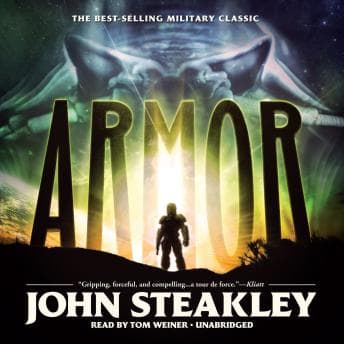

"Say you'll fight. Say you'll fight."
I don't remember the exact timestamp — somewhere around hour two, deep in the meat grinder on Banshee — but that line hit me like a nat-1 on a death save. I was supposed to be debugging a procedural terrain generator for my thesis. Instead I was white-knuckling my desk chair while Felix dropped into another impossible combat zone, watching his kill count climb while his humanity flatlined.
Armor wrecked me. And I need to talk about it.
The Engine Is the Scariest Thing I've Encountered Since Strahd
Here's what makes this book different from every other military SF novel you've read: Felix doesn't become a hero. He becomes a survival mechanism. Steakley introduces this concept called "the Engine" — a dissociative state Felix enters during combat where his conscious mind basically checks out and something else takes over. Something cold, efficient, and terrifyingly effective. It's not a magic system (though the magic system nerd in me wishes it was — imagine the Sanderson-level hard rules you could build around psychological combat states). Kvothe's system in Name of the Wind is the closest I've seen to that kind of rigorous internal logic applied to something deeply personal — though Steakley's doing the opposite, stripping the rules away entirely. It's a trauma response wearing power armor.
The Banshee sequences are relentless. Wave after wave of ant-like aliens, scout teams getting shredded, Felix surviving when nobody else does. Not because he's the best. Because the Engine won't let him die. There's this awful tension between Felix-the-person who is screaming inside and Felix-the-Engine who just keeps killing. It reminded me of those sessions in D&D where your character is doing something horrific and you're sitting at the table going "I don't want to do this but the dice say I have to." Except there are no dice. There's just war.
Jack Crow and the Structural Gamble That Almost Doesn't Pay Off
Okay, here's where I have to be honest. The book has a structural choice that nearly lost me. After those visceral, adrenaline-soaked Felix sections, Steakley pulls you out completely and drops you into Jack Crow's storyline — a charming rogue on a space station doing con-man stuff and getting tangled up in political intrigue. It's... fine? It's actually pretty good once you settle in. But the tonal whiplash is severe. You go from suffocating existential horror to what feels like a sci-fi heist movie, and your brain needs a minute to catch up.
I'll admit my attention drifted during parts of Jack's arc. Not because it's bad — it's actually doing critical narrative work, building toward a convergence that makes the ending devastating — but because my lizard brain kept wanting to go back to Banshee. Back to the Engine. (My D&D group would understand this. It's like when the DM cuts away from the dungeon crawl to do a political roleplay scene. Important? Yes. Do I want to roll initiative instead? Also yes.)
But here's the thing I realized around hour nine: the Jack sections aren't a detour. They're the lens. You can't understand what happened to Felix without seeing him through someone else's eyes first. That's the whole point. The structure IS the story.
Tom Weiner Put Me Inside That Armor
Tom Weiner's narration is the reason this audiobook works as well as it does. His voice has this deep, weathered quality that fits the material perfectly — when he's doing Felix's internal monologue during combat, there's a flat, dissociated quality that genuinely unsettles. And then he shifts to Jack Crow and suddenly there's warmth, humor, charisma. The contrast mirrors the book's structural gamble and actually makes it work better in audio than I think it would on the page.
He handles the multicultural cast without flinching — the varied accents for characters from different backgrounds (Chinese, Russian, Jamaican) sound natural rather than performative. Steven Pacey walked so other narrators could run, but Weiner is doing his own thing here and doing it well. His battle scenes are legitimately intense. You can feel the claustrophobia of the armor, the mechanical rhythm of the Engine taking over.
The Ending Will Haunt You (And That's the Point)
I finished this at 1 AM, sitting in the dark of my apartment surrounded by board game boxes and unread thesis drafts, and I just... sat there. The ending is devastating and deliberately, agonizingly incomplete. Steakley doesn't give you closure because Felix doesn't get closure. War doesn't do neat endings. There's a scene involving loss near the end that genuinely hurt to listen to — I won't spoil it, but if you've read reviews mentioning a dead puppy, yeah, that one's rough.
People compare this to Starship Troopers and The Forever War, and those comps are earned, but Armor is doing something neither of those books quite attempts. It's not about the politics of war or the alienation of coming home. It's about what happens to the person inside the armor — literally and psychologically — when survival becomes automatic and living becomes the hard part.
Who This Armor Fits
If you want nonstop action: the Felix sections will destroy you, but Jack's arc requires patience. If you can't handle uneven pacing and structural experiments, you might bounce off this. If you need tidy resolutions, look elsewhere.
But if you want military SF that's actually about something — about PTSD before we had good language for it, about the gap between the person and the soldier — this is essential. Yes, it's 13 and a half hours. Yes, it's worth it. I read this instead of writing my thesis, and for once I don't feel guilty about it.
The progression is satisfying — not in a LitRPG stat-block way, but in a "watching a human being slowly break and then seeing someone try to understand why" way. Which, honestly, hits harder.