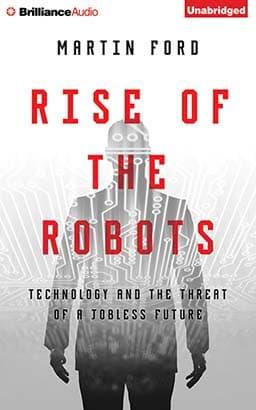

What happens when the automation you're building at work eventually automates... you?
I was debugging a particularly nasty race condition at 11 PM—you know, the kind where you start questioning every career choice that led you here—when this question hit me like a cold brew at 6 AM. I'd been listening to Martin Ford's Rise of the Robots during my commutes for the past week, and suddenly my job felt a lot less secure than my morning coffee habit.
The Book That Made Me Side-Eye My Own Codebase
Bottom Line: This is basically a comprehensive threat assessment for the entire knowledge economy, and Ford doesn't pull punches. He's not some outsider yelling about robots—dude's a Silicon Valley entrepreneur with 25+ years in computer design. When he says your job might be next, he's speaking from the inside.
The first six chapters are pure intellectual catnip for anyone in tech. Ford walks through how machine learning and automation aren't just coming for factory workers (that ship sailed decades ago)—they're gunning for paralegals doing document discovery, radiologists reading scans, even journalists writing earnings reports. The examples are specific and genuinely unsettling. He talks about algorithms that can grade essays, software that writes sports recaps, systems that handle legal research faster than any associate billing $400/hour. Data and Goliath digs into how these same systems are also quietly collecting everything about us in the process.
And here's the thing—the science actually holds up. Ford isn't making wild predictions; he's extrapolating from existing technology. That Watson winning Jeopardy example from the description? He uses it as a jumping-off point to explain how the same natural language processing is already doing work that used to require expensive professionals.
Where It Gets... Complicated
Around chapter seven, the book takes a turn. Ford moves from "here's what's happening" to "here's what we should do about it"—and suddenly you're in policy territory. Basic income discussions. Tax restructuring. The kind of stuff that makes half your coworkers' eyes light up and the other half reach for the skip button.
I'm not saying he's wrong. I'm saying if you're listening for pure tech analysis, the back half might feel like a different book. Some listeners apparently bounced hard here, calling it "political." Which—I mean, how do you discuss massive economic disruption without getting political? But fair warning: if you want neutral, this ain't it.
Personally? I found myself nodding along during my morning commute and then arguing with my phone during the evening one. That's probably a sign of a book doing its job.
Jeff Cummings Makes Data Sound Urgent
Here's where I have to give credit—Jeff Cummings is perfect for this material. He's got this steady, confident delivery that makes dense economic analysis feel accessible without dumbing it down. No dramatic flourishes, no weird emphasis on random words. Just clean, professional narration that lets the content breathe.
For a fact-heavy book like this, that's exactly what you want. I finished the whole thing in about 5 commutes (listening at 1.5x, obviously), and I never felt like the narrator was fighting the material. He matches Ford's tone—serious but not alarmist, urgent but not breathless.
Queue It For: Focused Commutes. Skip If: You Need Background Noise
This isn't a book you throw on while doing dishes. The arguments build on each other, and Ford references earlier examples constantly. You need to actually pay attention—ideal for a train commute where you can zone in, less ideal for the gym where you're counting reps. If you're in tech, finance, law, medicine, or basically any field where you've ever thought "AI can't do what I do"—this one's for you. (Spoiler: it probably can, or will soon.) Skip it if you're already deep in the automation/UBI discourse; you might find the second half covering familiar ground.
At 10+ hours, it's a commitment. But the ROI on this audiobook is high. The book won the Financial Times and McKinsey Business Book of the Year Award, which tells you the business world took it seriously. Published in 2015, some predictions have already come true. Others are still pending. None have been proven wrong yet.
Worth a Credit? Running the Cost-Benefit Analysis
If you're in any knowledge work field and haven't thought seriously about automation's impact on your career—yes, absolutely. This is the kind of book that might genuinely change how you think about your 5-year plan.
I finished my race condition debug at 2 AM that night. And then I spent another hour wondering if some ML system would be doing my job in ten years. Thanks, Martin Ford. Really needed that existential crisis with my debugging session.
But honestly? Better to think about it now than be surprised later. This book is a wake-up call disguised as an economics lecture, and Cummings delivers it with exactly the right amount of urgency.




![Steve Jobs [unabridged audiobook] audiobook cover](/_next/image?url=https%3A%2F%2Fcovers.audiobooks.com%2Fimages%2Fcovers%2Ffull%2F9788499923406.jpg&w=1920&q=75)