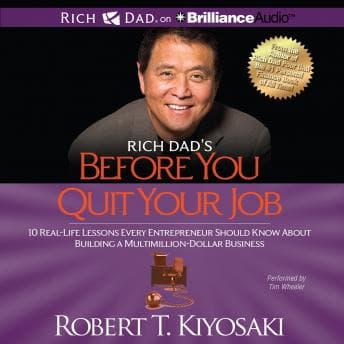

Look, I listened to this one while doing a 6 AM treadmill walk because I figured if I was going to revisit Kiyosaki, I needed to be moving. Standing still and listening to someone tell me I'm in the wrong quadrant of life felt too on the nose.
Bottom line: There's about 90 minutes of genuinely useful framework thinking buried in 8 hours of repetition and Rich Dad mythology. My 2.0x speed couldn't save this one.
The Core Idea (Which Is Actually Good)
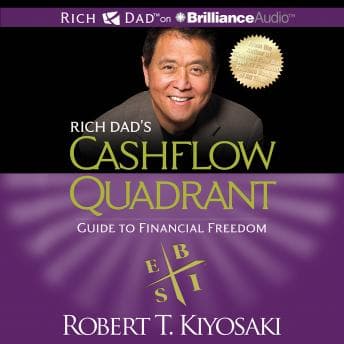
Here's the thing - the ESBI quadrant concept is legitimately useful. E for Employee, S for Self-Employed, B for Business Owner, I for Investor. Simple framework, easy to remember, and it does make you think about where your income comes from and where you want it to come from. My parents spent 30 years in the S quadrant - owning their own job at that dry cleaner, trading hours for dollars until their backs gave out. They never got to B or I. Kiyosaki would say they were doing it wrong. I'd say they were doing what they had to do to put two kids through college.
But here's where Kiyosaki gets it right: the mental shift between quadrants is real. I've watched startup founders who can't stop being the S - the brilliant solo operator who can't delegate, can't systematize, can't let go. They build jobs for themselves, not businesses. That insight alone? Worth the listen. The other 7 hours? Not so much.
Tim Wheeler Does the Heavy Lifting
Tim Wheeler's narration is honestly what kept me from bailing. His delivery is smooth, pacing is solid, and he manages to inject some urgency into material that could easily put you to sleep. When Kiyosaki gets into his "my rich dad said" stories for the fifteenth time, Wheeler's tone keeps it from feeling like a complete slog. The man earns his paycheck.
And Jenny would say I'm being harsh - Jenny is right - but there's only so much a narrator can do when the content loops back on itself. By chapter 6, I was pretty sure I'd heard the same point about "working for assets not money" at least four times. Wheeler delivers each repetition professionally. But still. Repetition.
Where It Falls Apart
The book promises to show you HOW to move between quadrants. It doesn't. Not really. You get philosophy, you get mindset, you get stories about Rich Dad's wisdom (a guy who may or may not have existed - let's not open that can of worms). Rich Dad Poor Dad had the same issue—big on inspiration, light on execution. What you don't get is a roadmap. No practical steps. No "here's how to actually build a system that runs without you." No real talk about the capital, skills, or connections you need.
I've seen this fail at three different companies. Founders who read books like this, get fired up about "passive income" and "making money work for you," then have zero idea how to execute. Mindset without execution is just daydreaming with extra steps.
And the last chunk of the book? Basically a commercial for Kiyosaki's board game and other products. I get it - the man has a business to run. But it felt cheap. Like sitting through a webinar that turns into a sales pitch.
The Ego Thing
Look, Kiyosaki has a bit of an ego. This isn't news to anyone who's read his stuff. But in audio form, when you're hearing Wheeler deliver lines about how Kiyosaki figured out what most people never will, it lands differently. Heavier. Some listeners won't mind - they're here for the guru energy. Others (hi, me) will find themselves rolling their eyes on the treadmill.
My parents never had a rich dad or a poor dad. They had each other, a steam press, and a lot of customers who needed their shirts by Tuesday. They didn't need a quadrant framework to know they were working hard. They needed capital they didn't have and time they couldn't spare. "Passive income" is fiction my parents never got to read.
Who Should Listen (And Who Should Skip)
If you're 22, just starting to think about money beyond your paycheck, and you've never been exposed to the idea that there are different ways to earn income? This could genuinely shift your thinking. The framework is solid. The mindset stuff isn't wrong, just overextended.
If you've read any serious business or investing books in the last decade? Skip to chapter 5, grab the quadrant concept, and move on. You don't need 8 hours of this.
Commuters, this works fine as background listening. Workout folks, same deal - Wheeler's pacing keeps things moving. Kiyosaki's Real Book of Real Estate at least brings in multiple voices and perspectives, even if it still leans heavy on the motivational side. But if you're looking for something to really focus on, something with depth and actionable content? Read The E-Myth Revisited instead. Or Built to Sell. Books that actually show you how to build the B.
Bottom Line
This is what my parents did instinctively - understanding the trap of trading time for money. Now it has a TED talk. And a board game. And about six sequels.
The core idea earns its place in the personal finance canon. The execution? Padded, repetitive, and ultimately more inspirational than instructional. Tim Wheeler's solid narration keeps it listenable, but even at 2.0x, I felt every one of those 8 hours.
Sample the first few chapters. If the quadrant concept clicks for you, great - you got what you needed. If you're waiting for the practical stuff to kick in, I'll save you the time: it doesn't.