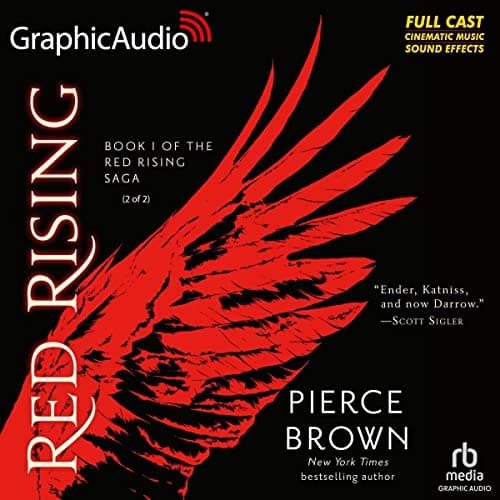
I was on a long solo drive through west Texas — flat highway, nothing but scrubland and radio static — when this second half kicked in, and I'm not exaggerating when I say I missed my exit because I couldn't pull myself away from a siege scene. That's the kind of hold this dramatized adaptation has on you when it's firing on all cylinders.
Red Rising Part 2 picks up Darrow's brutal journey through the Institute, where Gold teenagers tear each other apart for power and prestige while our secretly Red protagonist tries to survive long enough to burn the whole system down. Pierce Brown's story is visceral and propulsive, and this GraphicAudio treatment — full cast, cinematic score, layered sound design — turns what's already a kinetic novel into something closer to a movie playing between your ears.
Let's talk about what works first, because a lot works. Alejandro Ruiz carries Darrow with a raw emotional weight that hits hardest during the grief-soaked moments. There's a particular stretch dealing with the aftermath of Eo's death where his voice cracks in a way that doesn't feel performed — it feels lived in. Richard Rohan brings genuine authority to his role, the kind of deep-chest gravitas that makes you straighten up in your seat. Kay Eluvian and Jenna Sharpe both deliver layered performances that give their characters real interior lives beyond what the dialogue alone provides. And Stewart Crank is excellent in the alliance and betrayal sequences, threading tension through conversations that could easily feel expository.
The production itself is ambitious. Battle sequences land with percussive force — clashing weapons, distant screams, the rumble of collapsing structures. When the score swells during key emotional beats, it earns those moments rather than cheapening them. There were points on that Texas highway where I genuinely forgot I was listening to an audiobook and not a film soundtrack with dialogue.
But this adaptation isn't without friction, and I want to be honest about that. The most persistent issue is age mismatch. These are supposed to be teenagers — brutal, brilliant, terrified teenagers — and several voice actors sound comfortably in their thirties or forties. It doesn't ruin the experience, but it does sand down some of the desperate, reckless energy that makes these characters feel dangerous in Brown's prose. You lose a bit of the "kids with too much power" horror when everyone sounds like they've already survived a couple of divorces.
There's also the split problem. Dividing the novel into two parts means Part 2 has to do some narrative throat-clearing in its opening stretch, and the final hour loses momentum as it rushes toward resolution. It's not a pacing disaster, but you can feel the seams where the story was cut. If you're coming straight from Part 1, you'll adjust quickly. If there's been a gap, you might spend the first twenty minutes recalibrating.
Some listeners will struggle with the dramatized format itself. Rapid dialogue shifts between characters can be disorienting, especially if you're used to Tim Gerard Reynolds' celebrated single-narrator version. Reynolds gives you one consistent voice filtering everything through Darrow's perspective. This production gives you a crowd of voices, sound effects, and music competing for your attention. It's richer but also more demanding. You need to be actively listening — this is not a background-while-doing-dishes audiobook.
A few specific voice choices didn't land for me. Without naming every cast member, there's at least one antagonist whose vocal performance felt more cartoonish than threatening, which undercut what should have been a menacing presence. The sound mixing, while strong, occasionally buries dialogue under music during climactic moments — a frustrating choice when you're straining to catch a critical line.
Still, when I weigh everything, Part 2 delivers where it matters most: the emotional core. Darrow's internal war — between who he was, who he's pretending to be, and who he's becoming — comes through with genuine power. The alliance fractures and betrayals hit harder with multiple actors selling their side of the conflict. And the worldbuilding, already impressive on the page, gains physical dimension through the soundscape.
Who Should Listen (And Who Should Skip)
If you loved Part 1 and you're the type who cranks up a cinematic RPG soundtrack while reading sci-fi — basically, if your D&D sessions have a curated Spotify playlist — this is absolutely your format. Skip it if you prefer your narration clean and uncluttered, or if you've already bonded with Tim Gerard Reynolds' solo version and don't want that headcanon disrupted.
This is an audiobook that rewards your full attention and punishes distraction. It's cinematic in the best sense — immersive, emotionally anchored, occasionally overwhelming. It's not the definitive version of Red Rising (that debate between dramatized and single-narrator will rage forever), but it's a legitimate and frequently thrilling way to experience Brown's story. I had a comparable reaction to Firestarter — a production that also bets heavily on atmosphere and momentum, and largely wins that bet. I'd pick it up again for the grief scenes and battle sequences alone. Just don't listen while trying to navigate an unfamiliar highway.










![Red Rising (1 of 2) [Dramatized Adaptation]: Red Rising 1 audiobook cover](/_next/image?url=https%3A%2F%2Fcovers.audiobooks.com%2Fimages%2Fcovers%2Ffull%2F9781685088781.jpg&w=1920&q=75)