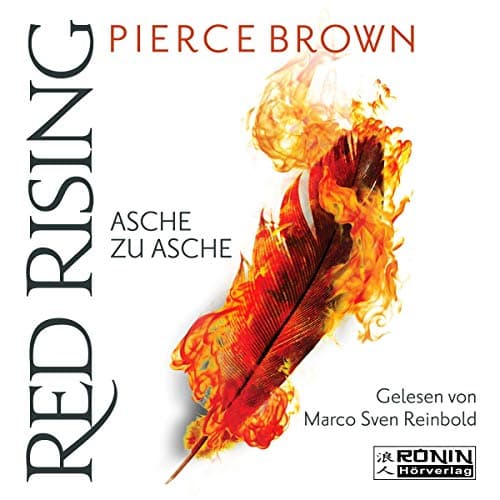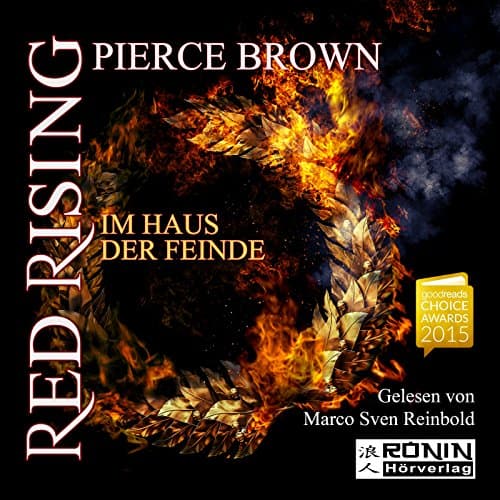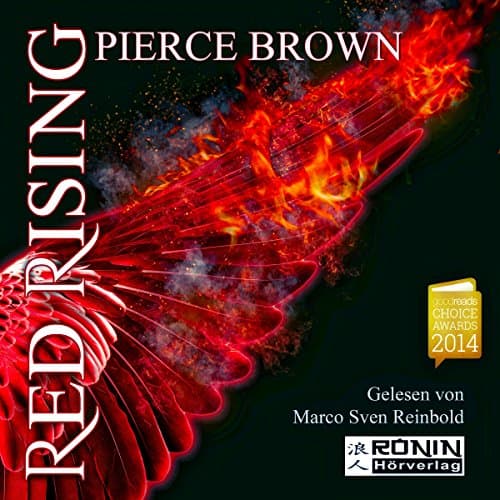

What happens when the lie holding your entire world together cracks open in the first hour of a seventeen-hour audiobook — and you're already on the highway with no intention of stopping?
That's roughly where I found myself with the German edition of Red Rising. Ten minutes into my commute, Darrow is underground, mining helium-3 beneath Mars, believing every swing of his drill is bringing humanity closer to a habitable surface. By the time I pulled into the parking lot, that belief had already detonated. The surface is green, the cities are built, and the Reds — Darrow's people — are disposable labor in a caste system so rigid it's literally color-coded into your DNA. I sat in the car for another twenty minutes. That's the kind of opening this is.
Pierce Brown's setup works because it doesn't rush. The mining colony, Darrow's marriage to Eo, the folk songs of the Reds, the claustrophobic tunnels — Brown takes his time building a world you can feel pressing in on you before he rips it apart. Some listeners will find this first act slow. I'd push back on that. By the time the inciting tragedy lands, it hits like a hammer specifically because you've spent time in those tunnels, understanding what these people believe and what they've sacrificed. Skip that groundwork and you lose the engine that drives everything after.
Once Darrow is physically transformed and infiltrated into the Gold elite's Institute, the book shifts into something between a Roman military campaign and a brutal academy survival game. Territory warfare, shifting alliances, betrayals that cost lives — Brown handles tactical logistics with impressive clarity. You always know the map, who controls what castle, which alliance is about to fracture. It's the kind of fiction that turns you into a backseat strategist, mentally running scenarios alongside the protagonist. Think of it like a campaign where the DM keeps changing the win condition mid-session and half your party is secretly working for the BBEG. Dance of Cloaks occupies some of that same territory — layered political maneuvering where every alliance is a trap waiting to spring — though it never quite reaches the kinetic brutality Brown sustains here. If you've ever binged The Name of the Wind for its academy politics or burned through Steelheart for its power-structure chess, this scratches a similar itch but with more blood on the floor.
Now, the narrator question. Marco Sven Reinbold carries this German edition with a voice that fits Darrow's controlled fury well. Where I noticed him most was during the moments of performance within performance — Darrow is constantly hiding his Red identity among Golds, and Reinbold captures that tension between the mask and the man underneath. During battlefield briefings and tactical arguments, his delivery has a measured urgency that keeps strategy sequences from feeling abstract. You can hear Darrow calculating. The emotional beats — grief over Eo, the complicated respect Darrow develops for certain Golds — stay restrained rather than melodramatic, which is the right register for a character who can't afford to break.
What I can't fully evaluate is whether the Gold-vs-Red class distinction comes through in vocal differentiation as distinctly as it might. In a single-narrator German production, the social layers of Brown's color system rely heavily on tone and cadence rather than accent shifts. Reinbold manages the large cast well enough that I rarely lost track of speakers, which with this many characters scheming at once is no small thing. His work in Im Haus der Feinde shows the same skill — a dense ensemble cast held together by consistent vocal discipline rather than theatrical showboating. But the voices don't pop the way they might in a full-cast production. For this edition, you're riding on Reinbold's intensity and consistency rather than theatrical range.
A few honest caveats. The violence is graphic — this is a book where teenagers kill each other for political advancement, and Brown doesn't soften it. The color-coded caste exposition hits dense in audio format, especially early on when you're absorbing terminology without visual reference. And the ending is a cliffhanger that functions less as a conclusion and more as a launchpad for the series. If you want a standalone experience with a clean resolution, look elsewhere.
But here's what Red Rising does better than most of its peers: it earns its anger. Darrow isn't rebelling because the plot needs a hero. He's rebelling because he watched his world revealed as a lie, lost the person who mattered most, and decided to burn it down from the inside. That motivation never feels cheap. Brown wrote a political allegory that doubles as a visceral survival story, and the German audiobook production preserves both dimensions at full intensity.
Who Should Listen (And Who Should Skip)
If you love sci-fi with deep worldbuilding, ruthless power politics, and protagonists who earn every inch of their rebellion — this one's for you. Fans of academy survival arcs and military strategy will feel right at home. Skip it if you need a self-contained story (this is very much a book one), if graphic violence among young characters is a dealbreaker, or if dense caste-system terminology in audio format sounds more exhausting than exciting.
I listened to most of this across a week of drives and two late-night sessions where "one more chapter" turned into three. At 16 hours 45 minutes, it's substantial — but the pacing after the Institute begins rarely lets you drift. This is an audiobook built for highway driving, gym sessions, and any context where your hands are busy but your mind wants to be somewhere else entirely. Just don't start it at bedtime expecting to sleep.