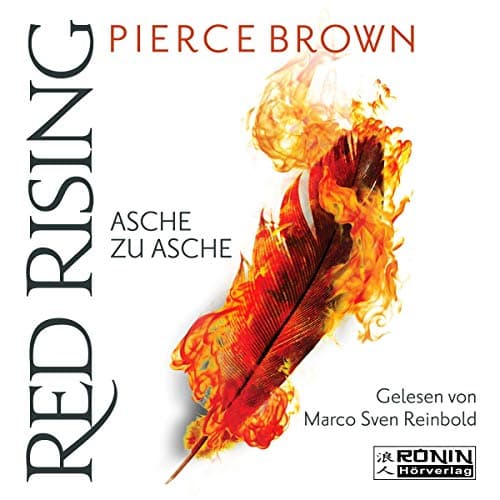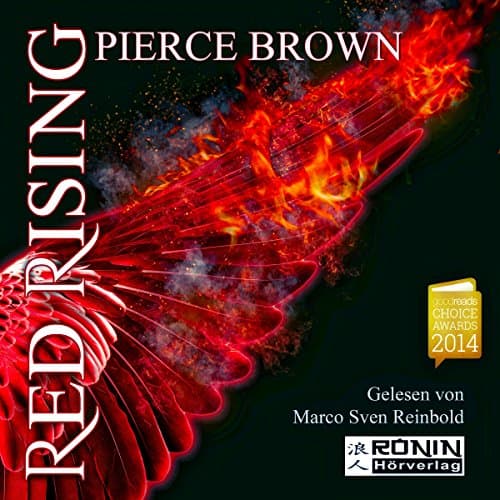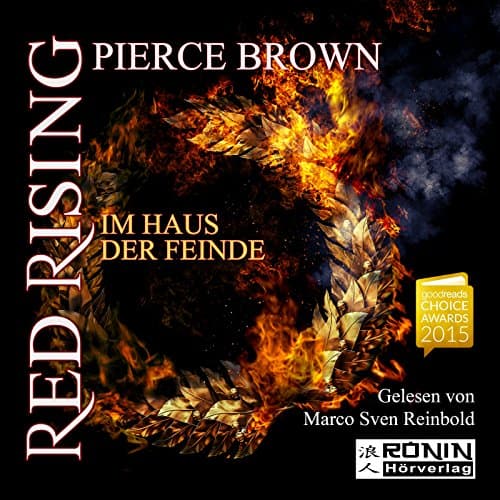

"Immer war Darrow stolz darauf" — Darrow was always proud. That line, delivered in the opening minutes with a quiet conviction that borders on naïveté, sets up everything that follows. Because pride is the engine of this entire book, and Marco Sven Reinbold voices it like a man who knows exactly how much damage pride can do.
Im Haus der Feinde is the German audiobook edition of Golden Son, the second installment in Pierce Brown's Red Rising saga. If you listened to the first book, you know the premise: Darrow, a Red miner from the guts of Mars, has been surgically rebuilt into a Gold — the ruling caste of a rigid color-coded hierarchy. He's living among the people who enslaved his entire race, pretending to be one of them while plotting their downfall from inside. The first book was a survival game. This one is a revolution.
My Red Rising review covers that first survival-game phase in detail if you want to know what you'd be committing to before jumping into this one.What surprised me as I kept listening is how much the structure shifts. The contained arena of Red Rising gives way to Senate chambers, fleet command bridges, and ballrooms where a wrong glance gets you killed as surely as a razor through the ribs. Brown juggles interplanetary politics, military campaigns, and Darrow's increasingly tangled personal loyalties without ever losing the thread. The pacing is aggressive — I started this on a weekday commute and ended up sitting in a parked car for an extra twenty minutes twice because the momentum wouldn't let me press pause.
Reinbold's narration is the reason this works as an audiobook rather than just an adequate reading of a good novel. What I noticed specifically: he handles the tonal whiplash between Gold aristocratic scenes and Darrow's internal Red-born guilt with distinct vocal registers. When Darrow is performing his Gold persona in front of the Sovereign's court, Reinbold's voice takes on a clipped, formal authority. When Darrow is alone — replaying memories of Eo, questioning whether he's becoming the thing he's supposed to destroy — Reinbold drops into something rawer and more halting. That contrast does the heavy lifting in scenes where Brown's prose leans hard on Darrow's dual identity. The battle-command sequences are another standout: Reinbold ratchets up the pace and clips his phrasing during fleet engagements, giving those sections a kinetic urgency that a print reading can't replicate.
The world-building here is dense and strange and genuinely its own thing — the kind of lore-heavy setting that'd make a great campaign sourcebook, honestly. Brown pulls from Roman history, Greek myth, and dystopian sci-fi, but the color-coded caste system — Golds, Silvers, Obsidians, Blues, Reds — operates by its own internal logic. In this second book, you see the gears of that machine: how Golds maintain power through ritual violence and spectacle, how the lower colors are kept compliant through mythology and resource control. Reinbold's measured delivery in the political scenes keeps these passages clear rather than bogging them down. I never had to rewind to figure out who was allied with whom, which matters when you're dealing with this many factions.
Here's where I have to be straight with you about the source material's weaknesses. Darrow can be a self-serious protagonist. He monologues about destiny and sacrifice in a register that occasionally tips into melodrama, and some of the plot reversals hinge on dramatic coincidence that asks a lot of your suspension of disbelief. The Goodreads rating of 3.91 tells the story: most people love it, but there's a contingent that finds Brown's maximalist approach exhausting. If constant betrayals, reversals, and "everything you believed was a lie" moments wear you out, twenty hours of this will test your patience. The content is also not gentle — significant violence, some sexual content, and rough language throughout.
But when the book works, it works at a level that few space operas reach. The final act had me standing motionless in my kitchen, completely wrecked by an ending that retroactively recolors everything you've experienced in the preceding nineteen hours. Morning Star carries that devastation forward and somehow raises the stakes even higher — I went straight to it after the last second of this one faded out. Reinbold delivers the climax with a mix of devastation and barely-contained fury that makes the moment land like a physical impact.
Buy this if you want space opera that escalates relentlessly and you don't mind a hero who takes himself seriously or an audiobook that demands your full attention. Skip it if you haven't listened to book one, if you want something calming for bedtime, or if constant betrayals and dramatic reversals make your eyes roll. At twenty hours, this is a commitment — but it earns its runtime.
For German-language listeners who want ambitious sci-fi with genuine emotional stakes and a narrator who elevates the material rather than just reading it: this is the real thing.