
Look, I'm a software engineer. I don't know anything about real estate beyond the fact that my SF rent is obscene and I'll probably never own property in the Bay Area. So why did I spend 8 hours listening to interviews with real estate billionaires?
Honestly? Morbid curiosity. And the fact that my Caltrain commute doesn't care what genre I'm consuming.
The ROI Calculation
Here's the thing about business books: most of them could've been blog posts. Who Moved My Cheese is the poster child for this—cute parable, could've been a pamphlet. You know the type—one decent idea stretched across 300 pages with increasingly desperate examples. I went in expecting Real Estate Titans to be exactly that.
It's... not. And I'm genuinely surprised.
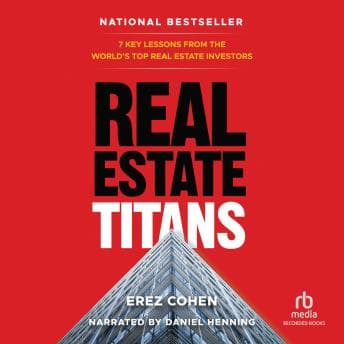
Erez Cohen basically did what I wish more business authors would do: he interviewed a bunch of people way more successful than him (Sam Zell, Stephen Ross, Barry Sternlicht—names that mean nothing to me but apparently are legends in the real estate world), extracted the actually useful stuff, and organized it into seven lessons. The structure is clean. The stories are specific. There's minimal fluff.
The lessons themselves aren't revolutionary if you've consumed any amount of business content—work harder than everyone, build relationships, understand cycles, take calculated risks. But the specificity of HOW these particular titans applied these principles? That's where the value is. When Sam Zell talks about contrarian investing, he's not speaking in abstractions. He's talking about buying distressed assets in the 90s while everyone else was running scared.
Daniel Henning Does the Heavy Lifting
Okay, so the content is solid. But this is an audiobook review, so let's talk about the listening experience.
Daniel Henning has that clear, professional business audiobook voice. Not Ray Porter (obviously), but competent. He doesn't try to do character voices for the different titans being quoted, which—honestly—is the right call. Can you imagine someone doing a bad Sam Zell impression? Yikes.
The pacing is good. Not too slow, not rushed. I listened at 1.5x and it held up fine. The glossary section at the end (yes, there's a glossary, which is actually super helpful for someone like me who doesn't know a cap rate from a capitulation) is handled well.
My one complaint: some sections get dense. Like, really dense. There were moments during my 6AM commute where I had to rewind because I'd zoned out during a particularly technical explanation of real estate cycles. That's not entirely the narrator's fault—the material is just inherently dry in places—but it's worth noting.
Who's This Actually For?
Let me be real: if you're a casual listener looking for entertainment, this isn't it. This is educational content. It's the audiobook equivalent of a really good lecture series.
But if you're:
- Actually interested in real estate investing
- A business student (Cohen's Wharton background shows)
- Someone who likes understanding how successful people think
- A commuter who wants to feel productive during dead time
...then yeah, this is worth your time.
I'm not about to go buy a commercial property or anything. But I did find myself applying some of the mental frameworks to my own career. The stuff about relationship-building and playing long-term games? That's universal. The contrarian thinking? Useful for anyone making investment decisions, even if your "investment" is just index funds. Though if you want actual tactical advice on automating those index fund investments, Automatic Millionaire is more actionable for regular people.
The book also made me realize how much real estate success is about timing and cycles—which, as someone who works in tech, felt oddly familiar. We have our own boom-bust cycles. The titans who survive are the ones who don't panic during the busts.
Ship It or Shelve It?
Bottom Line: Worth your commute if you're in learning mode. Skip if you want entertainment.
This isn't a page-turner. It's not going to make you gasp or cry or stay up past your bedtime. But it's a well-structured, information-dense business book that actually delivers on its promise. Seven lessons, real examples, minimal padding.
I finished it in about 4 commutes at 1.5x speed. Would I listen again? Probably not—but I might revisit specific chapters when I'm eventually ready to think about property investment (in like, 2045, at the rate SF housing is going).
For what it is, it's good. Just know what you're getting into.