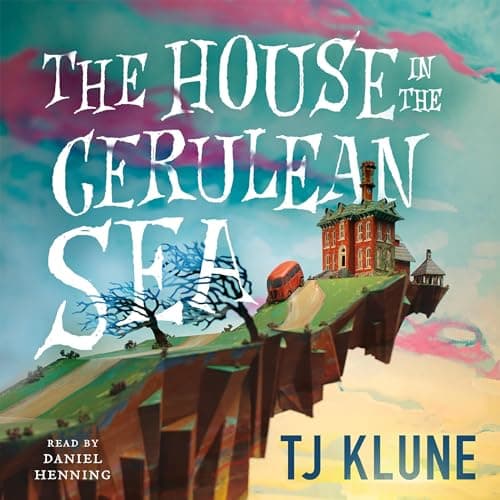

Okay, I need to talk about the fact that this book has a government bureaucrat who files reports about magical children, and the bureaucracy is SO on point that I got genuinely angry. Not at the book - at the system it was describing. Because I've filled out those forms. Different forms, sure - mine are about patient acuity levels and staffing ratios, not whether a child who can move objects with his mind is a threat to humanity - but the soul-crushing, dehumanizing paperwork that reduces people to checkboxes? That's real. TJ Klune gets that in his bones, and I was sitting in my car in the hospital parking lot at 7:15 AM, engine still running, post-shift exhaustion forgotten, because Linus Baker was having a crisis of conscience over a form and I was RIGHT THERE WITH HIM.
I did not expect this book to hit me where it did.
The Part Where a Nurse Cries Over a Fantasy Novel About Gnomes
So here's the setup: Linus Baker is basically the CPS of a world where magical beings exist, and he's sent to evaluate an orphanage on a remote island run by Arthur Parnassus. The children include a gnome who tends a garden, a wyvern who hoards buttons, and - oh, right - the literal Antichrist. Lucy. A six-year-old who listens to records and throws tantrums that involve the earth trembling. Daniel Henning voices Lucy with this mix of theatrical menace and little-kid petulance that is genuinely hilarious. Like, this child is summoning darkness while also being upset about bedtime. Henning pitches the voice just right - not cartoonish, not creepy, just... a kid who happens to be the spawn of Satan and doesn't see why that should be a big deal.
Carlos asked why I was crying in the car. I blamed allergies. But honestly it was the scene where Linus realizes these children have been written off by the entire world, reduced to case files and threat assessments, and he's the first government official who actually LOOKS at them. As someone who's actually worked a code on a patient whose chart everyone had already given up on - that moment of choosing to see the person instead of the paperwork? That wrecked me.
Henning's Voices Are a Whole Production
Let me break down what Daniel Henning does here because it's ambitious. Each of the six children gets a completely distinct voice. Talia the gnome is gruff and matter-of-fact. Chauncey - a blob-like creature who dreams of being a bellhop - gets this earnest, slightly wet quality that I cannot explain but is perfect. Sal, who's a were-Pomeranian (yes, really), is quiet and withdrawn, and Henning pulls his voice tight and small for those moments.
And then there's the dynamic between Linus and Arthur. Henning gives Linus this sort of fussy, anxious energy - someone compared it to Ryan Reynolds, and I can see that, though it's more like Ryan Reynolds if he worked in a government cubicle and ironed his socks. Arthur gets something warmer, steadier, with a deliberate calm that occasionally cracks. The love story between them builds slowly, and Henning lets the shift happen in Linus's voice - from stiff and formal to something softer. You can hear the man unclench.
Now. Some people find Henning's style over the top. I've seen complaints that the narration sounds artificial, even AI-like, and I understand the criticism even though I disagree. He's doing a LOT with vocal variety, and if that style doesn't click for you in the first hour, it probably won't click by hour twelve. Give it through chapter three before you decide.
This Is Not How Hospitals Work, But It IS How Institutions Work
The social commentary here is not subtle. It's about fear of the Other, about how institutions dehumanize the people they're supposed to protect, about chosen family versus the systems that try to break families apart. It's wearing its heart on its sleeve and it knows it. Some readers find this heavy-handed. I found it honest. Amy Schumer gets at something similarly unguarded in Girl with the Lower Back Tattoo — that willingness to just say the true thing out loud and let people decide if it's too much.
Because here's what I know from fifteen years of night shifts: institutions DO reduce people to categories. I've watched patients get treated differently based on what box got checked on intake. The Department in Charge of Magical Youth in this book is a fantasy version of every system I've ever seen fail the people inside it. Klune isn't being preachy - he's being accurate.
The pacing is gentle. This is a slow burn in every sense. If you need action set pieces or plot twists every chapter, this is going to frustrate you. The tension comes from emotional stakes - will Linus recommend closing the orphanage? Will the children lose their home? Will two middle-aged men admit they have feelings? It's quiet tension, but it's real.
Who Should Listen (And Who Should Skip)
Pick this up if you want something that's going to make you feel fiercely protective of fictional children and then realize you're actually feeling things about real-world injustice. Perfect for that post-shift decompression when you need something that believes in goodness without being naive about how hard goodness is.
Skip it if you need your fantasy with sharp edges and moral ambiguity. This book knows who the good guys are. It's not interested in grimdark complexity. It's interested in a gnome who loves her garden and a bureaucrat who learns to love something bigger than his filing system.
Night Shift Rx: Take With a Full Heart
Night shift approved. Twelve hours is the right length for a week of commutes, and by the end you'll be pulling into your driveway and sitting in the car because you need to hear how the last scene plays out. My mom would love this - she still thinks I should've been a doctor, but she's a sucker for a story about someone whose job is to take care of people, and Linus Baker's job is exactly that. He just needed to remember it.