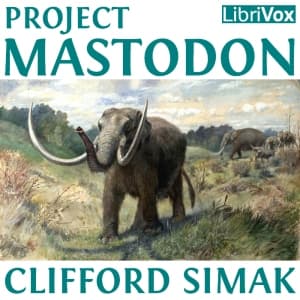

So I was up at 2 AM, supposedly debugging a procedural terrain generator for my thesis, when I realized I'd been staring at the same function for forty-five minutes and absorbing exactly none of it. My brain needed a palate cleanser. Something short. Something weird. Something that wasn't Brandon Sanderson for once. (I know, I know.) I spotted Project Mastodon by Clifford Simak sitting in my LibriVox queue — 1 hour 12 minutes, published in 1955, about dudes who build a time machine on a shoestring budget and go hang out with mastodons. Sold.
And you know what? This scratched an itch I didn't know I had.
A Time Machine Built Like a D&D Side Quest
Here's the pitch: a handful of guys figure out time travel. Not a government lab, not Tony Stark in a cave — just regular dudes with more ambition than funding. They go back 150,000 years to a North America full of mastodons and saber-toothed tigers, and then they try to figure out what to actually do with it. Including the very real problem of running out of money.
Simak wrote this in 1955, and honestly, the premise feels like something my old D&D group back in Dawson County would've cooked up after too much Mountain Dew. "Okay, so we have time travel, but we're broke. Do we try to claim the past as sovereign territory? Do we pitch it to the government? Do we just... live there?" The story plays with all of those questions, and it does it with this dry, almost folksy humor that's so distinctly Simak. He's not trying to blow your mind with hard sci-fi explanations. The time travel mechanism barely matters. What matters is: what would bureaucracy do if you showed up and said "I own 150,000 years ago"?
It's a premise story more than a plot story, and I think that's where some people bounce off it. If you need escalating tension and a big climax, this isn't that. It reads more like a really good thought experiment wrapped in mid-century charm. The characters are more archetypes than people — the dreamer, the practical guy, the skeptic — but for a story this short, it works. Simak's interested in the idea, and the idea is fun enough to carry you.
For context, this was essentially a novella that later inspired Simak's full novel Mastodonia, which expanded on a lot of these concepts. So think of it as the seed. The proof of concept. The session zero before the campaign starts.
Phil Chenevert Sounds Like Your Neighbor Telling You About Time Travel
Phil Chenevert is a LibriVox volunteer narrator, and look — you're not getting Steven Pacey here. (Steven Pacey walked so other narrators could run, but that's a high bar for anyone, let alone a volunteer recording in what I assume is a home setup.) What you ARE getting is a guy with a genuinely pleasant, warm voice that someone on the internet accurately compared to David Lynch, which is a wild comp but kind of tracks? There's this slightly drawling, unhurried quality to it.
He reads it straight and clean. No dramatic character voices, no theatrical shifts. For a story with this kind of wry, conversational tone, that actually works. Simak's humor is subtle — it lives in the absurdity of the situation rather than in snappy dialogue — and Chenevert doesn't try to oversell it. He trusts the writing.
The production is basic LibriVox: no music, no sound effects, no post-processing magic. Just a man, a microphone, and Clifford Simak's words. For 72 minutes of free audio, I'm not complaining.
Who Should Queue This Up (And Who Shouldn't)
If you like classic sci-fi that's more interested in playing with ideas than building elaborate universes — think Asimov's short fiction, Bradbury's quieter stuff — you'll dig this. If you want hard magic systems and 40-hour epics... this is not that. (Yes, 40 hours is worth it. But sometimes 72 minutes is too.)
My D&D group would love this as inspiration for a one-shot. Time travel campaign where the real enemy is the U.S. government's refusal to recognize your claim on the Pleistocene? That's a session right there. My group ran something vaguely adjacent to this energy when we used Dragon Orb as campaign fuel — that same "bunch of underpowered guys improvising their way through a big problem" DNA is all over it.
Perfect for: falling asleep without committing to a massive series, filling dead time between bigger listens, or procrastinating on your thesis at 2 AM when you need something that won't keep you up all night. It kept me up anyway, but only because I started thinking about procedural generation of prehistoric landscapes, which — hey, maybe that's actually thesis-relevant. (It's not. Dr. Patel would not agree.)
I Read This Instead of Writing My Thesis, and I'd Do It Again
It's free. It's short. It's a clever little 1955 time-travel story by one of sci-fi's underappreciated greats, read by a guy with a voice like warm flannel. You're not going to rearrange your top ten list for it, but you might spend a pleasant hour smiling at the absurdity of trying to homestead the Pleistocene. And sometimes that's exactly what you need.