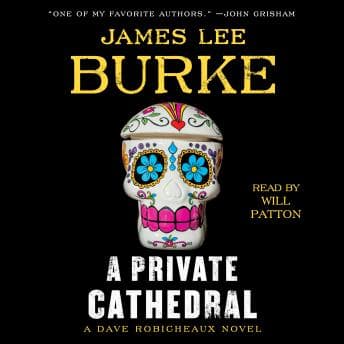

I was up past midnight last Saturday — Denise already asleep, the apartment quiet except for the radiator doing its thing — and I had maybe forty papers left to grade on The Great Gatsby. I needed something to keep me awake that wasn't another student explaining how the green light represents money. (It does, but come on, give me more.) So I put on A Private Cathedral, the latest Dave Robicheaux novel, figuring Burke's Louisiana noir would be the literary equivalent of strong coffee.
I was not prepared for a time-traveling assassin on a ghost ship.
When Faulkner Meets Stephen King on a Bayou Road
Let me be honest about something: James Lee Burke has always been a writer who happens to write crime fiction. The man is a two-time Edgar winner and Pulitzer nominee, and when you listen to his prose, you understand why. His sentences have the kind of weight and rhythm that most literary fiction authors would trade their MFA for. This reminds me of what Hemingway said about writing — that the dignity of movement of an iceberg is due to only one-eighth of it being above water. Burke writes like that. You feel the eight-eighths.
But here's the thing about A Private Cathedral: Burke takes his fortieth novel and decides to blow the doors off genre entirely. You've got the Shondell and Balangie families — old Louisiana crime dynasties locked in a feud that's basically the Montagues and Capulets if both families ran meth and protection rackets out of New Iberia. Their teenage kids, Johnny and Isolde, are rock musicians with voices described as almost supernatural, and they've fallen in love and bolted after Isolde was given as a sex slave to Johnny's uncle. That sentence alone should tell you Burke isn't interested in playing it safe.
And then he introduces a hitman who induces hallucinations and arrives on a ship that materializes out of nowhere. If you loved the Southern Gothic tradition — O'Connor, Faulkner, McCarthy — this is its spiritual successor, except it's also a horror novel and maybe a love story and possibly science fiction. Burke is eighty-four years old and writing like a man who has decided he doesn't owe anyone a conventional anything. That same refusal to play it safe reminded me of Troubles in Paradise, which also leans into genre chaos in ways that shouldn't work but somehow do.
My students would hate this. I love it.
Will Patton Knows Where the Ghosts Live
Let's talk about what makes this audiobook worth your time even when the plot gets wobbly — and it does get wobbly, but I'll come back to that. Will Patton has been narrating Robicheaux novels long enough that he doesn't perform the character so much as inhabit him. His Southern drawl carries genuine Louisiana inflections, not the Hollywood version of "Southern" where everyone sounds like they're selling sweet tea. When he shifts into Clete Purcel — Robicheaux's partner, his chaos agent, his moral compass that always points slightly south of legal — Patton drops into this gruff growl that's part bouncer, part wounded dog. You never confuse the two men. Not once.
The narrator understands that pause is punctuation. Burke writes these long philosophical monologues where Robicheaux wrestles with alcoholism, Vietnam, the women he's loved and lost, and Patton gives them room to breathe. He doesn't rush past the pain to get to the next gunfight. There's a delivery he brings to the profanity — the way he bites into the words — that makes even throwaway dialogue feel lived-in. One listener called his performance "stellar," and that's underselling it. This is a narrator who's been living inside Dave Robicheaux's head for years and has the emotional scar tissue to prove it.
The prose deserves to be savored. I listened at 1.0x. Obviously.
The Ghost Ship That Almost Runs Aground
Here's where I have to be straight with you. The supernatural elements — the time-traveling assassin, the ghost ship, the hallucinations — are going to divide people. Hard. For me, they work as metaphor. Burke has always written about evil as something almost metaphysical, and making that literal feels like an honest escalation after twenty-plus Robicheaux novels. The man's been circling this territory for decades.
But the last third of the book loses its footing. The philosophical monologues, which are gorgeous in small doses, start to pile up. There are passages where Robicheaux is reflecting on the nature of evil and love and redemption and you're thinking, Dave, I'm with you, but we have a plot to finish. Some listeners called the ending "off track," and I get it. Burke is swinging for something enormous — mixing crime, mythology, horror, romance — and not every swing connects. When you try to write a book that contains everything, sometimes the seams show.
That said? The ambition alone is worth respecting. This is a man on his fortieth novel choosing to be weird and wild instead of safe. I'll take a messy masterwork over a competent retread every single time.
Who Gets a Ticket to This Cathedral
If you've been following Robicheaux through the series, you already know Patton's voice is home. Come on in. If you're new to Burke, I'd actually point you toward The Neon Rain or In the Electric Mist first — this one assumes you know these people and their ghosts. If you need your crime fiction clean and procedural, this will frustrate you. Burke writes literary fiction disguised as genre, and this particular entry has more literary ambition than most novels shelved in the "L" section at Barnes & Noble.
If you love Southern Gothic, if you've ever argued about Flannery O'Connor at a dinner party, if you want crime fiction that actually cares about the human soul — this is your book. The supernatural stuff might lose you. The ending might lose you. But Burke's prose and Patton's voice will carry you further than you expect.
Worth Pausing the Faculty Meeting For
I finished this at 2 AM, papers ungraded, radiator still clanking. Denise found me asleep at the kitchen table with my earbuds in. She asked if it was good. I said it was frustrating and beautiful and too long and I couldn't stop listening. She said that's how she feels about my Faulkner episodes.
Fair enough.