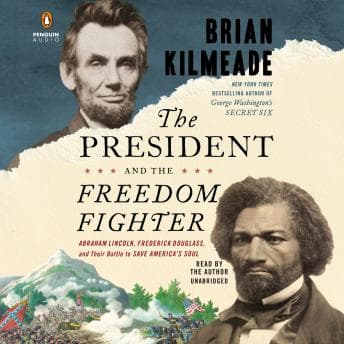

Brian Kilmeade wrote a book about Lincoln and Douglass, narrated it himself, and somehow didn't waste my time. That alone deserves acknowledgment.
I was meal-prepping Sunday dinner - Jenny's family was coming over, which means I needed banchan prep time and something to keep me from spiraling about my mother-in-law's opinions on my rice cooker. Six hours and forty-three minutes felt right for the task. And honestly? This was the right book for chopping vegetables and thinking about what this country actually cost people.
Two Self-Made Men Who'd Hate Your LinkedIn Bio
Here's what grabbed me: Kilmeade doesn't just parallel-track Lincoln and Douglass as some neat historical coincidence. He builds the case that these two men - one born into frontier poverty, one born into literal chains - arrived at the same fight from completely opposite directions and then had to argue with each other about how to win it. Douglass wanted the Constitution thrown out. Lincoln wanted to work within it. That tension is the engine of the whole book, and it's more interesting than most strategy decks I've read this year.
The early chapters on Douglass's escape from slavery hit different when you hear them described with specific detail - the borrowed sailor's uniform, the free papers that didn't match his description, the train conductor who barely glanced at them. That's not abstract history. That's a man betting his life on a stranger's laziness. Ed Yong's Immense World gave me a similar jolt - that specific, granular detail that makes you realize how much of existence you've been gliding past without actually seeing it. My parents bet everything on a dry cleaning shop in Koreatown in the '80s, and even they had legal documentation. Douglass had nothing but nerve.
Lincoln's arc is less dramatic but Kilmeade handles it well - the prairie lawyer who slowly, painfully evolved his position on race while trying not to lose half the country in the process. The book doesn't sanitize Lincoln's earlier views. He wasn't an abolitionist from day one. He was a politician doing political math. That honesty is worth more than hagiography.
Kilmeade Behind the Mic - The News Anchor Thing Actually Works
Look, I had low expectations. Author-narrated history books can go sideways fast. Either you get monotone academic reading or you get someone performing like they're auditioning for a History Channel special. Kilmeade lands somewhere useful - his news anchor cadence actually serves the material. He knows how to build toward a moment, pause for effect, and move on without over-explaining. It's the delivery of someone who's spent decades telling stories to people who might change the channel at any second.
Is it perfect? No. There's a sameness to his vocal register that means Lincoln and Douglass don't sound distinct from each other in quoted passages. You're relying on context to know who's speaking. For a book built on the dynamic between two very different voices, that's a missed opportunity. A dual-narrator production would've elevated this significantly. But Kilmeade's energy keeps things moving, and at under seven hours, the pacing never drags.
What My Parents Did Without a TED Talk
The part that stuck with me - and I was literally holding a knife over daikon when this hit - is Kilmeade's description of their second meeting at the White House. Douglass had criticized Lincoln publicly, harshly. And Lincoln invited him back anyway. Not to perform unity. Because he needed someone who'd tell him the truth about what was happening to Black soldiers in the Union Army. Lincoln wanted the intel that his own generals weren't giving him.
This is what my parents did instinctively. Now it has a TED talk. You find the person who sees what you can't see, and you listen even when it's uncomfortable. Every startup founder I've worked with who failed had the same blind spot: they surrounded themselves with people who confirmed their strategy instead of people who challenged it.
The book's weakness is that it occasionally reads like a History Channel companion piece - efficient but surface-level. If you've read David Blight's biography of Douglass or Doris Kearns Goodwin's Lincoln work, you'll find Kilmeade skating over territory those books excavate. But that's also the trade-off: this is 6 hours and 43 minutes, not 25. For the time investment, the ROI is solid.
Who Gets Value Here
If you want a graduate seminar on the Civil War, this isn't it. If you want a well-paced, personality-driven account of how two extraordinary people navigated disagreement toward something bigger than either of them - and you want it done before your meal prep is finished - this delivers. Business leaders, startup founders, anyone who thinks "strategic patience" is just a buzzword. Skip to the chapters covering their White House meetings if you're short on time. That's where the real insight lives.
Bottom line: a Fox News host wrote a history book that's better than it has any right to be, and narrated it with enough energy to justify the author-read format. Jenny would say I'm being harsh. Jenny is right. But she'd also agree this one earned its shelf space.





![Steve Jobs [unabridged audiobook] audiobook cover](/_next/image?url=https%3A%2F%2Fcovers.audiobooks.com%2Fimages%2Fcovers%2Ffull%2F9788499923406.jpg&w=1920&q=75)