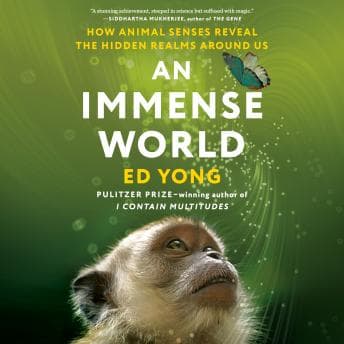

"The Earth teems with sights and textures, sounds and vibrations, smells and tastes, electric and magnetic fields. But every kind of animal, including humans, is enclosed within its own unique sensory bubble."
That line hit me somewhere around hour three, driving back from a client meeting in Houston. Ranger was asleep in the back seat, and I found myself wondering what the hell he actually experiences when he sticks his head out the window. Turns out, according to Ed Yong, my dog is processing a symphony of chemical information I literally cannot imagine. Not "don't understand" - cannot imagine. My brain lacks the architecture.
Let me cut to the chase: this is one of the most humbling books I've encountered since leaving the service. And I don't mean that in some soft, greeting-card way. I mean it in the tactical sense - this book fundamentally changed how I assess my environment.
The last time a book recalibrated my thinking that sharply was George Washington — different subject entirely, but the same gut-level reminder that the people we think we understand were operating with information and instincts we can barely reconstruct.Your Intel Is Always Incomplete
Yong introduces this German concept early on - "umwelt" - basically the sensory bubble each species lives inside. He uses it a lot. Maybe too much. (By hour eight, I was counting.) But the concept is worth the repetition because it's genuinely destabilizing once you internalize it.
Consider: beetles that can detect fires from 80 miles away because their survival depends on finding freshly burned forests. Or sea turtles navigating thousands of miles using Earth's magnetic field like it's GPS. Fire-seeking bugs. Magnetic navigation. These aren't superpowers - they're just different equipment. Standard issue for their species.
The scene that got me was the bat flight room. Yong describes researchers watching bats hunt moths, and the precision of their echolocation is absurd. These animals are building acoustic maps of their environment in real-time, updating faster than any radar system I ever worked with. And here's the kicker - the moths are listening for that sonar. It's an arms race happening in frequencies we can't hear, in a world we walk through every day without noticing.
Yong Behind the Mic
Yong narrates this himself, which is always a gamble. Some authors shouldn't be allowed near a microphone. Yong's fine. Better than fine, actually - he pronounces the technical terminology correctly (you'd be surprised how many don't), and there's genuine enthusiasm in his voice. The man clearly loves this subject.
But - and this matters for a 14-hour listen - his delivery is steady. Almost too steady. It's soothing in a way that works great for highway driving but can lull you into a zone where information slides past instead of sticking. I caught myself rewinding more than once during the detailed sections on electric fish. Not because it was bad. Because my attention wandered during what felt like the fifteenth example of electroreception.
Compared to his previous book, "I Contain Multitudes," this one demands more active engagement. Same intellectual rigor, but the subject matter here is more abstract - you're trying to imagine sensory experiences that have no human equivalent. That's hard work.
The Operational Takeaway
Here's what stayed with me: every threat assessment I've ever made was based on incomplete information. Not just because fog of war, not just because bad intel - but because my sensory equipment is fundamentally limited. A dog would've smelled what I missed. A bird would've seen ultraviolet signatures I couldn't detect. A crocodile - and this blew my mind - has a face as sensitive to touch as human fingertips. Crocodiles.
Yong isn't making a tactical argument, obviously. He's a science journalist writing about animal perception. But the implications extend everywhere. We build our entire understanding of reality on equipment that evolved to solve specific problems for a specific primate in a specific environment. Everything else is blind spot.
The book ends with a section on light pollution and noise pollution - how human activity is destroying the sensory environments other species depend on. It's not preachy, just factual. And somehow that made it hit harder.
Mission Debrief
Worth your time? Absolutely - if you're willing to work for it. This isn't background listening. It's the kind of book that rewards attention and punishes distraction. At 14 hours, it's a commitment. I'd recommend normal speed despite my usual 1.25x preference - Yong's pacing is already measured, and speeding it up makes the dense sections incomprehensible.
Who should listen: Anyone curious about how incomplete their picture of reality actually is. Science nerds, obviously. Dog owners who want to understand what their animal is actually experiencing. Veterans and security professionals who think about perception and awareness for a living.
Who should skip: If you need action to stay engaged, this isn't it. If detailed scientific explanation makes your eyes glaze, you'll struggle. And if you're looking for a quick listen, 14 hours is a serious deployment.
Ranger approved this one. Though I suspect he already knew most of it.






![Steve Jobs [unabridged audiobook] audiobook cover](/_next/image?url=https%3A%2F%2Fcovers.audiobooks.com%2Fimages%2Fcovers%2Ffull%2F9788499923406.jpg&w=1920&q=75)