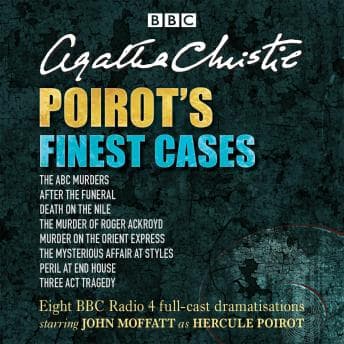

Look, I grew up with my mother's Agatha Christie novels stacked on every surface of our New Jersey home. Dog-eared copies of Murder on the Orient Express next to Bollywood VHS tapes. So when I say I have opinions about Poirot adaptations, I mean I have opinions. And my biggest complaint about this collection? It made me miss my stop. Twice. In one week.
I wasn't expecting much, honestly. BBC Radio dramatizations can go either way—sometimes they're atmospheric and clever, sometimes they feel like a high school play with better accents. These? They're the former. By a mile.
Why John Moffat Gets Poirot's Psychology Right
Here's what makes this collection work from a character psychology standpoint: John Moffat understands that Poirot isn't just fussy. He's not just the little grey cells and the egg-shaped head. The man is fundamentally lonely in a way Christie never quite spelled out but always implied. Moffat's performance captures this—there's a weariness underneath the precision, a sense that Poirot sees too much and wishes he didn't.
The full-cast format helps tremendously. When you've got actors like Joss Ackland and Sian Phillips playing suspects, Poirot gets to react to actual human performances instead of a single narrator doing voices. And reaction is where character lives. You hear Moffat's Poirot soften slightly with certain witnesses, sharpen with others. It's subtle, but as someone who studies how people construct identity through interaction—this is the good stuff.
Some listeners have noted Moffat's accent veers into "over-the-top" territory occasionally. Honestly? I didn't mind. Poirot himself is over-the-top. The man waxes his mustache with obsessive precision. He's performing a version of himself constantly. The slight theatrical edge in Moffat's delivery tracks psychologically.
The Stories That Hit Different in Audio
The Murder of Roger Ackroyd is the standout here, and if you know why, don't spoil it for anyone who doesn't. The radio format adds something to this particular story that I can't explain without ruining everything. Just trust me. Listen to it without reading spoilers first.
Death on the Nile benefits enormously from the atmospheric sound design—you genuinely feel like you're on that boat, which matters because the claustrophobia of the setting is half the tension. The sound effects can occasionally feel a bit much (there's only so many times I need to hear water lapping), but mostly they earn their place. Speaking of atmospheric tension that actually works, Cutting Season builds dread through setting in a way that reminded me why location matters so much in mystery.
Where the collection drags: Three Act Tragedy doesn't quite have the momentum of the others. The pacing feels off in the middle section, and I found my attention wandering during a particularly long dinner party scene. (My therapist would have thoughts about a character who throws parties where people keep dying, but that's another conversation.)
Moffat vs. Suchet: A Psychological Reading
If you've watched David Suchet's TV Poirot—and honestly, who hasn't at this point—Moffat offers something different. Suchet played Poirot with more warmth, more twinkle. Moffat's version is cooler, more clinical. Neither is wrong. They're just different psychological interpretations of the same character.
The radio format also means you're doing more imaginative work than with the TV series. No gorgeous 1930s costumes to distract you. No lingering shots of Art Deco interiors. Just voices and sound and your own brain filling in the gaps. For mystery specifically, I'd argue this is better—you're more engaged in the puzzle because you're actively constructing the scene.
Compared to Hugh Fraser's audiobook narrations of the Christie novels, these dramatizations feel more immediate, more alive. Fraser is excellent, don't get me wrong. But there's something about hearing actual dialogue between multiple actors that makes the social dynamics click in a way solo narration can't quite capture.
Skip If You're a Purist, Stay If You Want Fresh Eyes
If you're a Christie purist who wants every word preserved exactly as written—these are dramatizations, not unabridged readings. Things get cut. Things get rearranged. You might hate it. But if you want to experience these stories fresh, even if you've read them before? If you want to hear how Christie's character psychology translates to pure voice and sound? This collection delivers.
We process narrative differently through audio versus text—more emotional engagement, less analytical distance. Project Hail Mary is one of those rare audiobooks where the emotional engagement actually enhances the puzzle-solving instead of distracting from it. For mysteries, that's a trade-off. You might catch fewer clues. But you'll feel the reveals more viscerally.
I listened to most of this during morning jogs through Cambridge, which meant occasionally stopping dead on the sidewalk when something clicked into place. Probably looked unhinged. Worth it.
My Prescription
Fifteen hours of content means you're getting real value here. Eight full stories, each around two hours. Perfect for a long road trip or a week of commutes. Just maybe don't start Roger Ackroyd right before you need to get off the train.