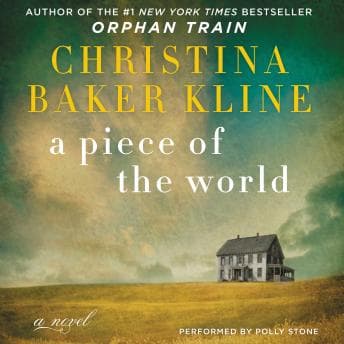

Most people know Andrew Wyeth's Christina's World — the woman in the pink dress dragging herself through dry grass toward a gray farmhouse on a hill. It's one of those paintings you've seen a hundred times, on dorm room posters and in art history textbooks, without ever really seeing it. I thought I knew what the painting was about. I didn't.
I started this one on a Saturday morning walk along the lakefront with Denise. By the time we got home, she had to practically drag me inside because I'd stopped walking and was just standing there, staring at the lake, listening. That should tell you something.
The Woman in the Grass Was Real, and Her Life Was Harder Than the Painting
Christina Baker Kline does something here that I spend half my career begging eleventh graders to do: she looks at the thing everyone thinks they understand and asks, but what's actually underneath? Christina Olson — the real woman behind Wyeth's painting — had a degenerative condition (likely Charcot-Marie-Tooth disease, though the novel wisely doesn't pin it down with clinical certainty) that slowly robbed her of mobility over decades. She refused a wheelchair. She crawled across the fields of her family's farm in Cushing, Maine, dragging herself by her fingers through dirt and grass.
And here's what Kline gets right that a lesser novelist would've botched: she doesn't turn Christina into an inspiration poster. Christina isn't "brave" in the way we use that word to make ourselves feel comfortable about other people's suffering. She's stubborn. Proud to the point of self-destruction. Bitter sometimes. Funny in a dry, Maine-coast way that sneaks up on you. The novel moves between Christina's youth — when she could still walk, still dance, still imagine a life beyond the farm — and her later years as Wyeth's neighbor, model, and unlikely muse. The juxtaposition is devastating without being manipulative.
I've seen some readers complain that Christina is too passive, too accepting of her shrinking world. I get it. But I think those readers are missing the point. This reminds me of what Hemingway said about courage being grace under pressure — except Kline complicates that idea. Christina's acceptance isn't grace. It's something more complicated and less comfortable. It's a woman who knows her options and has made her peace, even if that peace looks like resignation from the outside.
Polly Stone Knows That Silence Is the Loudest Sound
Here's where I expected to have a complaint and didn't. Polly Stone doesn't attempt a Downeast Maine accent. No lobsterman drawl, no Kennedy-esque New England vowels. At first I thought — really? You're setting a novel on the Maine coast and you're giving me PBS neutral? But it works. The narrator understands that pause is punctuation, and Stone's performance is built almost entirely on pauses and restraint. She disappears into the text the way a good frame disappears around a painting. You stop hearing a narrator and start hearing Christina thinking.
There's a moment — and I wish I could pinpoint exactly where — when Christina describes the touch of her brother Al's hand, just a small gesture of care between siblings who've spent their whole lives in the same house, and Stone's delivery slows just slightly. Not dramatically. Not actorly. Just enough that you feel the weight of decades compressed into a single touch. I had to stop grading the stack of sophomore essays on my desk and just sit with it. (The essays could wait. They were mostly about TikTok anyway.)
The prose deserves to be savored. Kline writes in clean, stripped-down sentences that feel like watercolors — thin washes of color that somehow convey enormous depth. At 1.0x speed, the eight hours felt exactly right. Not a minute wasted.
Who This Is For (And Who Should Keep Walking)
If you loved Olive Kitteridge — that same unflinching portrait of a difficult New England woman — this is its spiritual successor, quieter and more internal but with that same refusal to sentimentalize. I kept thinking of Cast while writing this — another audiobook where the narrator's restraint does more work than any dramatic flourish could. If you're coming from Orphan Train expecting the same propulsive plotting, slow down your expectations. This is a character study, not a page-turner. That's not a flaw. That's the design.
My students would hate this. I love it. There's no twist, no big reveal, no villain. The conflict is a woman against her own body, against time, against the smallness of the life she was dealt. And the resolution — if you can call it that — is a painting. A single image that captures everything she was.
Worth Pausing the Faculty Meeting For
This is the kind of book that makes you want to go look at the original painting again. And when you do, you won't see a poster anymore. You'll see Christina Olson's fingers in the dirt, and you'll know why she's reaching for that house, and you'll understand that she's not helpless — she's choosing. Eight hours well spent. Denise wants to visit the Olson House in Maine this summer. I told her yes before she finished asking.