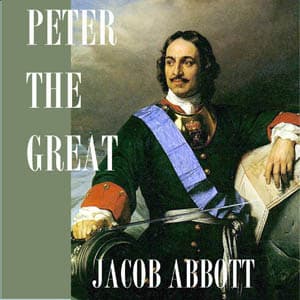

"There are very few persons who have not heard of the fame of Peter the Great." Abbott opens with this line, and I found myself nodding along while walking the lakefront last Tuesday morning. He's right. Everyone's heard of Peter. But how many of us actually know the story beyond "built St. Petersburg" and "was tall"?
I didn't, really. Not until this week.
What Abbott Understood About History
Here's the thing about Jacob Abbott's writing: it was meant for young readers in the 1850s, and honestly? That's kind of a feature, not a bug. The prose is clean, direct, almost conversational for its era. No Victorian sentence-mazes where you lose the subject three clauses back. He moves through Peter's life with a teacher's instinct for what will hold attention—the shipyard in Saardam where the Tsar worked with his own hands, the brutal political intrigues, the sheer weirdness of a monarch who wanted to drag his medieval nation into modernity by force.
I kept thinking about how I'd teach this. Abbott doesn't just tell you Peter was ruthless; he shows you the consequences, then steps back with these little moral observations that feel quaint but oddly effective. It's like reading Plutarch's Lives filtered through a New England schoolmaster's sensibility. My students would probably find it old-fashioned. I found it refreshing.
The comparison that kept coming to mind was Robert Massie's definitive Peter the Great from 1980—which I listened to years ago and clocks in at something like 40 hours. Abbott's seven-hour version is the appetizer plate. You won't get the deep political analysis or the granular detail. What you get is the story, told well, with enough context to understand why this strange, violent, brilliant man matters to Russian history.
The LibriVox Question
Let's talk about the elephant in the room. LibriVox is volunteer-narrated, which means you're getting enthusiasm and dedication, not professional voice acting. The narration here is clear—I never struggled to understand what was being said—and the pacing is consistent. But there's a flatness to it. A kind of even-keeled delivery that doesn't rise or fall with the drama of Peter's life.
And Peter's life had drama. Executions. Rebellions. A son he may have had killed. The kind of leadership decisions that would make the guys in Extreme Ownership deeply uncomfortable—though Peter would probably argue he took full ownership of every brutal choice. The narrator reads these passages with the same measured tone as the descriptions of shipbuilding techniques. It's not bad, exactly. It's just... neutral.
I couldn't find much about the specific volunteers who recorded this, but I'll say this: for a free audiobook, the audio quality is clean. No background noise, no weird audio artifacts. Perfectly serviceable for what it is. But if you're coming from professional narrators who do character voices and emotional beats, you'll notice the difference immediately.
For me, grading papers at 11PM with this playing through my earbuds, it worked fine. The content carried the experience. But I'd be lying if I said the narration elevated the material the way a great performance can.
Who Should Listen (And Who Should Skip)
This is an entry point, not the destination. If you've never really understood why Peter the Great matters—why Russia's trajectory as a nation traces back to this one man's obsessive modernization project—Abbott gives you the foundation. Seven hours is manageable. The prose rewards attention without demanding a PhD.
Teachers, this is genuinely useful for high school or early college students who need historical context without getting overwhelmed. The moral observations Abbott makes throughout are actually great discussion starters. (Yes, I'm already thinking about how to work this into my curriculum. Occupational hazard.)
Skip this if you want psychological depth, political complexity, or the way Peter's reforms echoed through centuries of Russian history. You'll need to go beyond Abbott for that—Massie's biography is the obvious next step. This is the trailer, not the movie.
The Teacher's Recommendation
I came away from this with a renewed appreciation for what 19th-century popular history could do. Abbott wasn't writing for scholars—he was writing for curious people who wanted to understand the world. There's something almost podcast-like about his approach, honestly. (And yes, I'm aware that comparing a 170-year-old book to podcasts is peak middle-aged English teacher energy. I've made peace with who I am.)
The narration won't blow you away. The prose might feel dated to some ears. But the story itself? Peter building a navy from nothing, Peter traveling incognito through Europe, Peter dragging Russia into the modern world through sheer force of will—that story still works.
I'd recommend listening at 1.0x, because Abbott's sentences have a rhythm that deserves to be heard properly. Save it for a quiet walk or a late-night grading session, not the chaotic commute. This one rewards a little patience.




![Steve Jobs [unabridged audiobook] audiobook cover](/_next/image?url=https%3A%2F%2Fcovers.audiobooks.com%2Fimages%2Fcovers%2Ffull%2F9788499923406.jpg&w=1920&q=75)