
How far would you actually go to protect your kid - even when your gut's been screaming for years that something's off with him?
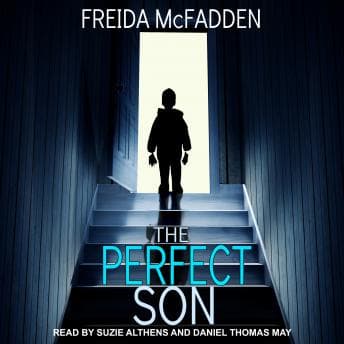
That's the grenade Freida McFadden drops in your lap about ten minutes into Perfect Son, and honestly, it detonated at exactly the right time for me. I was up past midnight with a bourbon and Ranger snoring at my feet, the house dead quiet, Linda already asleep. Not my usual listening context - I typically burn through audiobooks on I-35 between client meetings - but this one grabbed me during what was supposed to be a quick chapter before bed and turned into a four-hour siege.
When the Knock Comes and Everything Unravels
Let me cut to the chase: this is a domestic thriller about a mother, Erika Cass, whose carefully constructed suburban life gets blown apart when two detectives show up asking about a missing high school girl. Her son Liam was the last one seen with the girl. And here's where McFadden - who's a brain injury specialist in her day job - does something smarter than your average thriller writer. She doesn't just give you the "is he or isn't he guilty" question. She builds Erika as someone who's been cataloguing her son's oddities for years, suppressing them, rationalizing them. The dread isn't manufactured. It's been living in that house for a long time.
The book runs just under eight hours, which is pretty much the sweet spot for this kind of story. No filler. No subplot about Erika's book club or whatever padding other thriller writers love to throw in. McFadden keeps the focus tight - the investigation, the family dynamics cracking under pressure, and Erika's increasingly desperate mental gymnastics as evidence piles up.
Now, some readers have called the characters stereotypical, and I'll give them partial credit on that. The suburban setting and the worried-mom archetype aren't exactly fresh territory. But McFadden earns her keep with the ending. I didn't see it coming, and I've read enough thrillers - and lived through enough real situations where the "obvious" suspect turned out to be a dead end - to know when a writer is playing fair with their misdirection versus just cheating. She plays fair. The moral misdirection reminded me of how Delicate Truth keeps you questioning who the real threat is right up until the floor drops out.
The Dual Narration: One Hit, One Near-Miss
Suzie Althens and Daniel Thomas May split duties here, and this is where it gets interesting. Althens handles Erika's perspective and she's solid - you can hear the controlled panic underneath the composed-mom voice, and she calibrates the emotional shifts well as Erika's denial starts crumbling. She doesn't oversell the suspense moments, which I appreciate. Nothing kills tension faster than a narrator who sounds like they're narrating a haunted house tour.
Daniel Thomas May is... look, he's competent. His sections move fine. But his voice has this quality that I can see rubbing some people wrong - there's something almost too smooth about it for the darker material. Like wearing a dress uniform to a field exercise. It works, technically, but the fit isn't quite right. I've seen listeners call them a "dynamic duo" and others say May's voice was a dealbreaker. I land somewhere in the middle. He didn't ruin anything for me, but Althens clearly carries the heavier load.
No sound effects, no music, clean production. Exactly how I like my thrillers. Let the story do the work.
Where the Ammunition Runs Low
Here's where it lost me slightly: some of McFadden's thriller mechanics feel a bit assembly-line. She's prolific - this is one of many in her catalog - and you can sense the formula underneath. The chapter-ending cliffhangers come with metronomic regularity. Every chapter ends on a mini-bomb. Effective? Sure. But by hour five, I started anticipating the rhythm rather than being surprised by it. It's the thriller equivalent of a three-round burst pattern - predictable once you've heard enough of them.
And the supporting characters are thin. I couldn't tell you a single distinguishing trait about the detectives, which, as someone who's worked alongside law enforcement for decades, bugs me. Cops have personalities. These two are basically interchangeable question-delivery systems.
But that ending. Without spoiling anything - it's ambiguous in a way that actually works. McFadden leaves you sitting with the discomfort rather than tying a neat bow. That takes guts for a thriller writer whose audience usually demands resolution.
Mission Debrief
Worth your time? Here's the debrief: Perfect Son is a fast, focused suburban thriller that runs lean and hits its target. It won't redefine the genre, but it's a well-executed eight hours that respects your intelligence more than most. The ending alone elevates it above the pack. Best consumed in one or two sessions - don't let it sit too long between listens or the momentum dies.
Who should grab this: McFadden fans, obviously. Anyone who liked the moral ambiguity of a parent protecting a potentially dangerous kid. If you've ever had to make a judgment call about someone's character with incomplete information - and brother, I've done that plenty - this one hits.
Who should skip: If you need deep character development across a large cast, or if dual narration where one voice doesn't quite land is a dealbreaker, save your credit for something else.
Ranger slept through the whole thing, but he did twitch during the third act. I'm counting that as a recommendation.