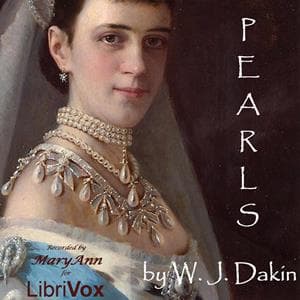

So I couldn't sleep. Again. This time it wasn't a production outage — Kevin had left for a work trip, the apartment was too quiet, and my brain was doing that thing where it cycles through every pull request I didn't review that day. I needed something calm, something with zero stakes, something that would feel like a Wikipedia deep-dive read aloud to me. Enter: a 3-hour audiobook about pearls written by an Australian zoologist in the early 20th century.
Bottom Line: Worth your commute if you're in the mood for obscure nonfiction that scratches the "I want to learn something weird" itch. Not life-changing, but surprisingly dense with cool facts for under 3 hours.
Everything You Never Knew You Wanted to Know About Oyster Secretions
William John Dakin was writing in an era when popular science meant actually explaining science to people, not packaging it with a TED Talk hook and three anecdotes stretched to 300 pages. This book could NOT have been a blog post — which is honestly refreshing. It's short, it's packed, and it respects your time. Dakin walks through pearl formation (the biology is genuinely interesting — nacre layering, the role of parasites vs. the old "grain of sand" myth), the history of pearl diving from the Persian Gulf to the Torres Strait, and the economics of the pearl trade in the early 1900s.
The section on Japanese cultured pearls and Mikimoto's techniques is where I actually perked up. Dakin explains the distinction between "natural" and "cultured" pearls with the kind of precision that makes you realize this was a legitimately controversial scientific and commercial debate at the time. He's clearly got opinions about it, too — you can feel him bristling at the jewelers who dismissed cultured pearls as fake. For a zoologist writing about mollusks, the guy had some fire.
What surprised me most: the descriptions of pearl diving operations read almost like dispatches from another planet. Free divers working at depth for hours, the mortality rates, the colonial economics underlying the whole industry. Dakin doesn't editorialize much, but the facts speak for themselves, and there's this dry, matter-of-fact tone that makes the brutality hit harder.
MaryAnn Spiegel and the LibriVox Question
Okay, let's talk about the elephant in the room. This is a LibriVox recording, which means volunteer narrator, no professional studio, no Audible-tier production. MaryAnn Spiegel reads clearly and at a steady pace — no major stumbles, no weird mic pops that I noticed. But it is what it is: a straight read of a century-old science text. There's not a ton of vocal range here because honestly the material doesn't demand it. It's not Ray Porter (nothing is Ray Porter), but she gets out of the way and lets Dakin's writing do the work, which is the right call.
I bumped it to 1.5x and it felt perfectly natural. The prose is formal early-20th-century academic English, so speeding it up actually helps it feel less stiff. At normal speed it might lull you to sleep — which, at 1AM on a Tuesday with no Kevin and no incidents to debug, was kind of the point.
Who Gets the Pearl, Who Gets the Shell
If you're the kind of person who falls down rabbit holes on obscure topics — the history of pigments, how clocks work, why we started eating lobster — this is your jam. It's a perfect one-commute listen (I literally finished it in a single round trip with time to spare). The ROI on this audiobook is high if you measure by "interesting facts per minute."
Skip this if you need narrative drive, characters, or anything resembling a story arc. This is a zoologist's survey of a topic he clearly loved, organized by subject rather than drama. It's a lecture, not a novel. And if you're particular about audio production quality, the LibriVox factor might bug you.
Perfect for: bedtime, background listening while cooking, short commute filler between longer series. Skip for: gym, anything requiring emotional engagement.
The Debug Log
I went in expecting filler and got a surprisingly efficient little knowledge bomb about something I'd never thought twice about. That same curiosity-scratching efficiency is what I loved about Declaration of Independence — both are short historical texts that pack way more insight than you'd expect. It's not going to crack my top 10, or even my top 50, but I genuinely learned things — like that the Romans valued pearls above all other gems, or that pearl formation has almost nothing to do with sand irritation. At under 3 hours and free on LibriVox, the cost-benefit ratio is basically unbeatable. Sometimes the best listens are the ones you grab on a whim at 1AM because your brain won't shut up.







![Steve Jobs [unabridged audiobook] audiobook cover](/_next/image?url=https%3A%2F%2Fcovers.audiobooks.com%2Fimages%2Fcovers%2Ffull%2F9788499923406.jpg&w=1920&q=75)