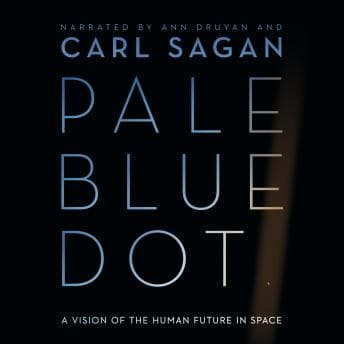

So there I was, 2AM on a Tuesday, post-incident review written and submitted, too wired to sleep but too fried to look at another terminal. I pulled up Pale Blue Dot thinking Carl Sagan's voice would be the cosmic lullaby I needed to finally knock out. I'd had a similar late-night-brain-won't-quit experience with Kybalion, where the material is dense enough to feel meditative but just keeps hooking you back in right when you think you're drifting off. And for those first few chapters - the ones Sagan himself narrates - it almost worked. His voice is this low, unhurried, almost gravitationally calm thing that makes you feel like the universe is fundamentally okay, even when he's telling you how cosmically insignificant you are.
Then Ann Druyan took over, and I was suddenly very awake.
The Two-Narrator Problem Is a Production Architecture Flaw
Here's the thing nobody warns you about: this audiobook is essentially two different listening experiences duct-taped together. Sagan narrates the opening chapters - including that famous Pale Blue Dot passage, the one that makes you want to simultaneously hug everyone on Earth and also scream into the void. His delivery is perfect. Relaxed, intelligent, the audio equivalent of a well-commented codebase. You trust this voice.
Then Druyan picks up the remaining ~11 hours. And look - she's his widow, she co-created Cosmos, she clearly understands this material at a molecular level. Her reading has genuine optimism and a sharp ear for the scientific details. But her voice is raspy and whispery in a way that genuinely fights the material. Multiple times on the train I had to rewind 30 seconds because I couldn't parse what she said over the ambient Caltrain noise. It's like - imagine you're trying to follow a complex explanation of planetary atmospheres, but the narrator sounds like she's telling you a bedtime story from across the room. The mismatch between content gravity and vocal delivery kept pulling me out.
I don't say this to be cruel. Some listeners genuinely love her narration as a continuation of Sagan's legacy, and I respect that. But on commute-worthiness? In a packed train car at 6AM with someone's backpack in your face and the Hillsdale stop announcement blaring? It's rough. I had to relisten to whole sections during quieter moments.
Sagan's Actual Arguments Hold Up Better Than Most 90s Tech
The book itself though - the content - is where the ROI kicks in. This isn't Cosmos Part 2 Electric Boogaloo. Sagan goes way harder on the practical case for space exploration. He walks through our solar system body by body, but the real payload is his argument that spreading humanity beyond Earth isn't aspirational fluff, it's a survival requirement. He wrote this in 1994 and his reasoning about existential risk, asteroid defense, the fragility of single-planet civilization - it reads like it could've been written last year. The science actually holds up remarkably well for a 30-year-old book.
What surprised me was how political he gets. Not in a partisan way, but in a "why are we spending money on this instead of that" way. He anticipates basically every objection to space funding that still gets thrown around on Twitter, and methodically dismantles them. It's structured like a really good technical argument - here's the problem, here's why the obvious solutions don't work, here's what we should actually do.
Also: the Library of Congress selected this audiobook for preservation in the National Recording Registry. Which feels right. Hearing Sagan's actual voice delivering the Pale Blue Dot speech is genuinely a cultural artifact.
Your Commute Calculus
At 13+ hours, this is roughly a week and a half of commutes. Here's my honest breakdown:
The Sagan chapters: Perfect commute material. His voice cuts through noise, the pacing is relaxed but never boring. I'd give these sections a 4.5/5.
The Druyan chapters: Requires focused listening. The whispery delivery plus occasionally rough audio quality means you'll miss stuff in noisy environments. Better for a quiet room or maybe a weekend with headphones. On a train? You'll be hitting that 30-second rewind button a lot.
I listened at 1.25x - slower than my usual 1.5x because Druyan's raspier sections needed the extra clarity. Wouldn't go faster than that.
Perfect for: People who want their space enthusiasm grounded in actual planetary science and policy arguments. If you loved Cosmos but wished Sagan would get more specific about why we should go and how we'd survive, this is that book.
Skip if: You need crystal-clear narration for commute listening or you're looking for a pure science deep-dive without philosophy. The narrator split will frustrate you if you're audio-quality sensitive.
Kevin asked me why I was staring at the ceiling at 3AM muttering about Titan's atmospheric composition. I told him Carl Sagan made me do it. He understood. (He always understands when it's Sagan.)
The Signal Through the Noise
This is a genuinely important book trapped in a flawed audio production. Sagan's arguments for becoming a spacefaring species are the strongest, most clear-eyed version of that case I've encountered in any format. But the narration split creates an inconsistent listening experience that drops the audiobook below what the material deserves. If you can power through Druyan's sections - or listen in a quiet environment - the ideas here will rewire how you think about humanity's timeline. Just maybe don't start it on the 6:12 Caltrain.




![Steve Jobs [unabridged audiobook] audiobook cover](/_next/image?url=https%3A%2F%2Fcovers.audiobooks.com%2Fimages%2Fcovers%2Ffull%2F9788499923406.jpg&w=1920&q=75)