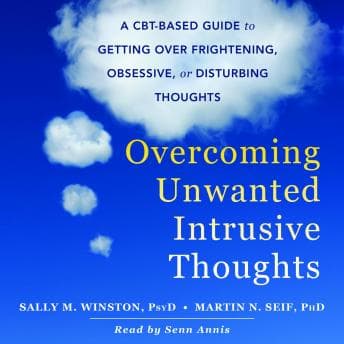

Everyone told me this book would be life-changing. The reviews are practically unanimous—five stars, tears of relief, "finally someone gets it." And honestly? I went in skeptical. I've read enough CBT-based self-help to fill a very depressing bookshelf, and most of it boils down to "notice the thought, let the thought go" repeated for 200 pages with slightly different metaphors. So I started this one while prepping a complicated dal makhani at 9 PM on a Tuesday (don't ask why I was making something that elaborate on a weeknight—I was avoiding my own writing, obviously), and I expected to be mentally drafting my critique by hour two.
I was wrong. Not completely wrong. But wrong enough to matter.
The Three Voices That Made Me Put Down My Spatula
Here's where this audiobook earns its keep, and it's almost entirely because of a production choice. Winston and Seif introduce a framework of three internal voices: the Worried Voice, the False Comfort voice, and the Wise Mind. On paper, that's a decent therapeutic model. In audio, narrated by Senn Annis, it becomes something genuinely useful. Annis doesn't just read the dialogue tags—she becomes each voice distinctly. The Worried Voice has this tight, urgent quality that sounds exactly like the inside of your head at 3 AM when your brain decides now is the time to revisit every terrible thing you've ever considered. False Comfort is smooth, reasonable-sounding, almost seductive in how it mimics helpfulness while actually keeping you stuck. And Wise Mind is calm without being patronizing, which is harder to pull off than it sounds.
I found myself asking: why does this three-voice framework work so much better in audio than in text? And the answer, I think, is that intrusive thoughts are fundamentally an auditory experience for most people. You hear them. Having someone externalize and differentiate those internal characters—giving them distinct vocal qualities you can recognize—is basically a form of cognitive defusion in real time. The research actually shows that externalizing internal experiences reduces their emotional grip, and this audiobook accidentally (or deliberately, who knows) weaponizes that principle through the format itself.
Where the Psychology Holds Up (And Where It Simplifies)
As someone who spends her professional life studying how narratives shape identity, I was paying close attention to the psychological framework here. Winston and Seif are ABCT-recognized anxiety specialists, and it shows. They get something right that a lot of popular psychology books get wrong: they don't tell you to fight the thoughts. They don't tell you to replace them with positive ones. They don't offer hollow reassurance. Instead, they explain the sticky mind concept—why certain brains latch onto thoughts and won't release them—and then walk you through why every instinct you have about managing these thoughts is probably making them worse.
That paradox is the backbone of the book, and it's presented clearly enough that someone with zero psych background could follow it. The protagonist of your own intrusive thought cycle—you—exhibits classic avoidance patterns that inadvertently reinforce the thoughts. The book names this cycle explicitly, which I appreciated.
Where it simplifies: the CBT framework here is solid but relatively surface-level. If you've done actual exposure and response prevention therapy, or if you're familiar with ACT (Acceptance and Commitment Therapy), you'll recognize the mechanisms. The book doesn't go deep into the neuroscience, and it doesn't address comorbidities in any meaningful way. At 5 hours 23 minutes, it can't. That's okay—it's not trying to be a clinical text. But I want to be honest that this is an introduction, not a comprehensive treatment plan.
Who Needs This In Their Ears (And Who Doesn't)
This is for the person who Googles "am I a bad person for thinking [X]" at midnight. The person whose brain generates horrible, violent, sexual, or blasphemous thoughts and who has never told anyone because the shame is too enormous. The book is extraordinarily compassionate about this specific experience, and the audiobook format means you can absorb it privately, at your own pace, without a judgmental book spine visible on your nightstand.
It is NOT a replacement for therapy. My therapist would have thoughts about anyone who treats a 5-hour audiobook as a substitute for professional help with clinical OCD. But as a companion to therapy, or as a first step toward understanding what's happening in your brain? Pretty much exactly what you need.
If you're a psych professional looking for new frameworks, this won't give you much you don't already know. If you're someone who experiences occasional weird thoughts but isn't particularly distressed by them, this might actually make you more anxious by overanalyzing something that wasn't a problem. Know thyself before you press play.
The Prescription I'd Actually Write
I finished the dal makhani. I finished the audiobook. And I sat at my kitchen table thinking about how many of my research participants have described exactly the thought patterns Winston and Seif outline—this is a fascinating case study in how normalizing language can dismantle shame spirals. The book's greatest trick is making you feel less alone in your own head, and Annis's narration turns a clinical framework into something that feels like a conversation with a very smart, very kind therapist who happens to live in your earbuds. That particular alchemy—where the right narrator transforms already-compelling content about an unusual mind into something viscerally intimate—is something Daniel Tammet achieves on the page in Born On A Blue Day, which I'd argue belongs in the same conversation about how we externalize and communicate inner experience to people who've never lived it. Not revolutionary for the field. But potentially revolutionary for the listener who needed exactly this, exactly now.