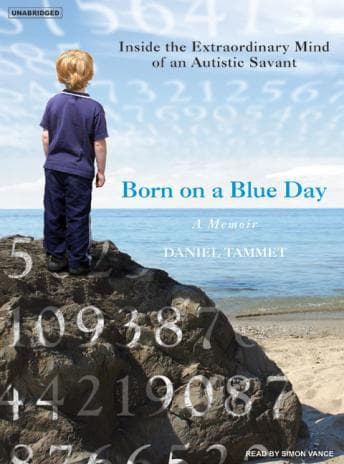

I'm going to start with a complaint that's really a compliment in disguise: this book made me feel dumb. Not in the condescending way—in the genuinely humbling way. I was on a red-eye to Chicago, couldn't sleep, figured I'd knock out a business memoir. Instead I got a front-row seat to a mind that experiences thirty-seven as "lumpy like porridge" and eighty-nine as "falling snow." Meanwhile I'm over here struggling to remember my hotel confirmation number.
Daniel Tammet isn't just one of fifty living autistic savants—he's the only one who can actually explain what's happening inside his head. That's the entire value proposition here. And at 6.5 hours, it respects your time in a way most memoirs don't.
What My Parents' Dry Cleaning Business Taught Me About Competitive Advantage
Here's what struck me: Tammet's story is fundamentally about finding your competitive advantage and then figuring out how to deploy it. He memorized 22,514 digits of pi. He learns new languages in a week. But for years, he couldn't make eye contact or understand why people laughed at jokes. The business parallel writes itself—you can have the most extraordinary capability in the world, but if you can't communicate it, if you can't connect it to what others need, it's just potential sitting on a shelf.
My parents never read a business book in their lives, but they understood this instinctively. You figure out what you're good at, you find the people who need it, you work until your hands crack. Tammet's journey from a kid who rocked and hummed in corners to someone who runs a language-learning company? That's not savant magic. That's hustle with unusual raw materials.
Simon Vance Knows When to Get Out of the Way
Vance is a Golden Voice narrator for a reason, and here he does something smart: he doesn't try to dramatize Tammet's experience. No theatrical pauses when describing synesthesia. No breathless wonder when Tammet explains how he sees numbers as landscapes. Just clean, calm British RP that lets the content do the heavy lifting.
This is exactly right. The material is extraordinary enough. Tammet describing how he learned Icelandic in seven days for a TV documentary, or explaining that he literally sees the answer to complex math problems as shapes that emerge in his mind—that doesn't need embellishment. Vance reads it like Tammet is explaining it to you over coffee. Precisely the tone the book requires.
The ROI Calculation
Bottom line: if you're listening for business insights, you'll find them, but they're not packaged as frameworks or action items. The key takeaway is worth the listen—understanding how radically different minds can process the same information opens up how you think about team composition, communication, and cognitive diversity. I've sat in too many McKinsey meetings where everyone's brain worked the same way. That's not a feature, it's a bug.
But I'll be honest—if you're looking for a productivity hack or a seven-step system, skip this. This is a memoir, not a manual. The value is in perspective expansion, not tactical application. Immune works the same way—it rewires how you see a system you thought you understood, without pretending to be a how-to guide.
Who's this for? Anyone in leadership who needs a reminder that "different" and "deficient" aren't synonyms. Parents of neurodiverse kids who want to see a success story that doesn't sand down the hard parts. And honestly, anyone who's ever felt like their brain works differently and wondered if that's a curse or an asset. (Spoiler: it's both, and that's okay.)
Who should skip? If you need constant action or narrative tension, this will feel slow. It's not slow—it's contemplative. But if you're the type who skips to chapter 5 in every book (guilty), you might get impatient with the childhood sections. Stick with it. The payoff is cumulative.
Park's Final Ledger
Jenny would say I'm being too analytical about a deeply human story. Jenny is right. But here's the thing—Tammet's book works precisely because he's analytical about his own deeply human experience. He doesn't ask for pity or awe. He just explains, with remarkable clarity, what it's like to be him.
I finished it before we landed in Chicago. Didn't touch my laptop once. That's the highest compliment I can give a non-business book that somehow taught me more about cognitive leverage than half my MBA curriculum.