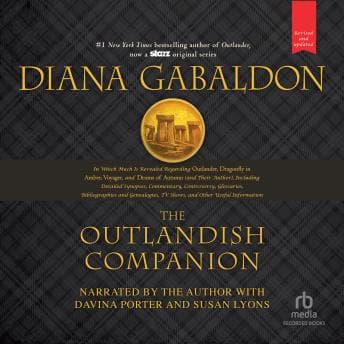

I was three hours into this on a Saturday morning, sitting at the kitchen table with cold coffee and a stack of ungraded essays I was actively ignoring, when Denise walked in and said, "You're listening to a book about books you already listened to?" And honestly? Fair question. The Outlandish Companion is a companion guide — essentially Diana Gabaldon pulling back the curtain on her first four Outlander novels. Synopses, character listings, family trees, essays on eighteenth-century medicine, her personal theory of time travel, horoscopes for Jamie and Claire. It's the literary equivalent of DVD bonus features, except it runs nearly fourteen hours.
So let me be honest about what this is and what it isn't before we go any further.
A Fourteen-Hour Love Letter to Her Own Universe
This is Diana Gabaldon writing for the already converted. If you haven't read — or listened to — at least the first four Outlander novels, this book will mean almost nothing to you. It's not a standalone experience. It's a guided tour of a house you need to have already lived in.
But here's what surprised me: the essays are genuinely interesting. Gabaldon's piece on researching historical fiction scratches the same itch I get when I teach my students about how authors build worlds from primary sources. She's candid about her process in a way that feels less like self-promotion and more like a conversation with someone who's been doing this work for decades and has opinions. The section on creating characters — particularly how Jamie Fraser evolved from a historical footnote into the center of a massive fictional universe — is the kind of craft discussion I wish more authors would publish. This reminds me of what Hemingway said about the iceberg theory, except Gabaldon shows you everything below the waterline and somehow makes the iceberg more impressive, not less.
The synopses, on the other hand, are a slog in audio form. Reading a summary of a book you've already experienced is one thing on paper where you can skim. I ran into the same problem with Beneath This Mask — a book I liked well enough in prose but found oddly exhausting when I had to sit still and let someone read the slower connective tissue back to me at full pace. Listening to it narrated at full length? That's where the fourteen hours start to feel every minute. I found myself checking the chapter markers during the Voyager recap, which is never a good sign.
Davina Porter Narrating About Davina Porter's Characters
Here's where things get interesting. Davina Porter narrates portions of this companion, and if you've listened to the main Outlander audiobooks, her voice IS these characters. She won an Audie in 2006 for Best Female Narrator and ended up in Audible's Narrator Hall of Fame, and you can hear why — her Scottish accent work is specific and lived-in, not the vague "I studied dialect tapes for a week" quality you get from lesser performers. When she reads Gabaldon's behind-the-scenes material, there's a meta quality to it. She's narrating the author's reflections on characters she's spent hundreds of hours voicing. The narrator understands that pause is punctuation, and Porter's pacing during the more reflective essays gives the material room to breathe.
Susan Lyons handles other sections, and the transition between narrators is clean but noticeable. It's like switching between two professors teaching the same course — both competent, but you develop a preference. I preferred Porter, which probably isn't surprising given she's been the voice of this world for so long.
Now — the pacing. Fourteen hours for a companion guide is a lot. Some chapters feel designed for print reference, not linear listening. The character listings and genealogical notes, the Gaelic pronunciation guide — these are useful on paper where you can flip to them. In audio, they're the equivalent of someone reading a phone book with excellent diction. I skipped the horoscopes entirely. (Sorry, Diana. I love you, but I'm a Capricorn and we don't believe in that stuff.)
Who This Is Actually For — And How to Listen
If you loved the first four Outlander novels, this is their spiritual successor in companion form. But I'd recommend cherry-picking. The essays on craft and research? Worth pausing the faculty meeting for. The TV series behind-the-scenes material? Fun if you're a fan of both versions. The full synopses and character catalogs? Skip them in audio unless you genuinely need a refresher before diving into later books in the series.
My students would hate this. I love it — or at least I love about eight of the fourteen hours. The rest is reference material trapped in a format that doesn't serve it.
Speed recommendation: honestly, 1.25x for the reference sections if you insist on listening to them, but keep Porter's essay narration at 1.0x. The prose deserves to be savored when Gabaldon is actually writing prose and not listing character names alphabetically.
The Extra Credit Assignment
This is a book for completists. Not casual fans, not newcomers — completists. If you want to understand how Gabaldon builds her world, how she thinks about time travel and historical accuracy, this delivers. If you want a great audiobook experience from start to finish, this isn't structured for that. It's a reference guide that happens to have some brilliant essays buried inside it, narrated by someone who's earned every bit of her reputation. Borrow it, listen to the good parts, and don't feel guilty about skipping the rest. I'm a teacher. I'm giving you permission to skim.