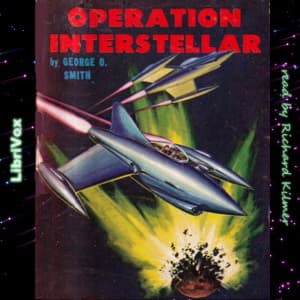

George O. Smith had genuinely interesting ideas about faster-than-light communication, and this audiobook actively fights you for trying to appreciate them.
I started this one at 5:45AM on a Tuesday, figured a sub-6-hour golden age sci-fi about interstellar comms theory would be perfect engineer brain candy. The premise is basically "what if someone tried to disprove the speed-of-light communication barrier and powerful people wanted to stop them" - which, as someone who spends her days thinking about latency and distributed systems, yes please. Z-wave technology as a plot device for real-time interstellar communication? That's catnip for me. Smith was writing this stuff in the 1950s and some of his thinking about signal propagation and the politics around paradigm-shifting tech is genuinely ahead of its time.
But here's the problem.
The Narration Is the Latency Bug You Can't Patch
Richard Kilmer's delivery is... look, I don't want to be cruel, but imagine someone reading a technical manual at a pace that suggests they're discovering each sentence for the first time. The cadence is stilted - not in an "I'm doing a dramatic pause" way, but in a "the rhythm of human speech has left the building" way. Conversations between Paul Grayson and his antagonists should crackle with tension, but they land flat because there's no differentiation in energy between "casual banter" and "your life's work is being sabotaged." Every line gets the same measured, unenthusiastic treatment.
And the technical sections - which in a book literally ABOUT communication theory are, you know, kind of important - become nearly impenetrable. Smith already writes dense when he's explaining wave propagation concepts, and without a narrator who can modulate their delivery to signal "okay, this is the important bit, lean in" versus "this is connective tissue, relax," it all blurs into one monotone stream. I caught myself re-rewinding the same 3-minute stretch about Haedaecker's Theory twice because my brain just... couldn't parse it through the delivery.
At 1.5x (my default), it was somehow both too fast to follow the technical bits and too slow to inject any energy into the dialogue. I bumped down to 1.25x for the science-heavy passages and up to 1.75x for the action sequences, which is more speed management than I've done since that one badly-paced business book about OKRs.
The Bones Are Good, the Meat Is Tough
Here's what frustrates me: there's a solid golden age sci-fi story in here. Paul Grayson as the stubborn scientist fighting institutional resistance is a classic archetype but Smith gives him enough specificity - his obsessive focus on the Z-wave experiments, the way he keeps running up against Haedaecker's Theory like it's a wall he can't stop punching - that it works. The conspiracy elements around who's trying to suppress the technology and why have a paranoid Cold War energy that feels very of-its-era in a good way.
Smith was an actual electrical engineer, and you can tell. The communication theory isn't just handwaved - he actually tries to build a logical framework for how faster-than-light signaling might work within (and then beyond) known physics. For a 1950s pulp novel, that's pretty impressive. It reminded me of early Asimov in the way it prioritizes ideas over character depth, which is a trade-off I'm usually fine with as long as the ideas are interesting enough. The genre has come a long way since then — something like Ruin of Kings shows what happens when a sci-fi/fantasy author actually invests in both the ideas AND the characters, which Smith never quite managed.
They are. But the audiobook format needs a narrator who can make you FEEL that excitement about the ideas, and Kilmer reads them like they're ingredient lists.
Who Gets Value Here (And Who Doesn't)
If you're a golden age sci-fi completist or you're specifically interested in the history of FTL communication concepts in fiction, there's genuine value in the source material. But I'd honestly recommend reading this one in text format if you can find it. The narration doesn't just fail to add value - it actively subtracts from the experience.
Perfect for: literally nothing in audio format, sorry. Skip for: commute, bedtime, anything where you need the narrator to carry you.
If you DO insist on the audiobook, treat it as background for a task that needs like 30% of your brain - maybe cooking or folding laundry - so you can tune in and out without feeling like you're missing connective tissue that wasn't being delivered anyway.
The ROI Math Doesn't Work
TL;DR: Interesting 1950s hard sci-fi about breaking the light-speed communication barrier, hamstrung by a narration that turns every scene - technical, dramatic, conversational - into the same flat line. The ideas deserved better. Smith deserved better. Your commute deserves better. Read it in print if the premise grabs you; skip the audio.