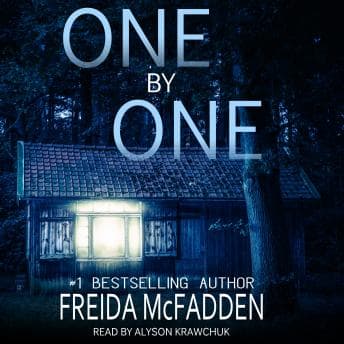

Look, I went into this one skeptical. Freida McFadden has become the thriller equivalent of a fast food chain - everywhere, wildly popular, and you're never quite sure if you're getting actual quality or just reliable comfort food. But here's the thing: One by One actually understands what makes survival horror work. And that caught me off guard.
The setup is pure horror fundamentals. Couples retreat gone wrong. Broken-down minivan on a dirt road. No cell reception. Getting lost in the woods. If you're rolling your eyes, I get it - I was too. This is the opening of approximately 47% of horror movies released since 2010. But McFadden knows the tropes she's playing with, and more importantly, she knows when to twist them.
When the Woods Get Quiet
What elevates this from generic thriller territory is the "one by one" structure actually delivering on its promise. The dread builds. People start dropping. And here's where it gets interesting - you genuinely don't know if you're dealing with an external threat or if the monster is sitting around the campfire with everyone else. That ambiguity? That's the good stuff. That's Shirley Jackson energy, even if it doesn't quite reach those heights. Murder in an Irish Village plays with similar uncertainty about whether the threat is inside or outside the community.
The pacing drags in spots. I'll be honest. There are moments in the middle where I was folding laundry and realized I'd zoned out for a few minutes. But when it picks back up? It picks UP. The twists hit, and while I saw one of them coming from about chapter three (occupational hazard of hosting a horror podcast for five years), a couple others genuinely surprised me.
Alyson Krawchuk's Anonymous Sections Are Spine-Chilling
I wasn't familiar with Alyson Krawchuk's work before this, but she commits. She really commits. Managing six distinct characters - three men, three women - is no small feat, and she pulls it off with the kind of ease that makes you forget you're listening to one person. The transitions are clean, the voices differentiated enough that I never got confused about who was speaking.
But the real standout? The "Anonymous" sections. Without spoiling anything, there are interludes from an unknown perspective, and Krawchuk makes them genuinely unsettling. That shift in tone when those sections hit - it's the audiobook equivalent of the lights flickering. My podcast listeners are going to love this detail.
Now, the child voices. Some people found them too childish or silly, and I can see that criticism. They didn't bother me personally, but if you're sensitive to that kind of thing, fair warning. It's a minor element, though - not enough to derail the experience.
The Sound Design Hits the Sweet Spot
There are subtle sound effects throughout - nothing overwhelming, just enough to enhance the isolation and urgency. It's a smart choice. Too many audiobooks either go full audio drama (which can feel gimmicky) or completely bare bones. This hits the sweet spot. The woods feel present. The tension feels earned.
I listened to most of this on a late-night walk around my neighborhood, which was either the perfect choice or a terrible one. When you're walking past dark trees and hearing characters get picked off in the woods... let's just say I walked a little faster than usual. Shirley (my cat) was unimpressed when I got home jumpy.
Who's This Actually For?
If you're a psychological thriller person who wants some actual horror elements - not just "dark" or "twisted" but genuine survival horror vibes - this delivers. Time for Mercy scratches a different itch - courtroom tension instead of woods terror - but it's got that same quality of making you forget you're listening to an audiobook. If you want something for your commute that'll make the time disappear, this works. If you're already a McFadden fan, you know what you're getting and you'll probably be satisfied.
Skip it if you need airtight plotting with zero loose ends. There are a couple of threads that feel unresolved, and if that kind of thing bothers you, it'll nag. Also skip if slow sections in the middle are a dealbreaker - this isn't a relentless sprint from start to finish.
The Final Frame
Here's my honest take: this is solid, genre-respecting thriller horror that doesn't insult your intelligence. The narrator elevates the material. The atmosphere works. It's not reinventing the wheel, but the wheel spins smoothly and takes you somewhere genuinely tense.
I listened in the dark. Mistake? Maybe. Worth it? Absolutely.