What happens when the weird girl at work doesn't show up one morning - and everyone's first reaction is annoyance instead of concern?
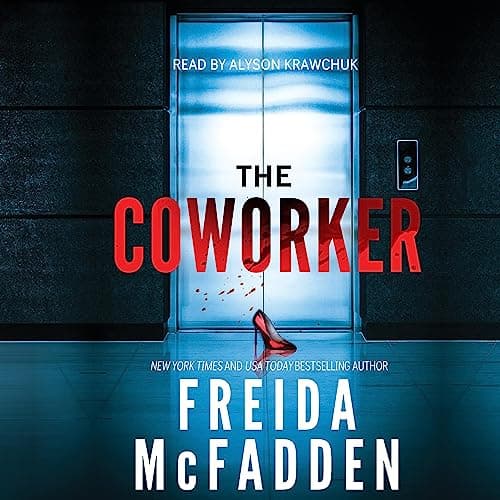
I was elbow-deep in scrambled eggs at 7:30 AM, still wired from a brutal night shift where we'd had three traumas roll in back to back, and I had The Coworker playing on the kitchen speaker because I was too keyed up to sleep. Carlos had already taken the kids to school. The house was quiet except for Alyson Krawchuk's voice and the sound of eggs hitting a hot pan. And honestly? That slightly unhinged post-shift energy was the perfect headspace for this book, because Freida McFadden writes characters who make you feel like you're watching a slow-motion car wreck through a break room window.
Dawn Schiff Deserved Better Coworkers (And So Did I, Some Shifts)
Here's what McFadden gets right: the office dynamics are painfully real. Dawn Schiff is that coworker - the one who arrives at exactly 8:45 every single morning, who eats lunch alone, who says things that land wrong. And Natalie Farrell is the golden girl, top sales rep, beloved by everyone, the kind of person who has never once eaten sad desk salad alone. The way McFadden builds the social hierarchy at Vixed (a nutritional supplement company, which already feels like the kind of place where the bullying would be wrapped in wellness language) is sharp. I've worked in enough hospital units to recognize that specific flavor of cruelty where people convince themselves they're not being mean, they're just being "honest about Dawn's vibe."
The dual perspective between Dawn and Natalie works well on the page-level plotting. McFadden alternates between them, and slowly you start to realize that neither woman is telling you the whole truth. The anonymous phone call Natalie gets after Dawn disappears kicks the suspense into gear, and for the first half, I was genuinely invested in figuring out who was playing whom.
But - and this is a big but - the twist lands with less force than McFadden's best work. If you've read The Housemaid, you know she can pull off a reveal that makes you want to throw your phone across the room. That same slow-burn dread of watching characters outmaneuver each other shows up in Cut and Thrust, though that one commits harder to its ending in a way McFadden doesn't quite manage here. The Coworker's ending felt more like finding out the cafeteria changed the menu. Surprising? Sure. Life-altering? Not quite. Someone described it as "a soggy fry" and I can't improve on that.
The Narration Problem Nobody Warned Me About
Okay. Alyson Krawchuk. This is where I need to be honest, because the listening experience is the whole point of an audiobook review and I owe you that.
Krawchuk brings energy to the narration. She puts personality into the descriptions, and there are stretches where you're cruising along just fine, especially during the thriller beats. But here's the issue: Dawn and Natalie are supposed to be fundamentally different people. One is socially awkward, precise, careful. The other is confident, charming, a natural salesperson. And in the audio? Their voices are almost indistinguishable. I kept losing track of whose chapter I was in during the first couple hours, which is a real problem in a book that depends on you tracking whose perspective you trust.
And the voicemail scenes. Lord. I was standing at my kitchen counter gripping a spatula and genuinely considering fast-forwarding. The voicemail narration felt like someone reading a script about reading a script - flat and awkward in a way that broke the tension McFadden was building. It's not a dealbreaker for the whole book, but it pulled me out of the story at key moments.
Krawchuk's northern accent adds a specific texture that works fine for Natalie's chapters but feels slightly off for Dawn's more internal, anxious narration. It's not bad narration. It's just narration that doesn't serve the story's structure the way it needs to.
Who Gets to Be the Victim?
What kept me listening through the narrator issues was the question at the book's core: who's really the victim in a workplace where everyone agrees someone is "weird"? McFadden doesn't let anyone off the hook. The office bullying is depicted with the kind of casual, normalized cruelty that makes your stomach turn because you've seen it. You've maybe even participated in it. That discomfort is the best thing about The Coworker - it's not just asking whodunit, it's asking who's complicit. Language of Flowers picks at that same nerve - the question of who gets to be seen as damaged versus dangerous, and how the people around them make that call without even realizing it.
At 8 hours and 12 minutes, it's the right length for this story. McFadden doesn't pad. The pacing clips along, especially in the second half when the cat-and-mouse game tightens. Perfect for that post-shift decompression when you want something that'll keep your brain occupied but won't require you to rewind every five minutes.
Night Shift Prescription
I didn't yell at my dashboard during this one. No medical details to get wrong (though McFadden is a physician specializing in brain injury, which - my mom would love this - she actually became a doctor AND a bestselling author, so there's really no winning with Filipino moms). What I got was a solid workplace thriller that asks uncomfortable questions about how we treat the people we decide are "other." The narration holds it back from being great in audio format specifically, but the story itself earns its keep.
Listen if you love workplace thrillers with unreliable narrators and you don't mind a twist that's more clever than devastating. Skip if distinct character voices in audio are non-negotiable for you, or if you're expecting another Housemaid-level gut punch - this one's good, just not that good.
Carlos asked why I was still up at 8 AM making eggs and muttering about office politics. I told him it was work-related. Which. Technically true.