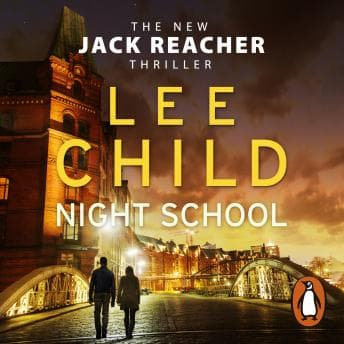

"The message was: The American wants a hundred million dollars."
That line hit me somewhere around hour two, and I remember thinking—okay, we're doing Cold War spy thriller with a Reacher twist. I was on my morning jog through Cambridge, dodging puddles from last night's rain, and suddenly I'm completely absorbed in 1990s Hamburg trying to figure out who's selling what to whom.
Lee Child is doing something psychologically interesting by taking Reacher backwards. We know who he becomes—this wandering vigilante with nothing but a toothbrush and a moral compass. But who was he before? What patterns were already forming in his late Army days? That's the case study I didn't know I needed.
The Psychology of Young(er) Reacher
The protagonist exhibits classic compartmentalization here. He's still in the system, still wearing the invisible uniform even when he's in civilian clothes, but you can see the cracks forming. The way he handles authority, the way he processes threat assessment—it's all there, just... earlier. Less refined. More institutional.
What makes this character compelling is watching the nascent version of behaviors we've seen fully developed in later books. Frances Neagley is here too, and their dynamic is fascinating from a trust-formation perspective. That partnership gets even more complex in Affair, where we see another layer of Reacher's pre-wanderer psychology. She's the one person Reacher relies on completely, and Child shows us why. (My therapist would have thoughts about Reacher's attachment style, honestly. Secure with exactly one person, avoidant with everyone else.)
The plot itself is a slow burn—someone in Germany is selling something catastrophic to someone very bad, and Reacher has to figure out who and what before it's too late. Cold War leftovers meeting post-Cold War chaos. Some listeners found it confusing in parts, and I get that. Child doesn't hold your hand. He drops you into intelligence briefings and expects you to keep up.
Jeff Harding's Clear-But-Complicated Delivery
So. The narrator situation.
Jeff Harding is not Dick Hill. And if you're a Reacher purist, that matters. Hill has won Golden Voice Awards for a reason—his Reacher IS Reacher for a lot of people. But Harding brings something different: clarity. Greater vocal clarity, actually, than Hill. Every word lands. Every tactical detail registers.
The trade-off? Some listeners found his voice nearly put them to sleep. I can see it—there's a steadiness to Harding that works for intelligence briefings but can flatten during slower sections. And his Southern accents? A little grating at times. Harding handles the Texas setting better in Echo Burning, though that might just be because the accents are more central to the story there. Not terrible, just... noticeable in a way that pulled me out of Hamburg and reminded me I was listening to an American narrator doing regional accents that weren't quite landing.
Here's what I found myself asking: why does the age of a narrator's voice matter so much for Reacher? Some listeners felt Harding sounded too old for the character at this point in the timeline. Psychologically, this doesn't quite track for me—Reacher has always read as ageless, this force of nature that exists outside normal human development. But voice creates expectation, and if you're hearing "older" when you're reading "younger," that dissonance is real.
Where the Narrative Drags (and Then Doesn't)
The pacing is uneven. Let's be real about that. There are sections—particularly in the middle third—where the intelligence gathering becomes almost procedural. Who met whom, what was said, what does it mean. If you're listening while doing something that requires attention (cooking, for instance—I burned exactly one pot of dal during a particularly dense briefing scene), you might lose the thread.
But then Child does what Child does. The tension ratchets. The pieces connect. And suddenly you're standing in your kitchen at 11 PM, dal forgotten, completely locked into whether Reacher is going to figure this out before something very bad happens.
The "ripped from the headlines" feel is strong here, even though those headlines are from 1996. Nuclear proliferation. Intelligence failures. The chaos of a world restructuring after the Soviet collapse. It feels almost prescient now.
Who Gets the Most From This One
Best for: Long commutes. Flights. Anything where you can give it sustained attention without needing to rewind constantly. Fans who want to understand the Reacher origin story will find psychological gold here.
Skip if: You need dynamic narration to stay engaged, or if slow-burn intelligence plots make you zone out. And maybe skip if imperfect regional accents are a dealbreaker for you.
Case Notes, Closed
As an audiobook? It's a solid entry in the series. Not the best. Not the worst. Harding's narration is clean and professional, even if it lacks the gravelly lived-in quality that Hill brings. The production is spotless—no audio issues, no weird volume jumps.
I finished it. I didn't love every minute. But I understood Reacher better by the end, and that's worth something.