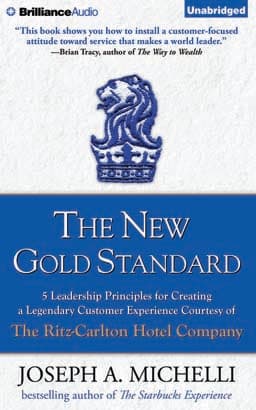

"We are Ladies and Gentlemen serving Ladies and Gentlemen."
That's the Ritz-Carlton credo. Eleven words. My parents ran a dry cleaning shop in Koreatown for 30 years and never had a mission statement. They just... did this. Instinctively. Treated every customer like the relationship mattered more than the transaction. Now it has a Harvard case study and an 8-hour audiobook.
I listened to most of this on a Saturday morning while Jenny slept in - coffee, laptop open, half-pretending I was going to answer emails. I wasn't. I was genuinely hooked, which surprised me, because Michelli's previous book on Starbucks was fine but felt like extended brand PR. This one has more teeth. The last time I felt this kind of narrative pull from a nonfiction listen was Killer Across the Table — completely different subject matter, obviously, but that same quality of operational specificity underneath the big ideas that makes you keep listening past the point where you meant to stop.
What the Ritz Actually Does That Nobody Else Does
The framework Michelli builds around five leadership principles sounds, on paper, like every other hospitality book you've ever skimmed. Anticipate needs. Empower employees. Obsess over details. You've heard it. The difference here is the operational specificity underneath the platitudes.
The detail that actually stopped me mid-sip: every Ritz-Carlton employee - every single one, from executive to housekeeper - is authorized to spend up to $2,000 per guest, per incident, to resolve a problem. No manager approval. No forms. Just fix it. I've advised three different companies on customer service redesigns, and getting a $50 exception approved required two sign-offs and a Tuesday. The Ritz figured out that the cost of bureaucracy is higher than the cost of trust. That's not a hospitality insight. That's a management insight.
The other piece that landed: their daily "lineup" ritual. Every shift, every department, every property worldwide, stops for a 15-minute standup. Not to review metrics. To share one story - a specific example of service excellence from somewhere in the global organization. They're not training people with manuals. They're building culture through narrative repetition. This is what my parents did instinctively. Now it has a TED talk.
The 45 Minutes of Gold Problem
Here's my honest read: the first half of this book earns its runtime. The second half is Michelli admiring his own research. Chapters four and five feel like he had great material and then kept writing anyway - lots of restating what was already established, some executive quotes that could've been cut without losing anything structural.
I ran it at 2.0x, obviously. At that speed, the redundancy becomes almost funny. You can feel the book breathing in the same room twice.
Tom Parks narrates cleanly - professional, measured, appropriate for the content. There's nothing wrong with the performance. There's also nothing remarkable. For a book about creating extraordinary experiences, the audio delivery is... adequate. Which is a little ironic. He's not the problem. He's just not adding anything either. The author co-narrates portions, which gives some sections more authority, but Parks handles the bulk of it without incident.
Who's Actually Going To Use This
If you run a service business - any service business - the $2,000 empowerment principle and the daily lineup ritual alone justify the listen. Steal both. Adapt them to your scale. The Ritz does it with 40,000 employees; you can do a version with four.
If you're a founder trying to build customer-obsessed culture from scratch, skip to the middle section on employee empowerment. That's where the operational density lives.
If you're a McKinsey type looking for frameworks to repurpose in a deck - honestly, you'll get what you need in the first three hours. The back half won't give you new slides.
If you're expecting this to translate directly to a scrappy startup context: it won't, not directly. The Ritz operates at a price point where white-glove service is the product. But the underlying logic - that culture is built through story, that trust is cheaper than process, that anticipating needs beats reacting to complaints - that scales down.
Bottom line: The key takeaway is worth the listen. The other four hours? Not so much. Worth a credit if customer experience is your actual job. Borrow it if you're just curious.