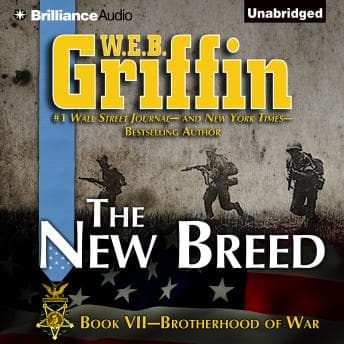

What makes a soldier? The question rattled around my head during a late-night drive back from a client site in Houston, Ranger snoring in the backseat while Eric G. Dove walked me through the jungles of Vietnam and the chaos of the Congo. W.E.B. Griffin's The New Breed tackles that question across two very different theaters of war, and as someone who's worn the uniform through three deployments, I had opinions before I even hit play.
Let me cut to the chase: Griffin gets it right. The man was Army, counter-intelligence trained, combat correspondent experienced. You can feel that in every page. When his characters discuss logistics, weapons systems, or the peculiar bureaucracy of military life, there's no Hollywood nonsense. No calling magazines "clips." No miraculous one-man-army scenarios. Just the grinding reality of professional soldiers doing their jobs in places most Americans couldn't find on a map.
Two Theaters, One Generation
The dual-theater approach is ambitious—maybe too ambitious for some listeners. Griffin bounces between the escalating American involvement in Vietnam and the mercenary operations in the African Congo, following the sons and protégés of characters from earlier Brotherhood of War books. It's a generational story, and that's where the title earns its weight. These young officers aren't fighting World War II or Korea. They're navigating a new kind of conflict where the rules are murky and the politics are murkier.
I'll be honest—the first few chapters tested my patience. Griffin has a habit of front-loading exposition, and there's some repeated content that feels like he's making sure you remember who's who from previous books. If you haven't read the earlier entries in the Brotherhood of War series, you might feel like you walked into a family reunion where everyone's discussing Uncle Harold's court-martial from 1952. (Worth noting: this is Book 7. Starting here is possible but not ideal.)
Once the narrative finds its footing, though, it moves with purpose. The Congo sections are particularly strong—there's a Wild West quality to the mercenary operations that Griffin captures without romanticizing. These aren't Rambo types. They're professionals operating in the gray zones of Cold War foreign policy, and Griffin doesn't pretend there are easy answers.
Dove Delivers the Debrief
Eric G. Dove has narrated most of Griffin's catalog, and there's a reason for that. Multiple Earphones Awards don't lie. His delivery is clean, professional, and emotionally calibrated—he knows when to let tension build and when to punch through with intensity. Military fiction lives or dies on whether the narrator can handle the jargon without stumbling, and Dove never breaks stride. Acronyms, rank structures, equipment designations—all delivered like he's been briefing generals his whole life.
What I particularly appreciated: Dove doesn't try to do theatrical accents for every character. Some narrators think they need to give every soldier a different regional drawl, and it ends up sounding like a bad comedy sketch. That controlled approach reminded me of the narration in Chamber: A Novel, where restraint served the story better than theatrics. Dove keeps it controlled. You can distinguish characters through tone and cadence rather than caricature.
I listened at my usual 1.25x and actually had to dial it back to 1.0x in spots. The military terminology is dense, and if you're not already familiar with Army structure and Cold War geopolitics, you'll want that extra processing time. This isn't background listening material. It demands your attention.
Where the Mission Stalled
The book's structure is its biggest weakness. Griffin was a prolific author—over thirty novels—and you can feel the production pace in some sections. The narrative occasionally feels disjointed, jumping between storylines in ways that disrupt momentum rather than building tension. Time for Mercy juggles multiple plot threads too, though Grisham manages to keep them more tightly woven. I've seen this scenario play out in real life: too many operations running simultaneously, and nobody's quite sure which one is the main effort.
Some listeners have called this book a chore to finish. I wouldn't go that far, but I understand the complaint. If you're coming to military fiction for non-stop action, you'll find stretches here that focus on relationships, career politics, and the domestic lives of military families. Personally, I think that's where Griffin shines—Linda would tell you those scenes hit closer to home than any firefight—but your mileage may vary.
Who Should Saddle Up (And Who Should Stand Down)
This one's for anyone who appreciates military fiction written by someone who actually served. Fans of the Brotherhood of War series will find this one of the stronger entries. History buffs interested in the early Vietnam era and Congo Crisis will learn something—I certainly did about Army aviation's evolution during this period.
Stand down if you need linear storytelling, want pure action without the political and personal subplots, or haven't read any previous books in the series and don't want to do homework.
Mission Complete
Griffin did his homework—because he lived it. The New Breed isn't his tightest work, but it's authentic in ways that matter. Twelve and a half hours is a significant commitment, and I won't pretend every minute justifies itself. But when Griffin is firing on all cylinders—when he's capturing the weight of command decisions and the bonds between soldiers—there's nobody better in the genre.
Ranger approved this one. Though he did wake up during a particularly intense Congo sequence, so maybe he was paying more attention than I thought.