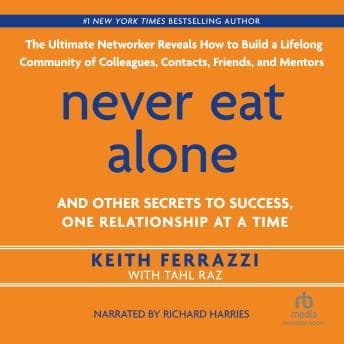

Is it possible to learn networking without wanting to crawl out of your own skin?
I've been asking myself this question for years. As someone who studies human connection for a living, I find most networking advice insufferable. It's usually some variation of "be strategic" dressed up in business casual, and it makes my psychology brain itch. So when I queued up Never Eat Alone during my morning jogs through Cambridge, I was prepared to be annoyed.
And look, I was annoyed. Sometimes. But also? Keith Ferrazzi kind of won me over.
The Psychology Actually Tracks
Here's what surprised me: Ferrazzi's core thesis isn't the transactional garbage I expected. The research actually shows that generosity-based relationship building creates stronger neural pathways for trust than strategic networking. Extreme Ownership approaches trust-building from a completely different angle—military leadership rather than networking—but the underlying psychology of putting others first is surprisingly similar. And that's basically what he's arguing: help people first, build genuine connections, stop treating humans like LinkedIn endorsements.
The protagonist of this book (and yes, Ferrazzi is very much the protagonist of his own story) exhibits classic secure attachment patterns. He genuinely seems to like people. Wild concept in the business book genre.
The framework he builds around vulnerability, generosity, and what he calls "relationship action plans"—it's grounded in real social psychology principles, even if he doesn't cite the literature. (My academic side wanted footnotes. My therapist would say I need to let that go.)
What makes this character compelling is that Ferrazzi grew up working-class, watched his father network his way into opportunities for his kid, and internalized that relationships are survival. That's not manipulation—that's adaptation. The same survival-driven relationship patterns show up in Gambler, where Billy Walters builds an empire on reading people and leveraging connections—though his version is considerably less warm and fuzzy. I found myself asking: why does this guy actually care so much about connection? And the answer seems to be... he just does. It's baked in.
Richard Harries Saves the Self-Congratulatory Bits
The elephant in the room. Ferrazzi name-drops. A lot. Bill Clinton. Various CEOs. His impressive dinner parties. At nearly 14 hours, there's plenty of time for him to remind you how successful he is.
But Richard Harries' narration does something clever—he delivers these moments with such warmth that they feel more like enthusiastic storytelling than bragging. His baritone has this quality of genuine excitement, like your most successful friend explaining how they got where they are over drinks. Not smug. Just... eager to share.
I listened at 1.25x speed (other listeners weren't wrong about the pacing) and honestly, that's the sweet spot. Harries' natural pauses still land, the content flows better, and you shave a few hours off the runtime. My morning jogs only last so long.
The narration is particularly good during the practical sections—the how-to-work-a-room stuff, the follow-up email templates, the conference strategies. He makes it sound achievable rather than exhausting. That's a skill.
Who Should Queue This Up (And Who Should Skip)
I kept thinking about my students while listening. The ones who are brilliant but awkward. The ones who think networking is fake and refuse to do it. This book is basically a case study in how an introvert's nightmare (constant relationship maintenance) can become sustainable if you reframe it as genuine curiosity about people.
Psychologically, this doesn't track for everyone. If you're someone who finds social interaction genuinely draining at a neurological level, Ferrazzi's "never eat alone" mandate might sound like a prison sentence. He doesn't really address that. His energy seems inexhaustible, and he assumes yours can be too. Skip this if you need permission to be selectively social—you won't find it here.
But for professionals who want to get better at this stuff without feeling slimy? It's pretty solid. The emphasis on being useful to others before asking for anything—that's just good psychology. Reciprocity norms are real. Ferrazzi understands human nature, even if he doesn't use the academic language.
The Parts That Made Me Roll My Eyes
Some sections feel dated. The book was updated but still carries that mid-2000s energy in places. And there's repetition—the same core ideas dressed up in different anecdotes. By hour ten, I got it. Relationships matter. Help people. Follow up.
Also, Ferrazzi's life is not your life. He had access to powerful mentors early. He's charismatic in a way that opens doors. The advice is good, but the "I did it, so can you" framing occasionally ignores structural advantages. (My therapist would have thoughts about this character's blind spots.)
Case Closed, With Caveats
Probably wouldn't listen to the whole thing again. But I've already recommended specific sections to a colleague who's terrible at maintaining professional relationships. The chapters on follow-up systems and building a personal board of advisors are genuinely useful.
For a 14-hour listen, it earns its length about 70% of the time. The other 30% is Ferrazzi being impressed with himself. Harries makes even that tolerable.
If you're cooking elaborate dishes alone like me, or running through Cambridge pretending your research will write itself, this is decent company. Just bump up the speed.