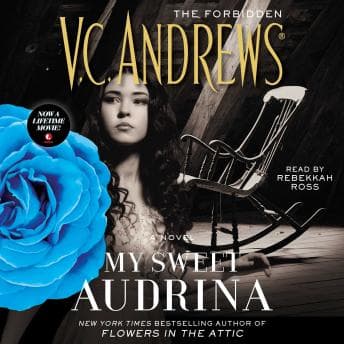

V.C. Andrews wrote gothic family horror the way Gygax wrote dungeon crawls — labyrinthine, occasionally cruel, and weirdly impossible to stop once you're in.
I was not expecting to pick this up. Like, at all. I'd been on a Cradle re-listen binge and needed something different while debugging a procedural terrain generator at 2 AM. My roommate's girlfriend left this on our shared Audible account, and I figured fifteen hours of gothic family drama would either put me to sleep or give me nightmares. It did both.
The Rocking Chair Is Basically a Cursed Item
Here's the setup: Audrina lives in this decaying family estate with a father who's basically a charisma-maxed narcissist running emotional manipulation like it's a spell list. There's a dead sister — the First Audrina — who was supposedly perfect in every way, and our Audrina is constantly measured against this ghost. Upstairs, there's a locked room full of the dead sister's belongings, including a rocking chair that the father makes Audrina sit in to "absorb" her sister's gifts. If that doesn't sound like a cursed artifact from a haunted dungeon, I don't know what does.
The thing that got me — and this surprised me, because I'm usually all about hard magic systems and clean world-building — is how Andrews builds the mystery through unreliable memory. Audrina can't remember things properly. Time doesn't work right for her. And you're sitting there going "okay, is this supernatural or is something really messed up happening in this family?" It's not Sanderson-level world-building, but the psychological architecture of this household is its own kind of system. Every family member has a role, a secret, a weapon they're wielding against someone else.
Vera is the cousin (or is she?) who functions as the party's chaos agent — she lies, she manipulates, she's genuinely hateable in a way that made me want to throw my earbuds across the room. And Arden, Audrina's love interest, starts out sympathetic and becomes... something else. Some listeners hate these characters. I get it. But hating them is kind of the point? Andrews isn't writing heroes. She's writing a family that's basically a trap, and every character is part of the mechanism.
Rebekkah Ross Understood the Assignment
Okay, so here's where I need to talk about Rebekkah Ross. She's not Steven Pacey — nobody is — but she's doing something really specific here that works. She gives the father this controlled, warm-but-menacing delivery that captures exactly how manipulative charm sounds. You can hear the difference between when he's performing love and when he's exerting control, and that distinction lives entirely in Ross's vocal choices. Vera gets this sharp, slightly nasal edge that makes her sound like she's always one sentence away from a lie. And Audrina herself shifts from this fragile, uncertain voice early on to something harder as the book progresses.
The Earphones Award she won? Earned. The gothic atmosphere depends almost entirely on her pacing and tone, and she nails the creepy without ever going campy. When Audrina's in that rocking chair, Ross drops into this dreamy, dissociative register that genuinely made my skin crawl while I was staring at a terminal full of Perlin noise functions.
Yes, the First Third Is a Slog (But the Dungeon Gets Better)
I'll be honest: hours one through maybe four or five are rough. The pacing is slow. Audrina spends a lot of time being confused and passive, and if you're the kind of listener who needs a protagonist with agency early on, you're going to be frustrated. I almost bailed around hour three. Someone in the reviews called the first section "hell to get through" and yeah, that's not entirely unfair.
But here's the thing — the slow burn is doing work. Andrews is laying traps. Every weird detail, every moment where something doesn't quite add up, every time the father deflects a question — it's all building toward reveals that genuinely hit. When the secrets start dropping, the progression is satisfying in a way I wasn't prepared for. Not stat-block satisfying, but the narrative equivalent of finally solving a puzzle that's been bugging you for hours.
Content warning: this book deals with abuse, sexual violence, and family trauma in ways that are genuinely dark. Andrews doesn't flinch. If you need content warnings, take them seriously here.
Who Gets Invited to This Dungeon
If you love psychological horror, gothic family sagas, or mysteries built on unreliable narrators — this is worth your time. Fans of Flowers in the Attic already know what they're getting into. If you need fast pacing and likeable protagonists, you're going to struggle. And if you're a fantasy nerd like me who wandered in from a completely different genre? You might be surprised how much the "family as prison" structure scratches the same itch as a really well-designed dungeon crawl.
I read this instead of writing my thesis. Dr. Patel would not approve. Worth it. Though I will say, the one time I tried to course-correct and picked up something "productive" like True North, I lasted about forty minutes before the gothic horror pull dragged me right back.